
Disclaimer: This has been reported after the availability of the order of the Court and not on media reports so as to give an accurate report to our readers.
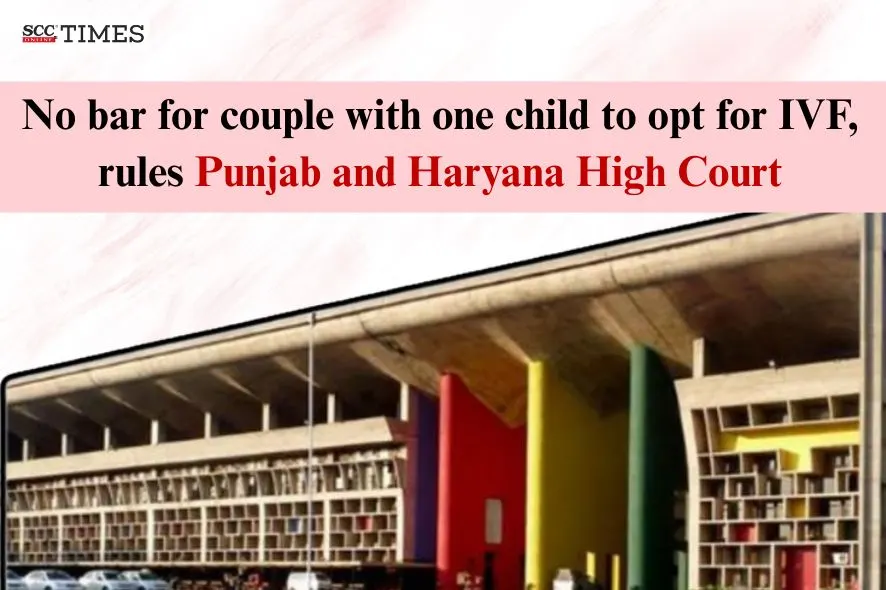
Punjab and Haryana High Court: In a petition challenging an order passed by the State Appellate Authority-Respondent 2 whereby petitioners, a couple, were denied access to Assisted Reproductive Technology (‘ART’), a Single Judge Bench of Suvir Sehgal, J., held that there is no bar in the Assisted Reproductive Technology (Regulation) Act, 2021 (‘ART Act’) for a couple to opt for In Vitro Fertilization treatment (IVF), when they have one living child.
Accordingly, the Court disposed of the petition and set aside the said order.
Background
In the case at hand, a 47-year-old woman, and a 56-year-old man, were a married couple with two children. Their daughter got married in 2020 and their son tragically scummed to jaundice in 2024.
The wife reached menopause four years earlier and was not able to conceive a child. Thus, the couple approached a doctor who was a Gynecologist-Respondent 4 but were informed that they could not be given ART treatment as Petitioner 2 had crossed the threshold age of 55 years and was debarred under the ART Act.
Thus, petitioners filed a writ petition pressing for the services under the ART Act, and a response was filed by Respondent 4 wherein he stated that both petitioners were healthy and could undergo IVF treatment. It was disposed of with a direction to Respondent 2 to treat the writ petition as a representation and to take a decision thereon in the light of statutory provisions as well as judicial precedents.
Respondent 2 rejected the case of the petitioners.
Analysis and Decision
Considering the first ground of rejection, that is, the husband has crossed the upper age prescribed under the ART Act, the Court stated that it was no longer a hurdle in granting relief to the petitioners since the reason given by Respondent 2 for not following Sanchita Ghosh v. Union of India and Manjit Kaur v. Union of India 2025 SCC OnLine P&H 1754 was that they were in the process of being challenged, however, the contesting respondents conceded that no appeal or SLP was preferred against the aforesaid judgments till date. The aforesaid judgements held that the statute reinforces age restrictions on an individual gender and not on a couple.
Regarding the second ground, that the wife had reached menopause and as no oocyte was available for fertilization, IVF would be carried out by the doner oocyte, which was not permissible under the ART Act, the Court stated that it was against the objective behind the framing of ART Act as well as the Surrogacy (Regulation) Act, 2021 (‘Surrogacy Act’). The Court further stressed that the ART Act’s primary purpose is to regulate and supervise clinics and banks to prevent misuse and unsafe or unethical practices. Thus, the intent of the statute would stand defeated if the reasoning given by Respondent 2 was accepted. The Court rejected the second ground and stated that since it violated the spirit of the ART Act as well as the Surrogacy Act, it could not withstand judicial scrutiny.
The Court considered the third ground that the wife would be a high-risk case of conception after menopause and high dose of exogenous hormones might be needed for such pregnancy which can complicate her health, and stated that Respondent 4 had elaborated upon the health and fitness of the couple and had submitted that the wife was a healthy woman fit to carry a pregnancy if a fertilized egg was successfully implanted in her uterus. Further, the Court stated that there were chances of the husband being able to produce a healthy sperm for fertilization of a donor egg sourced from an ART Bank, after screening and examination. The Court emphasized that the doctor also certified that he had made the couple aware of the risks involved in the IVF treatment, which petitioners were willing to undertake. Thus, Respondent 2 took up this ground without there being any statutory prohibition.
The Court stated that similarly regarding the fourth ground that as petitioners have a child, opting for IVF might be deterrent towards sex determination, there was no bar in the ART Act for a couple to opt for IVF, when they have one living child.
Thus, all the grounds given by Respondent 2 were not tenable, hence, turned down. The Court set aside the said order and held that the petitioners were permitted to undergo ART services, including IVF treatment, for the purposes of conception of human embryo and its implantation in in the wife.
[Sarbjit Kaur v. State of Punjab, 2026 SCC OnLine P&H 689, decided on 22-1-2026]
Advocates who appeared in this case:
For the Petitioner: Anmol Partap Singh Mann, Advocate and Navjot Singh Sidhu, Advocate
For the Respondent: Harinder Pal Singh Ishar, Addl. A.G., Punjab and Gurjeet Singh, Advocate