
Disclaimer: This has been reported after the availability of the order of the Court and not on media reports so as to give an accurate report to our readers.
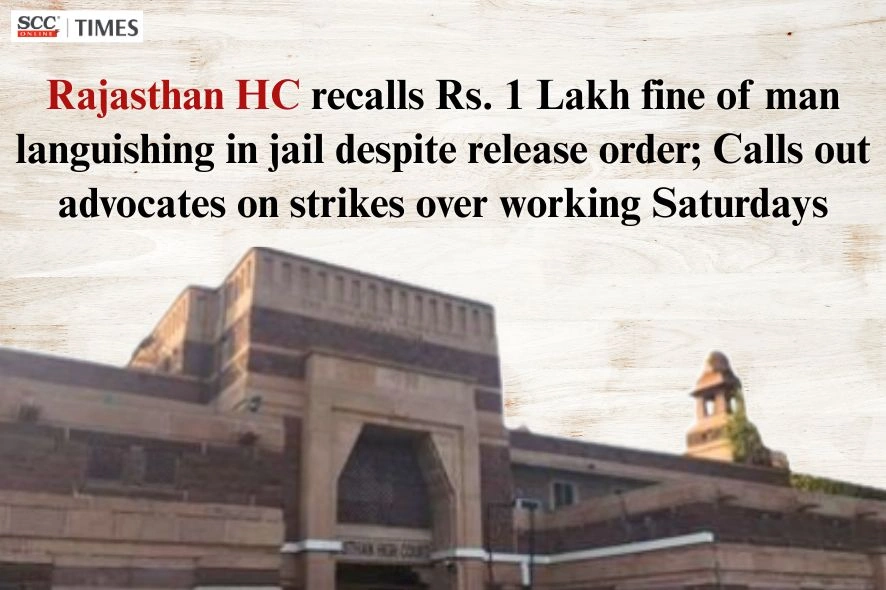
Rajasthan High Court: While considering an application filed by the accused-applicant, who was released by the High Court in October 2025, however he was languishing in jail as he could not deposit the fine amount due to poverty, a Single Judge Bench of Anoop Kumar Dhand, J., considered that the applicant’s counsel did not appear in order to participate in the lawyers’ strike over working Saturdays, the Court stated that going on strike and remaining absent from Court work is not a solution. The right to protest must be balanced with the rights of other citizens, such as the right to life and personal liberty and in the case at hand, the personal life and liberty of the applicant was at stake.
Thus, the Court held that poverty and penalty should not hinder an accused persons’ right of life and personal liberty, who has been released from jail, as Article 21 of the Constitution guarantees life and liberty. Accordingly, the Court recalled the imposed fine of Rs. 1,00,000 and directed the Trial Court to release him.
Background
In the present case, the accused-applicant was found guilty and was convicted for the offence punishable under Sections 8 and 15 of the Narcotic Drugs and Psychotropic Substances Act, 1985 (‘NDPS Act’) and sentence of 10 years was awarded to him out of which he had already served 7 years and 11 months. The High Court suspended the sentence of the applicant by order dated 7-10-2025. The applicant could not deposit the fine amount of Rs.1,00,000 because of his poverty.
The counsel for the applicant was not present in order to participate in a strike.
On a resolution passed by three different Bar Associations of the Court- two at Principal Seat at Jodhpur and one at Jaipur Bench, all the lawyers decided to abstain from work and remain on strike as a mark of protest against the decision taken by the Full Court for declaring two working Saturdays in every month.
Three Bar Associations of Lawyers expressed their opposition for designating two regular working Saturdays every month. Some representations have been reportedly submitted by these Bar Associations for redressing their grievances. On 6-1-2026, a committee was already constituted to look into the matter, and the decision is still awaited
Analysis and Decision
The Court stated that “Going on strike and remaining absent from Court work is not a solution. All problems have a solution and can be settled by debates and dialogues. Every challenge has a solution. Debates and dialogues can lead to a better understanding and also necessary for achieving any solutions.”
The Court stated that a call for strike/remaining absent from work by the lawyers was not warranted. When lawyers boycott the Courts, it directly violates the rights of the litigants to speedy justice, as guaranteed under Article 21 of the Constitution. The Court further stated that even an amendment has been proposed in the Advocates’ Amendment Bill, 2025, which prohibits lawyers from boycotting or abstaining from Court’s work.
Further, the Court stated that “In a democratic setup, right to dissent, express opinions and protest against the decisions is a fundamental right, often derived from freedom of speech, expression and peaceful assembly. However, this right is not absolute and is generally expected to be exercised peacefully without causing public disorder or hampering the cause of justice.” The Court emphasized that the right to protest must be balanced with the rights of other citizens, such as the right to life and personal liberty.
The Court opined that in the case at hand, the personal life and liberty of the applicant was at stake, as he was languishing in jail even though his release order was passed by the High Court. The Court stated that it is a settled law that “while suspending the sentence of the accused-appellant, the Appellate Court can impose certain conditions, but if any condition to deposit of amount is imposed, while suspending the sentence of the accused and it is found that it is not possible for the accused to comply with the same, such condition may amount to defeat his right to appeal and order of conviction, which violates his rights of personal life and liberty as guaranteed under Article 21 of the Constitution.”
Thus, the Court opined that poverty, and penalty should not hinder an accused persons’ right of life and personal liberty, who has been released from jail, as Article 21 of the Constitution guarantees life and liberty. The Court stated that if the applicant could not arrange the fine amount and has remained in custody despite his release order, it clearly violated his personal right of life and liberty. Thus, the Court recalled the imposed fine amount of Rs. 1,00,000 and directed the Trial Court to release the applicant in terms of the other conditions imposed by the High Court. The Court allowed the application accordingly.
[Rajesh Kushwah v. State of Rajasthan, 2026 SCC OnLine Raj 575, decided on 24-1-2026]
Buy Constitution of India HERE