
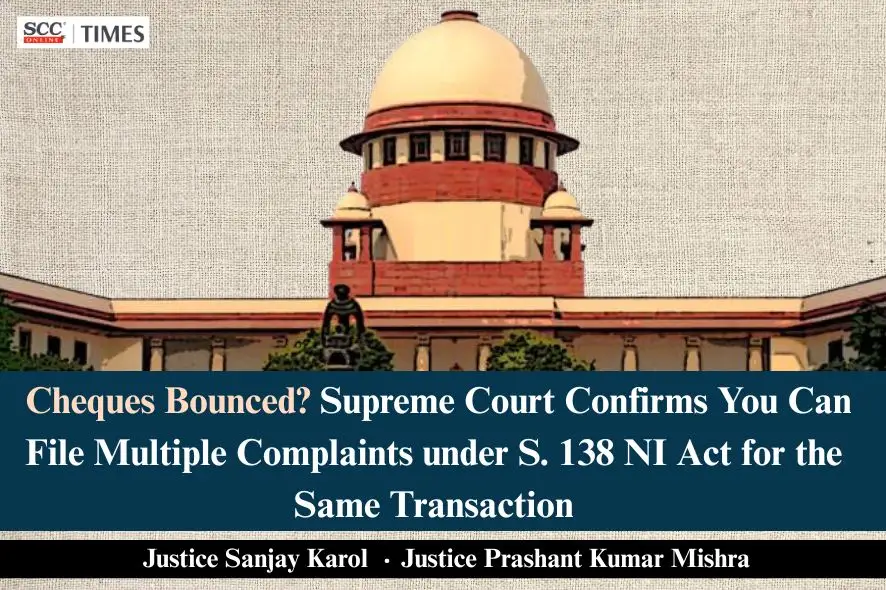
Supreme Court: The bench of Sanjay Karol and Prashant Kumar Mishra, JJ has held that multiple complaints under S. 138 NI Act, arising from dishonour of multiple cheques issued pursuant to the same transaction, do not per se amount to abuse of process. Each dishonoured cheque constitutes a distinct and independent cause of action, subject to fulfilment of statutory requirements including presentation, dishonour, notice, and failure to pay.
Background
In the present case, the appellant entered into an Agreement to Sell with the respondent developer for three commercial units in a Ghaziabad project, paying a total consideration of approximately ₹1.72 crore. The respondent failed to execute and register the sale deeds in the agreed timeframe. Towards refund of the amount along with compensation, the respondent issued multiple cheques, some drawn on the firm’s account and some personally by the proprietor. All the cheques were dishonoured upon presentation.
Consequently, the appellant filed multiple complaints under S. 138 NI Act in respect of the dishonoured cheques. The respondents approached the Delhi High Court seeking quashing of the complaints. The High Court quashed one complaint on the ground that multiple prosecutions arising from the same transaction amounted to parallel proceedings, while refusing to quash other complaints. Aggrieved by the quashing of the one complaint, the appellant approached the Supreme Court.
Analysis and Ruling by the Supreme Court
The main issue before the Court was whether multiple complaints under S. 138 NI Act are maintainable when multiple cheques, arising from the same transaction, are dishonoured, and whether the High Court was justified in quashing one complaint at the threshold by examining disputed questions of fact.
The Supreme Court held that each dishonoured cheque constitutes a distinct cause of action under Section 138 NI Act, even if arising from the same underlying transaction.
“It is well settled that under Section 138 of the NI Act, a separate cause of action arises upon each dishonour of a cheque provided the statutory sequence of presentation, dishonour, notice, and failure to pay is complete. The fact that multiple cheques arise from one transaction will not merge them into a single cause of action.”
The Court emphasized that the High Court exceeded its jurisdiction by prematurely evaluating facts during quashing:
“Whether those cheques were issued as alternative or supplementary instruments, or represented fresh undertakings, is a disputed question of fact requiring evidence at trial and cannot be resolved at the threshold. Questions such as whether the firm’s cheques were issued in substitution of the personal cheques, whether the parties treated them as alternative securities, and whether both were intended to be simultaneously enforceable, are all mixed questions of fact. The inherent jurisdiction of the High Court under Section 482 CrPC cannot be used to decide such disputed issues.”
The Court, further, observed that the statutory presumption under Section 139 NI Act operates in favour of the complainant and issues relating to legally enforceable debt or liability must be decided at trial.
“A bare perusal of Section 139 of the NI Act would indicate that once a cheque is issued in discharge of liability and dishonoured, a presumption of liability in favour of the complainant arises. The accused person is then required to rebut the presumption by raising facts that either there was no debt or liability when the cheque was drawn, or the cheque was not drawn in discharge of liability, or notice was not served in time. The statutory presumption attached to the issuance of a cheque, being one made in discharge of a legally enforceable debt or liability, is required to be accorded due weight.”
Therefore, it was held that in circumstances where the accused approaches the Court seeking quashing of proceedings even before the commencement of trial, the Court must exercise circumspection and refrain from prematurely stifling the prosecution at the threshold, particularly by overlooking the legal presumption that operates in favour of the complainant.
Conclusion
The Court clarified that mere multiplicity of complaints under S. 138 NI Act does not constitute abuse of process when statutory requirements are fulfilled. In the case at hand, cheques were dishonoured, statutory notices served, and summons issued. The Court, hence, held that “the complaint prima facie stands”.
[Sumit Bansal v. MGI Developers & Promoters, 2026 SCC OnLine SC 49, decided on 08-01-2026]
*Judgment Authored by: Justice Prashant Kumar Mishra
Advocates who appeared in this case:
For Appellant(s): Mr. Sameer Rohatgi, Adv., Mr. Namit Suri, AOR, Mr. Rameezudin Raja, Adv., Ms. Pepakayala Geetanjali, Adv., Mr. Anish Singh, Adv., Dr. Harshvir Pratap Sharma, Sr. Adv., Dr. Harshvir Pratapm Sharma, Sr. Adv., Mr. Tejas Patel, AOR, Mr. Akul Krishnan, Adv., Ms. Sakshi Apurva, Adv.
For Respondent(s): Dr. Harshvir Pratap Sharma, Sr. Adv., Mr. Tejas Patel, AOR, Mr. Akul Krishnan, Adv., Ms. Sakshi Apurva, Adv., Mr. Sameer Rohatgi, Adv., Mr. Namit Suri, AOR, Mr. Rameezudin Raja, Adv., Ms. Pepakayala Geetanjali, Adv., Mr. Anish Singh, Adv.