Disclaimer: This has been reported after the availability of the order of the Court and not on media reports so as to give an accurate report to our readers.
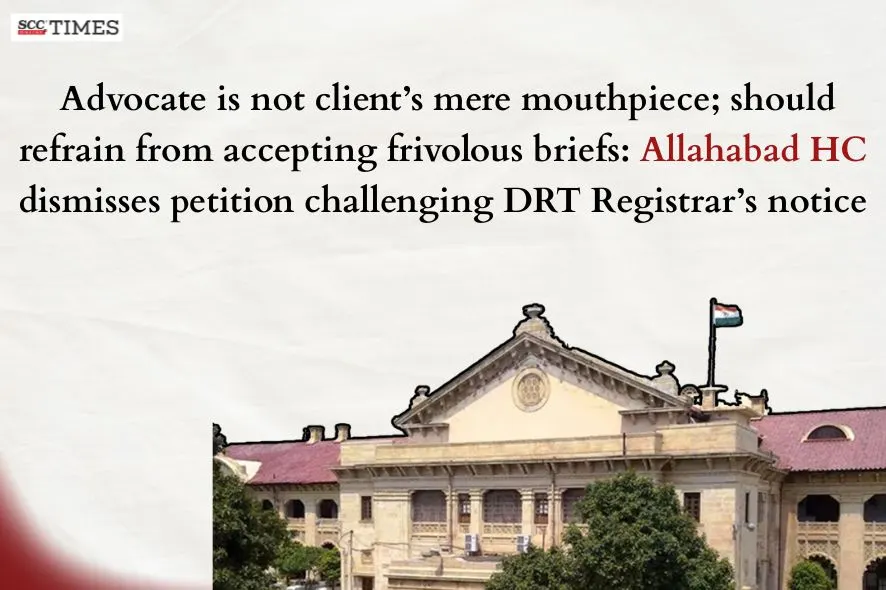
Allahabad High Court: While considering a petition under Article 227 of the Constitution, the petitioner challenged jurisdiction of the Registrar, Debts Recovery Tribunal, Lucknow (‘DRT’), requiring him to appear before him, in an application under Section 17 of the Securitisation and Reconstruction of Financial Assets and Enforcement of Security Interest Act 2002 (‘SARFAESI Act’), a Single Judge Bench of Subhash Vidyarthi, J., held that the notice had not caused a failure of justice or grave injustice to the petitioner, which was absolutely necessary for maintaining a petition under Article 227 of the Constitution.
Accordingly, the Court dismissed the petition and stated that an advocate is not a mere mouthpiece of his client and in case a client insists for filing a petition or advancing a submission which is frivolous, he should advise him not to do so and he should refrain from accepting such a frivolous brief.
An application was filed under Section 17 SARFAESI Act, and the Registrar of the DRT had issued a notice asking the petitioner to appear before him on 17-11-2025 in person or by a pleader/advocate to show-cause why the securitisation application should not be allowed. The notice further stated that if the petitioner failed to appear then the said application would be heard and and decided ex parte. On 17-11-2025, the Registrar listed the matter for 1-12-2025 before the Presiding Officer of the DRT.
On 18-1-2025, the petitioner sent an email to the official email ID of the DRT stating that the Registrar has no authority to issue notice and that it is direct contravention of the DRT (Procedure) Rules, 1993 (‘DRT Rules’).
The petitioner contended that DRT had no power to order appearance of the opposite parties before him to show cause because the admission, hearing and disposal of the securitisation application fell within the jurisdiction of the DRT, and this function should be exercised by the Presiding Officer of the DRT, not by its Registrar.
The Court noted that the grievance of the petitioner was only regarding a delay caused in listing of the said securitisation application before the Presiding Officer of the DRT. Considering that the said application now stood listed, and there was no claim that the petitioner suffered any legal harm due to the delay, the Court stated that the petitioner should contest the matter before the DRT. The Court requested the petitioner’s counsel to raise even this plea before the Presiding Officer of the DRT in order to spare the time of this Court for being utilized for deciding the matters of those litigants who have no alternative remedy.
However, the petitioner’s counsel submitted that he could approach the DRT only against an action of the bank under the SARFAESI Act, and he could not raise the grievance regarding a notice issued by the Registrar before the Presiding Officer of the DRT. He further stated that he was raising a question of jurisdiction, and the High Court should adjudicate the same.
The Court perused the Rules 4, 5, 12, 13, 22 and 23 of the DRT Rules and clarified that a securitisation application shall be presented by the applicant to the Registrar of DRT. The Court held that when power to issue notice to a defendant has specifically been conferred upon the Registrar of DRT, it cannot be said that the Registrar has no power to issue notice to a defendant to show-cause as to why the securitisation application should not be allowed, and also to caution the defendant that in case he fails to file a reply, the S.A. will be heard and decided ex parte.
The Court stated that it failed to understand as to how withdrawal of the notice would have expedited the hearing of the securitisation application, rather the application could not be heard without issuance and service of notice of the same upon the defendant. Thus, the Court held the petitioner’s objection self-harming. The Court further stated that the said notice did not cause a failure of justice or grave injustice to the petitioner, which is a sine qua non for maintaining a petition under Article 227 of the Constitution.
Hence, the Court dismissed the petition at hand at the admission stage.
The Court emphasized that there were 207 matters listed in the list of fresh petitions, 128 matters in the additional list, and 51 matters in the daily IA list, and stated that it repetitively requested the petitioner’s counsel to refrain from wasting the time of the High Court and to raise his pleas before the DRT where the securitisation application was pending but due to his insistence, the Court had to decide the petition by this detailed judgment, which resulted in unwarranted wastage of the precious time of the Court, which could have been utilized for deciding some other matter.
The Court stated that normally cost would have been imposed for wasting time, however, keeping in view that the counsel is a young and inexperienced counsel, who got enrolled with the Bar Council only in 2024, lenient view was taken. The Court cautioned the counsel that “although he represents his client before the Court, he is not a mere mouthpiece of his client. In case a client insists for filing a petition or advancing a submission which is frivolous, the Advocate should advise him not to do so, and the Advocate should refrain from accepting such a frivolous brief.”
The Court further stated that “Besides being a representative of his client, an Advocate is a responsible officer of the Court and he should assist the Court with his precise and concise submissions, wherever possible, with the assistance of the relevant Laws, including the Statutes, the Rules and the judicial precedents.” The Bar and the Bench are the wheels of the same chariot. For fast and smooth running of the chariot, it is necessary that all the wheels should move forward at the same pace and one set of wheels should not try to put brakes on the other set of wheels of the chariot.
[Dinesh Kumar Jindal v. DRT Lucknow, 2026 SCC OnLine All 83, decided on 19-1-2026]
Advocates who appeared in this case :
For the Petitioner: Noel Victor