
Disclaimer: This has been reported after the availability of the order of the Court and not on media reports so as to give an accurate report to our readers.
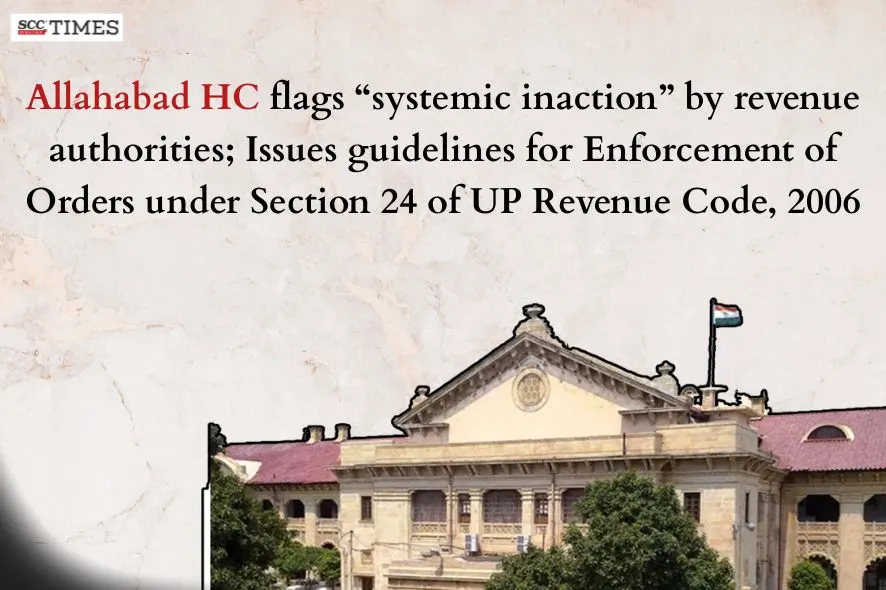
Allahabad High Court: In a batch of writ petitions filed against non-execution of demarcation orders passed under Section 24 of the Uttar Pradesh Revenue Code, 2006 (“the Code”), the Single Judge Bench of Dr. Yogendra Kumar Srivastava, J., allowed the petitions, holding that the respondents concerned, particularly the Sub-Divisional Officer (“SDO”). and Collector, were under law bound to ensure that orders under Section 24 are effectively enforced.
Furthermore, the Court directed the respondents, particularly the SDOs concerned, to execute all subject orders in the instant batch of writ petitions, within four weeks, strictly as per the approved site memo/demarcation report, by ensuring affixation of boundary marks and also possession restoration, wherever required.
Background
A batch of nine writ petitions was filed raising a common grievance about the non-execution of demarcation orders passed under Section 24 of the Code. The orders passed in favour of the petitioners attained finality after a due inquiry, submission of reports, and issuance of notices to the concerned parties. However, the statutory authorities failed to execute the said orders, thereby rendering the entire proceedings ineffective.
The petitioners contended that the State deliberately delayed execution, adopted obstructive tactics, and failed to discharge their statutory and administrative duties, despite repeated requests.
Analysis
At the outset, the Court remarked that the present batch of writ petitions brought forth a seemingly systemic inaction of the revenue authorities concerned.
“Despite having successfully navigated the statutory procedures, undergoing summary inquiries, site inspections, and obtaining final execution orders for affixation of boundary marks, the petitioners find themselves to be in a situation where the end relief remains illusory. The orders in their favour remain on paper, unimplemented on the spot due to inaction on the part of the revenue authorities.”
The Court stated that Section 24 of the Code provides a statutory mechanism for the resolution of disputes relating to boundaries of land or villages through a summary inquiry conducted by the SDO. The scheme of Section 24 underscores the legislative intent to provide a speedy and effective mechanism for the resolution of boundary disputes, based on documentary evidence in the form of survey maps or, where necessary, of actual possession.
The Court added that pursuant to an order passed under Section 24, the SDO is expressly empowered to restore or secure possession in favour of the entitled party while deciding the boundary dispute by employing necessary force to give effect to such restoration, thereby combining quasi-judicial determination with executive enforcement to ensure the efficacy of the order. However, the use of force for restoration of possession must be proportionate, necessary, and limited to the extent required to secure compliance with the order and to maintain peace. The Court also stated that although an appeal lies to the Commissioner against an order passed under Section 24, the order of the SDO, including directions relating to possession, remains operative and enforceable unless stayed or set aside by the appellate authority.
The Court further noted that Section 24 mandates that the entire summary proceeding, including the determination of boundaries and restoration or fixation of possession, shall be completed, as far as possible, within three months from the date of the application. Thus, the SDO was under a statutory obligation to endeavour to conclude proceedings within the prescribed period of three months under the Code and to ensure that all consequential steps are undertaken within the stipulated time frame. Unexplained or avoidable delay in deciding the case or in implementing the final order constitutes failure of statutory duty.
“Section 24 provides a speedy, statutory recourse for the resolution of boundary disputes with direct possession enforcement powers. The statutory object of Section 24 is to avoid protracted litigation and to ensure prompt resolution of boundary disputes along with effective delivery of possession.”
Regarding Rule 22 of the U.P. Revenue Code Rules, 2016 (“the Rules”), the Court stated that it has been consistently interpreted as laying down mandatory procedural requirements which must be complied with before proceedings under Section 24 of the Code can validly be undertaken. It has been held that non-compliance with Rule 22 would vitiate the summary inquiry contemplated under Section 24.
The Court added that the SDO is required to satisfy himself, at the threshold, that the application conforms to the requirements of Rule 22, and only thereafter proceed to adjudicate the boundary dispute.
“The procedure prescribed under Rule 22 is not to be a mere technical or formal requirement, but a substantive safeguard intended to prevent ambiguity in land identification, protect the rights of all affected parties, and ensure fairness in summary adjudication. Any order passed under Section 24 in disregard of the requirements of Rule 22 has to be held to be vulnerable to challenge on the ground of procedural illegality.”
As far as the SDO was concerned, the Court stated that the SDO exercises both quasi-judicial and administrative functions under Section 24 and is bound by the rule of law. The SDO must also act within the four corners of the Code, the Rules, and binding Government Orders, without being guided by extraneous or irrelevant considerations.
Additionally, as a quasi-judicial authority, the SDO must follow the principles of natural justice and balance individual rights with the larger public interest in ensuring sanctity of land records, predictability and stability of possession, and avoidance of conflict and law and order issues.
“Discretion must not be exercised arbitrarily, capriciously, or selectively. Similarly situated litigants in boundary disputes should receive consistent treatment, in line with statutory provisions.”
The Court added that every order under Section 24 must be a speaking order, demonstrating application of mind to (pleadings of the parties, revenue records relied upon (khatauni, khasra, maps, etc.), and demarcation report and any objections thereto. The order must also clearly:
-
record the facts and the nature of the boundary dispute;
-
specify the basis on which the boundary is fixed.
-
record findings on claim of possession or wrongful dispossession, where applicable;
-
direct, in explicit terms, the demarcation, fixation of boundary pillars, and, where necessary, restoration of possession.
“Reasoned orders are essential to ensure transparency, accountability, judicial review, and to prevent arbitrariness.”
From the perspective of administrative law, the Court underscored the importance of effective enforcement to the exercise of quasi-judicial power. Executive aids (Tehsildar, Revenue Inspector, police authorities) are to be utilized as implementing arms of the SDO’s quasi-judicial order.
“An order which is not implemented on the spot reduces the entire proceeding to a paper exercise and defeats the legislative intent.”
On the aspect of appeal to the Commissioner, the Court remarked that it serves as an internal check against error, perversity, or illegality in the SDO’s order, but does not suspend enforcement unless specifically ordered. However, mere filing of an appeal would not operate as an automatic stay. Unless an express interim order is granted by the appellate authority, the SDO’s order remains operative and must be executed. The appellate jurisdiction is also quasi-judicial and thus, subject to the same requirements of fairness, reasoned decision-making, and adherence to statutory limits.
The Court further stated that the proceedings contemplated under Section 24 of the Code are strictly confined to the demarcation of boundaries and restoration of possession based on the relevant revenue records. The jurisdiction of the SDO under this provision does not extend to the adjudication of complex questions of title or ownership. In cases where a genuine dispute regarding title arises, the SDO’s authority remains limited to the determination of boundaries; any attempt to adjudicate proprietary rights under the guise of a Section 24 inquiry would be ultra vires and beyond the scope of the powers to be exercised.
Thereafter, the Court issued some guidelines for the enforcement of orders under Section 24 to obviate recurring grievances arising out of non-enforcement of such orders, considering the statutory provisions and relevant government orders.
Guidelines for Enforcement of Orders under Section 24:
-
Pre-Adjudication: Application & Registration:
-
The revenue authorities, at the threshold, shall ensure that every application filed under Section 24 of the Code strictly conforms to Section 24 of the Code, Rule 22 of the Rules, Government Order dated 16-12-2025, and administrative law principles.
-
The application under Section 24 shall fully comply with Rule 22 requirements, i.e., two copies containing Gata particulars, updated khatauni, contiguous Gata details, and challan receipt, before proceedings commence.
-
On receipt of an application for demarcation, on the same or next working day, the SDO shall register the case in the Revenue Court Computerised Management System (“RCCMS”).
-
Three copies of notices shall be issued from the computerized system and delivered to the Revenue Inspector through the Tehsildar.
-
-
Demarcation & Inquiry:
-
After fixing the date of demarcation and intimation to all the concerned tenure holders, the Revenue Inspector or any other revenue official would demarcate the land, parcel or parcels, as the case may be.
-
During demarcation, if any affected tenure holder is not a party to the case, such tenure holder shall be made a party to the case by the Revenue Inspector on the spot, and the same would be mentioned in the demarcation report.
-
Demarcation shall be completed within a month from the date of the order for the same by the SDO.
-
The Revenue Inspector shall prepare the demarcation report along with the site memo. If there are no objections to the same, then after getting the consent and signature of all the concerned parties on the demarcation report, the same shall be sent to the SDO through the Tehsildar within a week.
-
On receipt of the report, the SDO shall pass an order confirming the same. If the affected parties do not give their consent or if there is any objection to the demarcation report, notice would be issued by the SDO to all parties, fixing a date of hearing which shall not be beyond 15 days from the date of notice, and thereafter, pass an order of boundary demarcation after hearing all concerned parties.
-
-
Execution, Physical enforcement, Prompt and Effective restoration of Possession:
-
The SDO, after having ascertained by summary inquiry the person best entitled to the property, shall put such person in possession.
-
If, in the course of inquiry, it is shown that possession has been obtained by wrongful dispossession of the lawful occupant, the SDO shall put the person, so dispossessed, in possession and, for that purpose, use or cause to use such force as may be necessary and shall fix the boundary accordingly.
-
SDO’s written requisition to Station House Officer under Rule 22(14) of the Rules for police force would be mandatory where any resistance or obstruction is apprehended.
-
The SDO would endeavour to complete the process within the stipulated time period of three months as specified in Section 24 (3) and, if the process is not completed within such time, then the reason for the same shall be recorded.
-
-
Post-Execution Compliance & Reporting: Compliance report detailing pillar locations, possession status must accompany geo-tagged photographs (GPS-enabled) and form part of the record. RCCMS upload of the verification report in the Board of Revenue-prescribed format would be mandatory.
-
Expeditious disposal of Appeals:
-
Appeals preferred before the Commissioner against orders passed under Section 24 shall be taken up and disposed of promptly.
-
As a matter of practice, such appeals should ordinarily be decided without undue delay. Mere filing would cause no automatic stay, i.e., execution shall continue unless an express interim stay is granted. Pendency of Section 30 proceedings or title dispute would ipso facto not suspend Section 24 execution in the absence of any stay order having been granted.
-
-
Interim protection and preventive measures:
-
Pending inquiry/enforcement, SDO may pass interim orders, including maintaining the status quo, restraining illegal construction, interference, or dispossession.
-
Where disputes threaten breach of the peace, SDO shall exercise administrative powers concurrently for urgent possession restoration.
-
The police authorities shall render requisite protection and assistance in the discharge of their duties.
-
-
Enforcement of the order as part of proceedings: An application under Section 24 shall not be treated as ‘decided’ and proceedings not ‘concluded’ unless boundary marks have been made on the spot consequent to the order. The file shall not be consigned to the record room unless a physical verification report with a geo-tagged photograph is uploaded.
-
Monitoring, Reporting, and Accountability: The SDO shall maintain periodic records of compliance showing the status of enforcement of orders passed under Section 24.
-
Accountability and Consequences of Non-compliance: Persistent delay beyond statutory timelines, repeated non-execution, or any wilful failure/deliberate inaction on the part of the officials in complying with orders relating to possession shall invite appropriate departmental action.
-
Implementation Protocol: The Board of Revenue shall endeavour to expeditiously develop Standard Operating Procedures for RCCMS verification format and also appropriate training modules for the concerned revenue officers.
-
Jurisdictional limits: These proceedings, being summary, exclude genuine title disputes as the SDO’s jurisdiction is strictly confined to boundary disputes and possession. Complex ownership claims would require civil adjudication, and any overreach would render the orders ultra vires.
Decision
Reiterating the nature of an order under Section 24 and the consequence of failure in enforcement, the Court stated that the aforementioned broad guidelines aimed to provide a structured framework harmonizing statutory, executive instructions, administrative law principles, and constitutional imperatives of fairness and public order.
On the merits of the issue at hand, the Court held that the respondents concerned, particularly the SDO and Collector, were under law bound to ensure that orders under Section 24 are effectively enforced.
Accordingly, the Court directed that the Secretary, Department of Revenue, Uttar Pradesh, shall ensure state-wide circulation of the aforementioned guidelines to all revenue authorities within the State. A mechanism for providing mandatory training and RCCMS protocol compliance might also be ensured.
Furthermore, the Court directed the respondents, particularly the SDOs concerned, to execute all subject orders in the instant batch of writ petitions, within four weeks from the date of production of a certified copy of this order, strictly as per the approved site memo/demarcation report, by ensuring affixation of boundary marks and also possession restoration, wherever required.
[Meena Devi v. State of Uttar Pradesh, 2025 SCC OnLine All 8494, decided on 18-12-2025]
Advocates who appeared in this case:
For the petitioners: Rohit Pandey Sandeep Kumar Singh, Digamber Dwivedi, Munna Tiwari, Sandeep Kumar Singh, Dharamdas, Vijay Bahadur Yadav, Anoop Kumar Sharma, Anurag Shukla, Shubham Dwivedi, Raj Kumar Shukla, Arvind Kumar Srivastava
For the respondent: Additional Advocate General Manish Goyal, Chief Standing Counsel J N Maurya, Additional Chief Standing Counsel Abhishek Shukla, Ravi Anand Agarwal, Azad Rai