


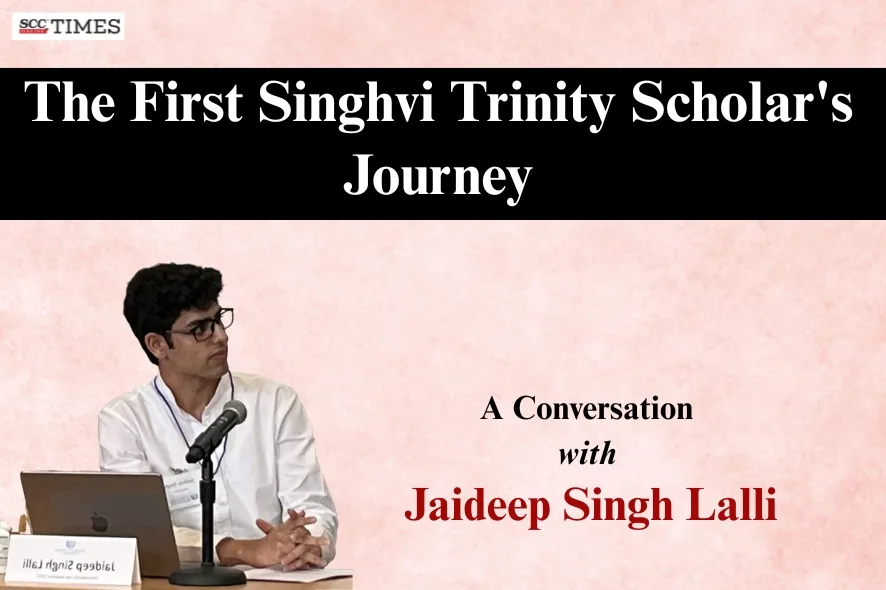
1. Kindly introduce yourselves to our readers.
I am Jaideep Singh Lalli, a PhD student and Trinity-IGS Scholar in Law at Trinity College, University of Cambridge. My research lies at the intersection of legal philosophy, analytic metaphysics, and critical theory. Broadly, I study how different areas of law acquire their functions and conceptual identities. For instance, what it means to call something “discrimination law” or “social welfare law”. Alongside this theoretical work, I also write on South Asian legal history, particularly on Hindu inheritance, gender, and colonial codification. Before beginning my PhD, I completed the LLM (First Class) from Cambridge and the BA LLB (Hons.) with Distinction from the University Institute of Legal Studies, Panjab University, Chandigarh. Trinity scholarships have generously supported my postgraduate study in full.
2. To begin with, could you share your journey from a law student at Panjab University to pursuing a fully funded LLM and now, PhD in Law at the University of Cambridge?
My journey has been shaped by curiosity, generous mentorship, and a growing awareness of law’s philosophical and social depth. At Panjab University, I had the privilege of learning from remarkable professors, Professor Rattan Singh, who first drew me into constitutional law; Professor Shruti Bedi, whose elective on Organised Crimes and Internal Security Laws transformed how I understood State power; Ms Komal Garg, who introduced me to Public International Law; and Dr Supreet Gill, who taught me arbitration law with precision and care. Professor Bedi, Senior Advocate Dr Menaka Guruswamy, and Hon’ble Justice Arun Palli became my most formative mentors. Working with Dr Guruswamy refined the way I thought about constitutional law and sensitised me to the multiple axes of marginalisation that shape legal and political life. My time with Justice Palli involved rigorous philosophical discussions about what decisions ought to be made in specific cases, which deeply shaped how I think about legal reasoning. Our shared love for sustained intellectual exchange made those conversations some of the most formative of my intellectual journey. Additionally, internships with human rights bodies and with Justices of the Supreme Courts of India and Nepal gave me an early sense of the law’s institutional complexity.
That formative period prepared me for my LLM at Cambridge, where I was fortunate to be the inaugural Singhvi — Trinity Scholar. There, I began exploring the philosophical foundations of legal systems — asking what gives different areas of law their coherence and conceptual identity. That inquiry has since evolved into my doctoral project, which examines the ontology and function of discrimination law.
3. What challenges did you face while aiming for an LLM at Cambridge and what role did your law school journey play in reaching your destiny?
The biggest challenge was navigating self-doubt. The idea of applying to Cambridge initially felt unattainable. What sustained me was not only the discipline my family instilled but also the unwavering support of my friends — Akriti Sharma, Bhavyata Kapoor, Urvashi Singh, Ashna Singh, Rashi Shahrawat, Niraimathi Nagarajan, and Nikita Garg — who read my application materials, offered honest feedback, and believed in the possibility long before I did. The habits of rigorous reading, debate, and perseverance that I built at Panjab University, together with that circle of friendship and faith, were crucial when applying for the LLM.
4. Your published work includes “Silent Histories, Loud Exclusions: Hindu Inheritance and Transgender Personhood from Dharmaśāstras to India’s Trans Rights Act”, “Communalisation of Citizenship Law: Viewing the Citizenship (Amendment) Act 2019 Through the Prism of the Indian Constitution”, and “ndian Supreme Court’s Interpretative Experiments: The Status of Compensatory Benefits & Lapse of Eminent Domain Acquisitions” to name a few. What were some of the most significant challenges you faced while developing these pieces of work, and what strategies helped you overcome them? What was your personal experience and beliefs that led your journey of writing on trans rights?
Across most of my writing, a central thread has been a concern with marginalisation and discrimination, not only as social phenomena but as structures of knowledge embedded within law itself. Whether one looks at caste, gender, religion, or sexuality, what interests me is how law participates in producing hierarchies of visibility and asymmetric distributions of precarity.
The greatest challenge in developing these pieces has been working across disciplinary boundaries. My research often moves between law, philosophy, and history, which requires constant negotiation between different vocabularies and standards of reasoning. Writing “Silent Histories, Loud Exclusions”, for example, meant reading Sanskrit texts alongside colonial archives and contemporary statutes — worlds that do not easily speak to one another. The task was to let each discourse illuminate the other without collapsing their differences.
My work on trans rights, in particular, grew out of my broader concern with marginalisation; a theme that has animated my writing from the very beginning. The same motivation informed my undergraduate paper on the Citizenship (Amendment) Act (CAA), which was published in the University of Oxford Human Rights Hub Journal. That early piece marked my first attempt to think about how law codifies exclusion. My views on the CAA have since evolved, and I hope to revisit the issue in the future with a more philosophical lens. I have long been drawn to questions of how the law sees and fails to see certain lives. The exclusions faced by trans persons are not just matters of policy but of epistemology: They reveal how the law constructs and limits the very categories of personhood and harm. Morally and emotionally, I find it impossible to suspend my concern for asking whose realities are left at the margins. That question continues to anchor everything I write.
5. You have received multiple recognitions at Cambridge, such as the Equality & Liberation Award. What action went behind these success stories and how have these accolades shaped your academic ethos and your perspective about law and society?
Much of my work at Cambridge has revolved around sensitising the academic community to questions of decolonisation and discrimination, not only as abstract themes, but as lived institutional realities. I have been involved in conversations and campaigns that push the University to reckon with its own colonial inheritances and the subtle hierarchies that persist within academic life.
One of the most significant of these efforts has been my campaign for the removal of Lord Macaulay’s statue from Trinity College’s antechapel, or at the very least for the installation of a contextualising plaque beside it. The Latin inscription beneath the statue celebrates, without qualification, his “legislative reform” in India; a phrase that conceals the violence and cultural subjugation those reforms entailed. The campaign is not about erasure but about context, about inviting the institution to acknowledge that the legacies of empire cannot be curated only through pride, but must also be confronted through truth and reflection.
These experiences have deeply shaped how I understand my role as a scholar. Scholarship, in my view, carries a responsibility to interrogate the operations of power; to question how history, language, and institutional memory organise what we take to be knowledge itself.
6. You have engaged with academic and student communities (given your experience as an assistant lecturer at Jindal Global Law School). How do you approach public engagement beyond traditional academic publishing?
I see public engagement as an extension of pedagogy. Teaching at Jindal Global Law School, and later mentoring students informally, convinced me that philosophical ideas gain life when shared conversationally. I often write for broader platforms and deliver talks that translate ideas operating at a very high level of abstraction into more accessible reflections on law, power, and social imagination. For me, engagement is about deepening collective understanding and making complex questions feel thinkable and shared.
7. What are your long-term career aspirations: Do you see yourself in academia, policy advising, public service, or another field and how do you plan to leverage your Cambridge experience and networks towards the future goals?
I hope to remain in academia while keeping my work closely tied to the public life of law. The Cambridge environment, with its deep interdisciplinary networks, has shown me the importance of research that is both conceptually rigorous and socially responsive. In the long term, I want to develop a body of work that rethinks how we define, classify, and evaluate areas of law, and how those definitions shape the politics of recognition and exclusion.
8. Are there emerging areas within law that you believe require urgent scholarly attention and why?
Yes, the philosophy of “legal kinds” is an underexplored area. We often ask what the purpose of a law is but rarely ask what makes something a distinct kind of law to begin with. In fact, I think we do not yet have philosophical clarity on what we even mean when we ask about the purpose or function of a law. I also believe there is a pressing need to cultivate serious engagement with legal philosophy in Indian law schools, where the discipline is often misunderstood or treated as peripheral. What excites me most is the possibility of drawing connections between recent developments in metaphysics (particularly debates about kind individuation, functions, and ontology) and the way we theorise different areas of law (for example, discrimination law, tort law, criminal law, or social welfare law). These intersections, I believe, can open up new ways of thinking about what law is.
9. In the context of Indian legal education, what reforms or pedagogical shifts would you advocate for contemporary law schools?
Legal education in India would benefit from slower, deeper reading and from integrating philosophy and history into the study of doctrine. Students should learn to ask why a rule exists, not just what it says. Greater emphasis on small-group teaching, analytical forms of assessment that test reasoning rather than recall, and sustained engagement with primary materials could transform classrooms into genuine spaces of inquiry and debate rather than rote preparation.
10. Reflecting on your experiences and journey, what advice would you offer to young law students, early-career researchers and professionals aiming for postgraduate study abroad?
First, do not measure your ability by the prestige of your institution or your accent of confidence; measure it by your intellectual honesty and curiosity. Second, start reading beyond the syllabus early; the best research projects are those that grow out of sustained reading, not last-minute ambition. And finally, seek mentors who challenge your thinking rather than simply reassure you. Every academic journey is as much about learning to think for oneself as it is about learning from others.
1. PhD student and Trinity-IGS Scholar in Law at Trinity College, University of Cambridge.
2. Student Ambassador, UILS, Panjab University, Chandigarh.
3. EBC-SCC Shadow Ambassador, 2025-26.
This conversation made Jaideep Singh Lalli’s academic journey feel so human and inspiring — from his early law studies in India to his current research at Cambridge, the mix of curiosity, mentorship, and perseverance shines through. Your piece gave such a vivid sense of how legal scholarship can bridge philosophy, history, and real-world impact. I’m curious — was there a particular challenge he mentioned that reshaped his thinking the most?