


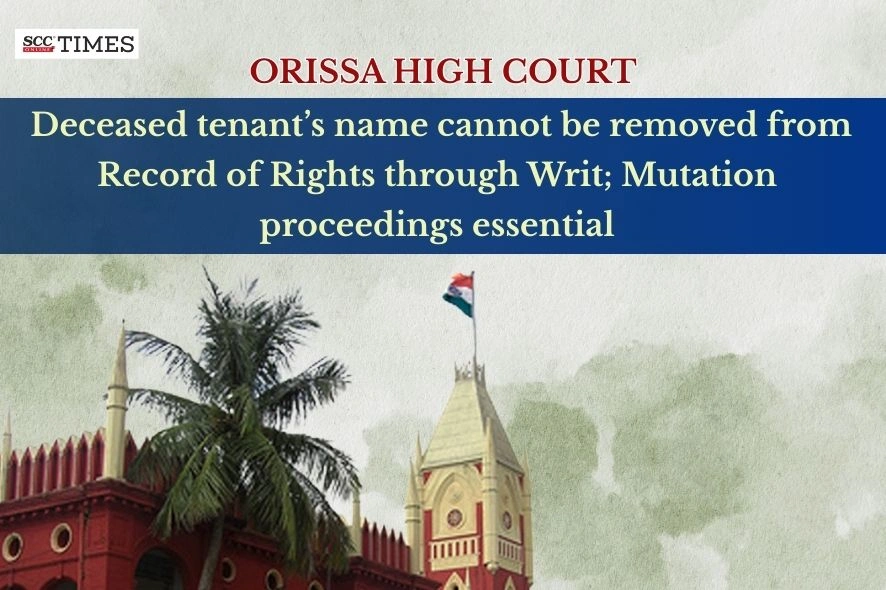
Orissa High Court: While hearing a writ petition under Articles 226 and 227 of the Constitution, a Single Judge Bench of Ananda Chandra Behera*, J., held that deletion of the name of a deceased recorded tenant from the Record of Rights (‘RoR’) cannot be ordered directly in writ jurisdiction. The Court emphasised that the proper course is to file a mutation application before the Tahasildar, who shall conduct enquiry and pass necessary orders. The writ petition was accordingly disposed of, granting liberty to the petitioners to approach the Tahasildar.
The petitioners sought deletion of the name of a deceased recorded tenant from the RoR relating to a specific Khata number in Mouza Erbanpali. It was contended that since the individual had expired, his name ought to be excluded from the records. The petitioners further argued that the Tahasildar should be directed to carry out such deletion. On the other hand, the State submitted that the proper legal procedure must be followed, which requires filing of a mutation application before the Tahasildar, who alone is competent to conduct enquiry and pass orders.-
The Court emphasised that for deletion of the name of a recorded tenant from a RoR on the ground of his/her death, a Mutation Case is to be registered on the basis of an application submitted by an interested party. The Court noted that thereafter an enquiry is to be conducted by the Tahasildar and necessary order may be passed for deletion/exclusion of the name of the dead recorded tenant from the RoR and in his place, the names of his/her legal representatives (‘LRs’) be indicated.
The Court observed that it cannot pass a blanket order in a writ petition directing deletion of the name of a dead person, because some formalities as per law are required to be made before the Tahasildar through a mutation proceeding. In view of this settled proposition, the Court highlighted that there was no justification to allow the writ petition in full.
Finally, the Court disposed of the matter by allowing the petition in part, granting liberty to file an application before the Tahasildar, who shall register a Mutation Case, conduct enquiry, and pass necessary orders.
Thus, the writ petition was disposed of with directions limited to following the proper statutory procedure.
[Jayanti Biswas v. State of Orissa, 2026 SCC OnLine Ori 100, Decided on 08-01-2026]
Advocates who appeared in this case:
For the Petitioners: Niranjan Panda, Advocate
For the State: S. Nayak, Addl. Standing Counsel
Buy Constitution of India HERE


Nice and prompt