
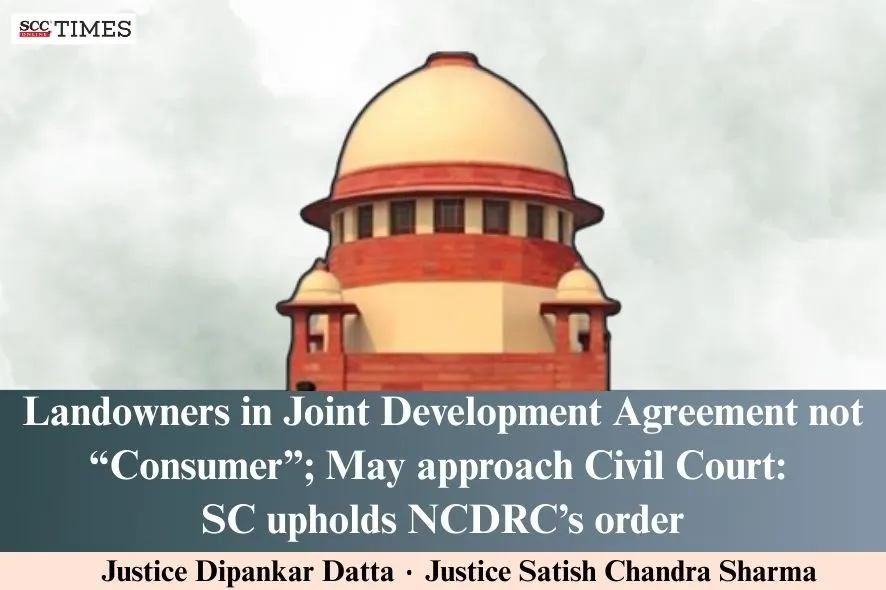
Supreme Court: In an appeal challenging order of National Consumer Disputes Redressal Commission (NCDRC) dismissing appellant’s consumer complaint on the grounds of limitation and lack of consumer status, a Division Bench of Dipankar Datta and Satish Chandra Sharma, JJ., declined to interfere with the findings of the NCDRC and held that Landowners in Joint Development Agreement are not “Consumers” and that there was “no reason to entertain this civil appeal” , while granting liberty to the appellants to pursue their remedies before the civil court.
In the instant matter, the appellants are landowners who entered into joint development agreements dated 30-03-2001 with respondents for redevelopment of a piece of land. Under the arrangement, the developer was to demolish existing structures and construct a cellar mosque with ground plus two upper floors after obtaining GHMC sanctions. The developer furnished an interest-free refundable deposit of Rs. 1 crore, to be returned in stages, and the project was to be completed by September 2003 with an extension of six months.
According to the complainants, though possession of their 50% share was handed over by April 2009, there were deficiencies including incomplete handover, defects, deviations from sanctioned plans and non-obtainment of the occupancy certificate. A consumer complaint was filed before the National Consumer Disputes Redressal Commission (NCDRC) on 01-07-2016 claiming, inter alia, rental damages of Rs. 14.36 crore, compensation of Rs. 1 crore for mental agony, removal of the mosque from the cellar and costs
The NCDRC, vide order dated 29-08-2025 dismissed the complaint on two principal grounds (i) the complaint was barred by limitation, the cause having accrued with possession/knowledge and not being kept alive indefinitely by project formalities such as an occupancy certificate, and (ii) the complainants were not “consumers” as the 50:50 joint development arrangement was a commercial venture undertaken for profit. The NCDRC stated that the landowners contributed land, received an interest-free deposit of Rs. 1 crore, obtained equal share in the constructed area (including 19 flats and commercial space) and thereafter exploited the property commercially by rentals and sales. The NCDRC treated the transaction as a business-to-business joint enterprise, falling within the “commercial purpose” exclusion thereby taking the landowners outside the fold of “consumer.”
At the threshold, the Court condoned the delay. On merits, the Court declined to interfere with the NCDRC’s decision on not finding any reason to entertain this civil appeal. However, the Court expressly preserved the appellants’ liberty to pursue their remedies in the civil forum.
“However, if the appellants seek to pursue the channel of civil litigation by instituting a suit, they shall be entitled to claim exemption from the laws of limitation under Order VII Rule 6 of the Code of Civil Procedure, 1908 read with the specific provisions of the Limitation Act, 1963.”
[Habib Alladin v. Mahmood Builders (P) Ltd., 2026 SCC OnLine SC 54, Decided on 06-01-2026]
Advocates who appeared in this case:
Mr. C. A. Sundaram, Sr. Adv., Mr. Pranab Kumar Mullick, AOR, Ms. Soma Mullick, Adv., Mr. S. N. Shakeel, Adv., Mr. Abhishek Gupta, Adv., Mr. Hemant Kumar, Adv., Counsel for the Appellant
Mr. Jaideep Gupta, Sr. Adv., Mr. Sridhar Potaraju, Sr. Adv., Mr. B. Shravanth Shanker, AOR, Mr. Shivam Kunal, Adv., Mr. B. Yeshwanth Raj, Adv., Mr. Riddhi Bose, Adv., Ms. Racheeta Chawla, Adv., Ms. Rishi Agarwal, Adv., Ms. Sampriti Bose, Adv., Ms. Niharika Singh, Adv., Ms. Chamundeswari Pemmasani, Adv, Counsel for the Respondent