
Disclaimer: This has been reported after the availability of the order of the Court and not on media reports so as to give an accurate report to our readers.
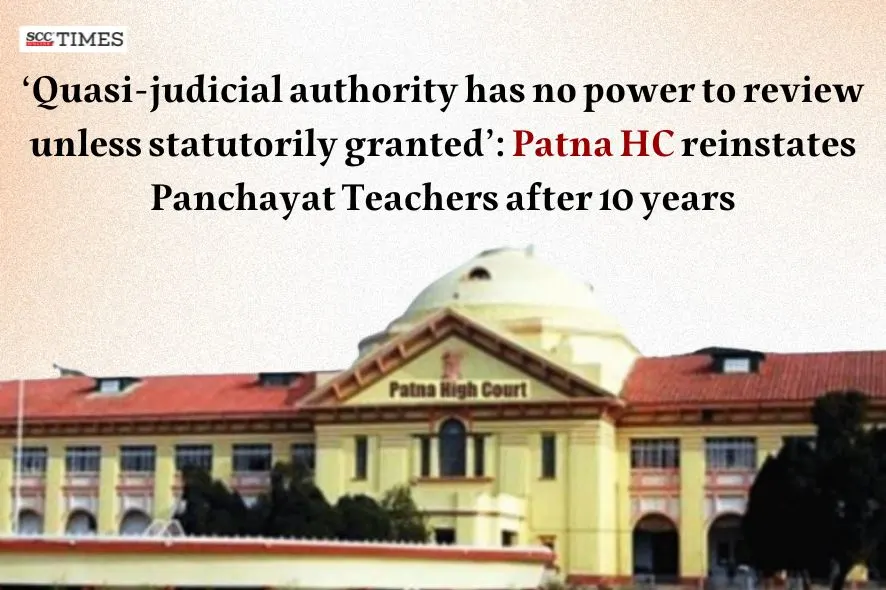
Patna High Court: In a writ application filed by two panchayat teachers whose appointment was disputed for more than 10 years, the Single Judge Bench of Alok Kumar Sinha, J., allowed the application, holding that the District Teachers Employment Appellate Authority, Buxar (“District Appellate Authority”), which allowed their claim and later overturned it, had no power to review, recall or reopen its own final order.
Background
The petitioners were appointed as Panchayat Teachers pursuant to the selection process conducted under the Bihar Panchayat Primary Teacher (Appointment and Service Conditions) Rules, 2006 (“the 2006 Rules”) after due process of selection, counselling, and verification. Subsequently, a dispute arose regarding the legality of the alleged appointments. The matter was taken before the District Appellate Authority, which allowed their claim in 2014. However, in 2016, the District Appellate Authority reviewed and recalled its earlier order holding that the previous order suffered from error.
Aggrieved, the petitioners assailed the 2016 order before the State Teachers Employment Appellate Authority (“State Appellate Authority”), but it dismissed the appeal and affirmed the order passed by the District Appellate Authority.
Hence, the present writ application.
Issues
-
Whether, under the Bihar Panchayat Primary Teachers (Appointment and Service Conditions) Rules, 2006 and the Guidelines of 2008, the District Teachers Employment Appellate Authority had the power to review, recall, or reopen its own final order?
-
Whether the impugned order dated 25.01.2016 passed by the District Teachers Employment Appellate Authority in Appeal No.4 of 2013 is without jurisdiction?
-
Whether the subsequent proceedings culminating in the order dated 24.08.2017 passed in Appeal no. 83 of 2017 stand vitiated as a consequence thereof?
-
Whether the provisions of the Rules of 2020 can be applied retrospectively to validate the impugned action?
Analysis
The Court stated that, as per the 2006 Rules and the 2008 Guidelines, the jurisdiction of the Appellate Authority is confined to hearing and deciding appeals arising out of disputes relating to appointment. Significantly, the Rules do not contain any provision, either express or by necessary implication, conferring upon the Appellate Authority the power to review, recall, or reopen its own final order once the same has been passed.
Noting this, the Court reiterated that the power of review is not an inherent attribute of a judicial or quasi-judicial authority and must emanate from a specific statutory conferment. In this regard, the Court referred to Patel Narshi Thakershi v. Pradyumansinghji Arjunsinghji, (1971) 3 SCC 844, Kuntesh Gupta v. Hindu Kanya Mahavidyalaya, (1987) 4 SCC 525, and Kalabharati Advertising v. Hemant Vimalnath Narichania, (2010) 9 SCC 437.
Applying the aforesaid principle, the Court held that in the absence of any express provision under the Rules 2006 and Guidelines 2008, the District Appellate Authority could not have assumed unto itself the power to review or revisit its own final decision. Once the final order was passed, the Authority became functus officio.
The Court noted that the power of review was explicitly introduced under Rule 15 of the 2020 Rules. The express incorporation of such power in 2020 clearly indicated that no such power existed earlier. The Court remarked that the very fact that the legislature found it necessary to introduce an explicit provision conferring power of review in 2020 left no doubt that such power did not exist under the earlier statutory regime, i.e., the Rules of 2006 read with the Guidelines of 2008.
“The power of review being substantive in nature cannot be applied retrospectively to validate actions taken at a point of time when no such power existed.”
Applying the aforesaid statutory and legal principles to the facts of the present case, the Court held that the 2014 order passed by the District Appellate Authority had attained finality and at that stage, the Authority stood divested of jurisdiction to reopen or reconsider the matter.
Furthermore, the Court held that the State Appellate Authority, while passing the impugned order, proceeded on the erroneous assumption that the merits of the dispute could be reopened, notwithstanding the absence of any statutory power of review under the governing Rules at the relevant time. Such an exercise amounted to an assumption of jurisdiction which the statute did not confer.
Accordingly, the Court also held that all four issues had been answered in favour of the petitioners and the impugned orders of 2016 and 2017 passed by the District and State Appellate Authorities, respectively, were ex facie without jurisdiction.
Thus, the Court allowed the petition and set aside the impugned orders. The Court also directed the respondents to accept the joining of the petitioners as per the 2014 order, and pursuant to their appointments, the respondents shall grant all consequential benefits which the petitioners would be legally entitled to with effect from the date of issuance of their appointment letters. This exercise shall be completed within 15 days.
[Kumari Bandana v. State of Bihar, 2025 SCC OnLine Pat 3570, decided on 23-12-2025]
Advocates who appeared in this case:
For the petitioners: Akash Chaturvedi
For the respondents: B. Singh, SC-28