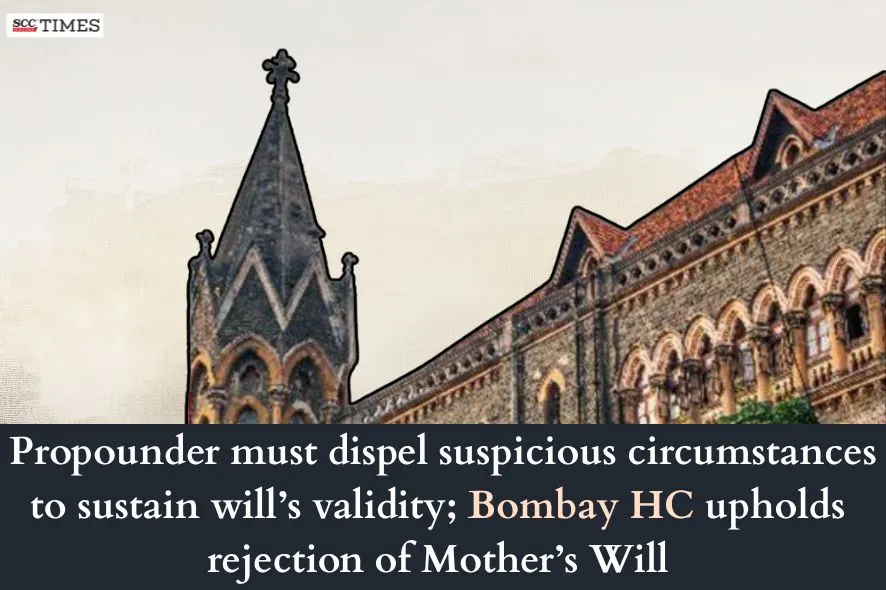
Bombay High Court: In an appeal arising from a long-standing family dispute centering around two conflicting wills of the deceased parents, the issue was whether the will executed by the mother was valid. The Single Judge had earlier dismissed the suit citing suspicious circumstances. The Division Bench, upon appeal, initially set aside the dismissal, but the Supreme Court remanded the matter for fresh consideration. Ultimately, the Division Bench of M.S. Sonak and Advait M. Sethna*, JJ., held that although the will was formally proved, the suspicious circumstances surrounding its execution were not dispelled by the propounder to the satisfaction of the Court in order to sustain the will’s validity, thereby disentitling her from Letters of Administration.
Background:
The deceased father left behind a will dated 22-8-1971 appointing his wife and two sons as executors and trustees. He conferred life interest on his wife and directed that after her lifetime, the house and plot would devolve upon his two sons as tenants in common, subject to payments to other children. Out of Rs 20,000 to be paid, Rs 5000 each was earmarked for other two children and the appellant, while Rs 5000 was to go to the fifth son provided he stopped consuming alcohol. This will was probated on 24-4-1980. Subsequently, on 7-7-1982, the mother executed her own will, bequeathing all her property to three children in equal shares. The execution took place at the residence of an advocate, who drafted the will and attested it along with his wife. The mother also filed an affidavit stating that she had no knowledge of her husband’s will and believed he made it ‘in a fit of temper’. She passed away on 24-11-1985.
The appellant (‘propounder’) filed a suit against her four brothers for administration of the estate to which one of the brothers averred that the mother did not leave any will as the same was not probated. She then filed a testamentary petition seeking Letters of Administration with the will annexed. After the death of the brother on 26-1-1993, his widow and children (‘respondents’) filed caveat to oppose the grant of Letters of Administration.
The Single Judge vide judgment dated 7-3-2003 dismissed the appellant’s suit stating three suspicious circumstances surrounding the execution of the mother’s will which were:
-
the will was cryptic, and it did not mention the property of the deceased;
-
the propounder took prominent part in the execution of the will; and
-
the will did not contain any explanation as to why the other two sons were excluded.
The appellant then preferred an appeal wherein the Single Judge’s order was set aside by an order dated 22-1-2009. The respondents preferred a civil appeal before the Supreme Court which remanded the matter to the Division Bench of this Court observing that the reasoned judgment of a Single Judge could not be interfered with without deep consideration.
The propounder’s counsel argued that execution and attestation were duly proved through the advocate who drafted the will and the propounder’s husband, and that the mother was of sound mind and had the testamentary capacity. He urged that the propounder apart from accompanying her deceased mother, who was 70 years old at the relevant time, played no active role in making the will in question. He pointed out that the Single Judge failed to consider that the appellant could not travel from Canada to India because of heart issues followed by surgery in the year 1995.
The respondents’ counsel countered that the will was void for uncertainty under Section 89 of the Indian Succession Act, 1925 (‘Succession Act’), as it failed to describe the property and offered no explanation for disinheriting two children. It was argued that the mother had already accepted her husband’s will treating the property as his sole ownership when she applied for the probate of the last will of her husband, thereby electing under Section 180 of the Succession Act to give up any right to bequeath the same property being the subject matter of her late husband’s probate will.
In the rejoinder by the appellant, it was submitted that the mother and the father were joint tenants for the said property and not the tenants in common, and in her lifetime, she had gotten a certificate issued to transfer the property in her own sole name. Thus, she had always treated the property has her own after her husband’s death, leading to misconstrued reliance on Section 180 of the Succession Act by the respondents. It was also stated that the excluded sons never objected to the grant of Letters of Administration in favour of the appellant, nor did the deceased brother file any caveat or challenge the mother’s will.
Analysis and Decision:
The Court acknowledged that the propounder had formally proved the will under Section 68 of the Evidence Act, 1872 (‘Evidence Act’). However, the central question was whether suspicious circumstances surrounding the will were adequately dispelled. The Court discussed the circumstances as follows:
-
Cryptic nature of the will: The will did not specify the details of the property. This omission was significant because the father’s probated will had already disposed of the property, conferring only life interest on the mother. The Court noted that when the mother was aware that only a life interest in the property was created in her favour, under her deceased husband’s will, it was natural that the details of the property ought to have been specified. The absence of particulars raised doubts under Section 89 of the Succession Act, which voids a will for uncertainty.
-
Prominent role of the propounder: The Court noted that the evidence showed that the advocate who drafted the will did not know the testator directly and was introduced by the appellant, who brought her mother to his house for execution. He also gave legal advice to the appellant regarding property. Further, the appellant who was aware of all the necessary facts chose not to be a witness and did not offer herself for examination and cross-examination. The Court observed that where there was an ambiguity or deficiency in the description of the property sought to be bequeathed, the same could not be cured by extrinsic evidence of the propounder, by going behind the intent of the will of the testator.
The Court was not impressed by the absence of the appellant on the ground of her health condition. The Court referred to Vidhyadhar v. Manikrao, (1999) 3 SCC 573, wherein it was observed that “where a party to the suit does not appear into the witness box and states his own case on oath and does not offer himself to be cross examined by the other side, a presumption would arise that the case set up by him is not correct”. The Court also acknowledged that the mother had exercised her right to elect under Section 180 of the Succession Act, when she had applied for probate of her husband’s will, which treated the subject property, as his sole ownership.
-
Exclusion of the other two sons: The Court noted that the will excluded two sons without explanation and the appellant did not step into the witness box to explain the same. The Court relied on H. Venkatachala Iyengar v. B.N. Thimmajamma, 1958 SCC OnLine SC 31, where it was held that when the propounder of a will has received a substantial benefit under the same by taking a prominent part, in its execution, that itself is generally treated as a suspicious circumstance. The Court opined that while the exclusion of the two sons alone was not suspicious, but when coupled with lack of explanation and the propounder’s active involvement, it created legitimate doubts.
The Court referred to Ram Piari v. Bhagwant, (1990) 3 SCC 364, wherein the Supreme Court held that when suspicious circumstances exist, the Court should not be swayed by due execution of the will alone. The Court also referred to Gurdial Singh v. Jagir Kaur, 2025 SCC OnLine SC 1466, where it was observed that the onus was on the propounder to dispel suspicious circumstances surrounding the will to the satisfaction of the conscience of the Court.
The Court opined that when there were allegations of the existence of suspicious or unusual circumstances, peculiar and unique to the factual complexion, the same ought to be examined and taken to its logical conclusion. Thus, the Court observed that while execution of the will was formally proved, the suspicious circumstances remained unresolved. Consequently, the Court, while dismissing the appeal, held that there was no irregularity in the Single Judge’s order and decided not to interfere with the same.
[Myra Philomena Collaco v. Lilian Coelho, 2025 SCC OnLine Bom 5530, decided on 30-12-2025]
*Judgment authored by: Justice Advait M. Sethna
Advocates who appeared in this case:
For the Appellant: Karl Tamboly, a/w Bhavin Shah, Alisha Lambay i/by Lambay & Co.
For the Respondents: Nigel Quraishy, a/w Dushyant Krishnan, Snehil Rai, Shruti Dubey i/by Susmit Phatale.