
Disclaimer: This has been reported after the availability of the order of the Court and not on media reports so as to give an accurate report to our readers.
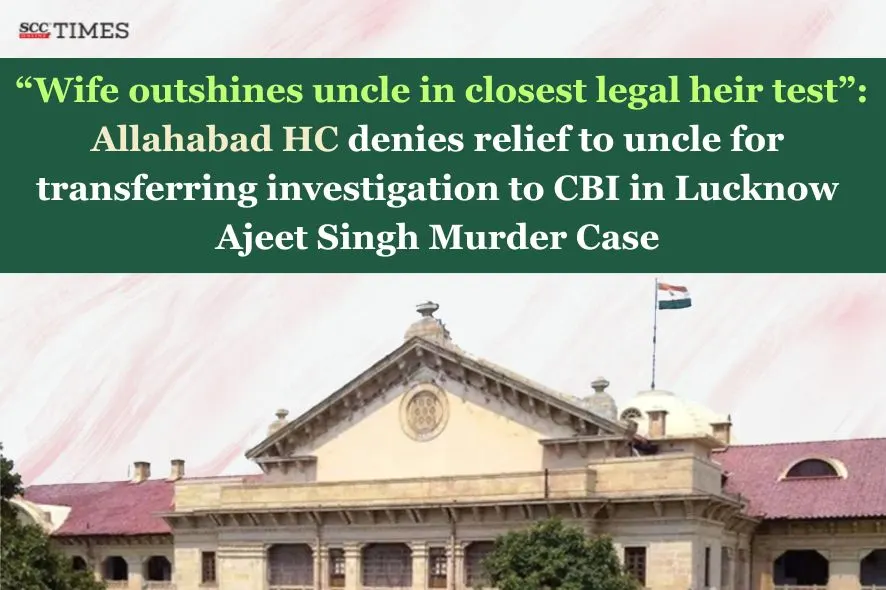
Allahabad High Court: In a set of two criminal writ petitions filed by uncle of deceased Ajeet Singh in the Lucknow Ajeet Singh Murder Case seeking transfer of investigation to CBI, the Division Bench of Rajesh Singh Chauhan and Abdhesh Kumar Chaudhary, JJ., disposed of the petitions, holding that the uncle had no locus to seek such relief and allowing the petitions would tantamount to allowing a stranger to interfere in ongoing criminal proceedings. The Court also held that the wife outshines the uncle in the closest legal heir test.
Background
Two writ petitions were filed by two accused persons seeking transfer of their criminal cases registered under Sections 120-B, 302, 307, and 34 of the Penal Code, 1860 (“IPC”), and under Section 5 (2) of Official Secrets Act, 1923(“OSA”), respectively, to the Central Bureau of Investigation (“CBI”). They also sought a speedy investigation.
In the first FIR, the present petitioner was the uncle of the murdered victim, Ajeet Singh. However, he was not one of the affected parties in the second FIR, which was lodged by one Sub Inspector against Suresh Bahadur Singh, a Senior Journalist of Jan Sandesh, and another man for possessing a secret document allegedly by adopting illegal means.
Analysis
Upon perusal of the definition of victim under Section 2(wa) of the Criminal Procedure Code, 1973 (“CrPC”), the Court stated that the definition clearly indicated that the victim would be a person who has suffered a loss or injury caused by an act or omission by an accused person, and also includes his/her legal heir. In this regard, the Court noted that the informant of the first FIR was a friend of the deceased Ajeet Singh, who also received injuries because he was with him when the alleged incident of firing and murder occurred.
The Court also noted that the wife of the deceased Ajeet Singh in the first FIR had filed a writ petition seeking transfer of the case to the CBI claiming that an Ex-Member of Parliament, Dhananjay Singh, who was alleged to be involved in the murder, was a highly influential person and investigation had already been transferred from local police to Special Task Force (“STF”), which did not yield any result and instead Dhananjay Singh was being protected. Thus, she was apprehensive that the STF would either protect him or implicate him for minor offences only.
Thereafter, the said writ petition was dismissed by the Court observing that there was no ground to entrust the matter to any other agency, such as CBI, as a charge sheet had already been filed against thirteen accused persons, including Dhananjay Singh, and no infirmity in the investigation conducted by the STF was shown or brought on record. However, the Court allowed the wife to challenge the charge sheet if she was aggrieved and if so advised.
The Court further noted that the wife appealed the order of dismissal before the Supreme Court, but ultimately withdrew it along with other similar writ petitions filed by her before her apprehension could be resolved. The petitioner uncle filed an impleadment application in the wife’s appeal seeking a similar relief. Though his application was rejected, the Supreme Court granted him liberty to file a fresh writ petition before the High Court.
The Court noted that the petitioner uncle filed the present first writ petition, but did not assail the charge sheet or file any other petition challenging the charge sheet and prayed for the identical relief, which was earlier prayed for by the wife of the deceased Ajeet Singh.
Noting the aforesaid, the Court remarked that it was unable to comprehend as to what was the locus of the petitioner uncle in filing the present writ petitions, when he was neither the “victim” in view of Section 2 (wa) of the CrPC nor a person aggrieved in any manner or a legal heir. Admittedly, the petitioner was the uncle of the deceased Ajeet Singh, and even if the degree of closeness of their relationship was considered, the wife was the immediate victim and aggrieved, so the uncle could not be placed above her.
The Court opined that a restrictive meaning ought not to be given to the meaning of ‘legal heir’ as per Section 2(wa) of the CrPC. However, considering the nature of criminal proceedings and the limited right available even to a complainant, once the criminal machinery has been set into motion, the meaning of “victim” has to be given a purposeful interpretation.
Regarding the aspect of whether the petitioner uncle would be considered a legal heir or relative of the deceased Ajeet Singh, the Court perused the definition of near relative under Section 394 of the CrPC, which included parent, spouse, lineal descendant, brother, or sister. The Court also perused the meaning of legal representative under the Civil Procedure Code, 1908, CrPC, and the Hindu Succession Act, 1956.
Upon such perusal, the Court found that the uncle was a faraway and/or distant relative and did not find any place both under the meaning of the word ‘near relative’ or ‘legal representative’ mentioned in the CrPC.
Thus, the Court held that it ought to devise a mechanism, which may be called as the ‘closest legal heir test’, to determine whether a particular person would come under the definition of ‘legal heir’ in terms of Section 2(wa) of the CrPC, keeping in mind that the law had to be interpreted to ensure that the ‘spirit of justice’ prevailed and recognizing the right to prosecute a legitimate grievance of the victim, especially in serious cases.
The Court demarcated that “according to the ‘closest legal heir test’, the closest or the proximate legal heir of the victim must outshine the next closer legal heir because the administration of justice does not warrant any dispute even on determining as to who would be the ‘legal heir’ to pursue the grievance of a victim, in pursuing a criminal case, which is fundamentally construed to be an offence against the society. Therefore, it is the primary duty of the State to protect the rights and interests of the victim.”
Holding the aforesaid, the Court stated that in the present case, the wife of the victim was present, thus her right as a legal heir outshone the right of an uncle, as the wife is a closer legal heir in the pedigree table than an uncle. Therefore, the right of a wife to be a legal heir of the victim is at a higher pedestal than that of an uncle.
The Court further stated that since the wife had admittedly withdrawn all writ petitions seeking CBI investigation, the same relief now being sought by a distant legal heir, i.e., uncle, had to be seen with some circumspection and cannot be entertained in the absence of any authorization and/or No Objection Certificate (NOC) from the wife.
Notably, the Court remarked that much water had flown under the bridge after the wife of the deceased Ajeet Singh withdrew her writ petition seeking similar relief. After completion of the investigation, a charge sheet has been filed, which could have been assailed before the Court by filing a petition under Section 482 of the CrPC or in this writ petition as well. However, admittedly, that charge sheet had not been assailed either by the wife of the deceased Ajeet Singh or by the petitioner uncle.
Furthermore, the Court noted that the trial for the first FIR was going on smoothly and in full swing.
Regarding the second FIR, the Court held that the complainant was a Sub Inspector and allegations were levelled against two accused persons, namely, Suresh Bahadur Singh and Dhananjay Singh. The petitioner uncle was not the victim in this case either, as the alleged crime did not distinctly affect him or his family. Furthermore, the charge sheet had been filed, and the trial was presently stayed by the Court.
Upon perusal of all allegations of influence over the investigation and trials, the Court stated that the order of transfer of investigation could have been passed when the Court found that there was new material or evidence of sterling nature, which had been ignored by the investigating agency. However, in the present case, no such material or evidence had been produced, and only apprehension had been expressed that the main mastermind and allegedly the instrumental person in the murder of the deceased Ajeet Singh, Dhananjay Singh, had a close association with the STF, the investigating agency; therefore, such an investigation was not proper.
Considering the aforesaid, the Court stated that if the wife or the petitioner uncle finds some evidence or material regarding their apprehension, they could always intervene in the trial proceedings to the extent of aiding the prosecution, as per the provisions of the CrPC. In this regard, the Court agreed with Madras High Court’s decision in All India Democratic Women’s Association v. State, 1997 SCC OnLine Mad 1040, wherein it was held that if third parties were allowed to intervene in all criminal proceedings, then there will be a number of associations to represent one party or the other and this would give rise to chaos and confusion and stalling of criminal proceedings.
Therefore, the Court held that appropriate party/ parties may file an appropriate application before the Trial Court to alter or add the charge(s), if there is any sufficient material or evidence of sterling nature, and those applications may be considered by the Trial Court strictly in accordance with law and disposed of in the interest of justice.
The Court further held that if any relief was granted in the present petitions, it could amount to interfering in the already initiated criminal proceedings pending before the Trial Court. Thus, the locus standi of the petitioner uncle to file the present writ petition and interfere in pending criminal proceedings was absolutely negated as the locus standi of a stranger to interfere in criminal proceedings was absolutely limited. In this regard, the Court referred to Prisoners’ Rights Forum v. High Court of Judicature at Madras, 2014 SCC OnLine Mad 7377, and Sanjai Tiwari v. State of U.P., (2021) 15 SCC 660.
Decision
Accordingly, the Court dismissed the writ petitions, holding that:
-
The petitioner uncle was not a victim as per the provisions of Section 2(wa) of the CrPC.
-
The prayer of transfer of investigation to the CBI was stale and technically infructuous as the investigation was completed in both the FIRs, and trial had commenced in the first FIR, and all the proceedings had been stayed in the second FIR.
-
The entire case has been premised on apprehension, and no cogent evidence had been provided to entail any consideration of such a prayer by the Court.
-
Any relief granted at this stage would amount to interference by a stranger in an ongoing trial, which was not permissible under the provisions of the CrPC.
However, the court granted liberty to the parties to file the requisite application before the Trial Court at the appropriate stage, as per CrPC. If any appropriate application is filed before the Trial Court, it shall be considered and disposed of without being influenced by any observations made herein.
[Rajesh Singh v. State of U.P., 2025 SCC OnLine All 8105, decided on 18-12-2025]
Advocates who appeared in this case:
For the petitioner: Kapil Misra, Ashish Kumar Singh
For the respondent: Government Advocate V.K. Singh, Anurag Kumar Singh, Naved Ali
Buy Penal Code, 1860 HERE
Buy Code of Criminal Procedure, 1973 HERE