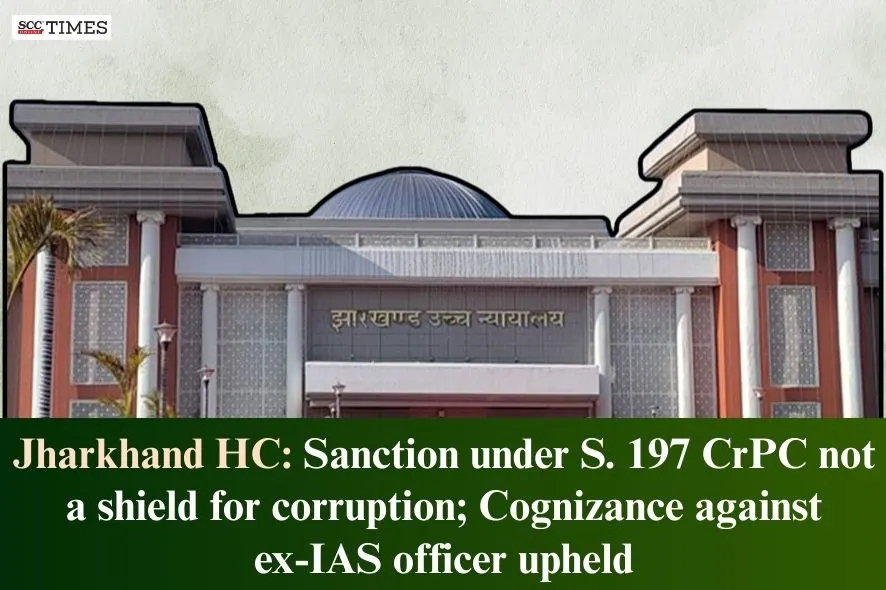
Jharkhand High Court: In a writ petition challenging the cognizance order passed by the Special Judge under the Prevention of Money Laundering Act, 2002 (‘PMLA’), a Single Judge Bench of Justice Ambuj Nath held that the absence of prior sanction under Section 197 of the Criminal Procedure Code, 1973 (‘CrPC’) does not invalidate the order. Emphasising that siphoning State funds and amassing ill-gotten wealth can never be considered part of a public servant’s official duty, the Court clarified that the Section 197 CrPC corruption shield cannot be invoked to protect acts of corruption. Consequently, the writ petition was dismissed.
Background:
The prosecution complaint was filed after multiple FIRs were registered by the Jharkhand Police at Khunti, where audit reports confirmed large-scale defalcation of government funds running into crores. It was alleged that between 16-02-2009 and 19-07-2010, funds sanctioned for development projects were misappropriated to the tune of Rs 18.06 crore, in connivance with engineers. Subsequent raids and searches led to the recovery of Rs 19.76 crore in cash, along with documents and digital devices. The petitioner failed to provide any lawful source of income and was arrested on 11-05-2022.
The petitioner contended that cognizance was taken without obtaining prior sanction under Section 197(1) of the CrPC, which is mandatory for prosecuting public servants. It was argued that the cognizance order was legally flawed as this requirement had not been met. The Enforcement Directorate, however, submitted that sanction is intended to protect responsible public servants from vexatious proceedings only when the alleged act is reasonably connected with the discharge of official duty, and not when official duty is used merely as a cloak for objectionable or corrupt acts.
Analysis and Decision
The Court emphasised that Section 197 CrPC gives protection to public servants employed in the Central or State Government against vexatious criminal proceedings while acting as public servants. The Court noted that protection has been extended to acts exceeding official duty if there is reasonable connection between the act and performance of duty. However, the Court observed that accumulating ill-gotten wealth by siphoning State funds cannot be said to be part of official duty of any public servant.
The Court highlighted that sanction under Section 197 CrPC is only for acts reasonably connected to official duty, not personal illegal acts even if done by public servants. The Court stressed that sanction is not for shielding corrupt officials. The Court noted that the guiding principle governing necessity of prior sanction is whether the impugned act is reasonably connected to discharge of official duty. If the act is wholly unconnected or manifestly devoid of nexus to official functions, the requirement of sanction obviates.
The Court observed that the issue of sanction can be taken up before the Trial Court at any stage of the proceedings, depending on the nature of evidence that the prosecution may lead. Sanction can be obtained at any stage before pronouncement of judgment.
Consequently, the Court held that taking cognizance without sanction in the present case will not vitiate the cognizance order. Accordingly, the writ application was dismissed, and pending interlocutory applications also stood disposed of.
[Pooja Singhal v. Enforcement Directorate, 2025 SCC OnLine Jhar 3961, decided on 22-12-2025]
Advocates who appeared in this case :
For the Petitioner: Indrajit Sinha, Sneh Singh, Akhouri Awinash Kumar, Ashwini Priya
For the Respondent: Zoheb Hossain, Amit Kumar Das, Sourav Kumar, Varun Girdhar, Pranjal Tripathi