
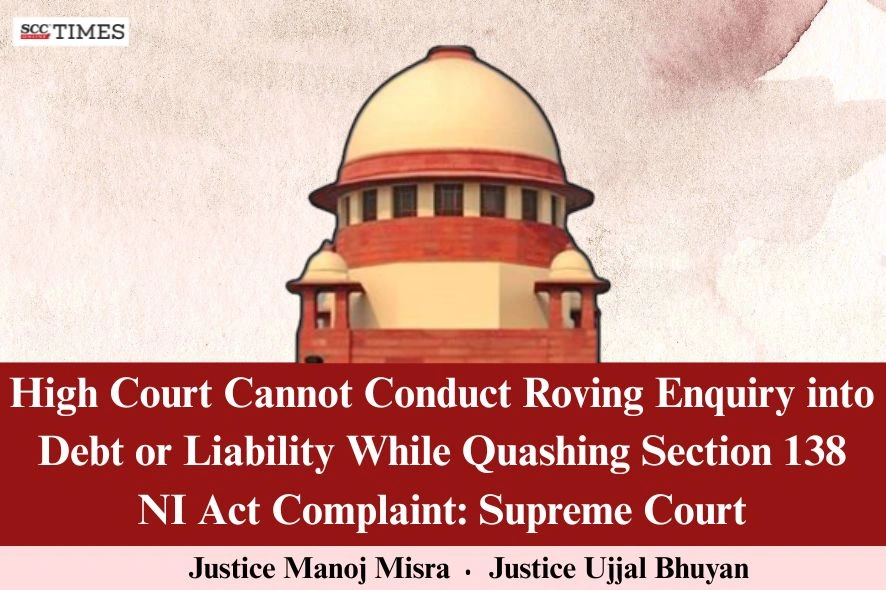
Supreme Court: In a case where the Patna High Court had quashed criminal proceedings under Section 138 of the Negotiable Instruments Act, 1881 at the pre-trial stage, the bench of Manoj Misra* and Ujjal Bhuyan, JJ set aside the said order after observing that the High Court exceeded its jurisdiction by conducting a roving enquiry into disputed questions of fact at the pre-trial stage.
Background of the Case
In the case at hand, the appellant—complainant had alleged dishonour of a cheque of ₹20 lakh issued by the respondent towards payment for goods supplied. After the cheque was dishonoured twice for insufficiency of funds and payment was not made despite statutory notice, a complaint under Section 138 NI Act was filed. The Magistrate took cognizance and issued summons. Aggrieved by the summoning order, the first respondent filed an application under Section 482 CrPC, before the High Court. The Patna High Court, exercising powers under Section 482 CrPC, quashed the proceedings on the ground that the cheque was not issued for the discharge, in whole or in part, of any debt or other liability.
Supreme Court’s Analysis and Ruling
The Supreme Court reiterated the well settled rule that while considering a prayer to quash the criminal complaint and the consequential proceedings at the threshold, the Court is required to examine whether the allegations made in the complaint along with materials in support thereof make out a prima facie case to proceed against the accused or not. If upon reading the complaint allegations and perusing the materials filed in support thereof, a prima facie case is made out to proceed against the accused, the complaint cannot be quashed, particularly, by appreciating the evidence/ materials on record because the stage for such appreciation is at the trial. No doubt, in exceptional circumstances, the Court may take notice of attending circumstances to conclude that continuance of the proceedings would amount to an abuse of the process of the Court, or where quashing of the proceedings is necessary to secure the ends of justice.
In the case at hand,
-
The complaint clearly spelled out the necessary ingredients for commission of an offence punishable under Section 138 of the N.I. Act.
-
It was also alleged in the complaint that the cheque was issued in the discharge of liability qua goods supplied by the complainant.
-
The cheque was brought on record along with the dishonour memo of the bank concerned which indicated that it was returned unpaid for insufficient funds in the drawer’s account.
-
The complaint also indicated that complainant had served notice of demand within the specified period and despite service of notice of demand, no payment was made
It was, hence, noted that the necessary ingredients of an offence punishable under Section 138 of N.I. Act were disclosed by the complaint warranting issuance of process to the first respondent.
However, the High Court, in its jurisdiction under Section 482 CrPC, proceeded to test whether the cheque was issued for the discharge, in whole or in part, of any debt or other liability.
The Supreme Court found such an exercise unwarranted because, under Section 139 of the N.I. Act, there is a presumption that the holder of a cheque received the cheque of the nature referred to in Section 138 for the discharge, in whole or in part, of any debt or other liability. This presumption can be rebutted by evidence led in trial. A fortiori, the said issue can appropriately be decided either at the trial, or later, upon conclusion of trial, by the appellate/ revisional court.
The Supreme Court, hence, held that the High Court committed an error by conducting a roving enquiry, at the pre-trial stage, as regards the cheque being issued for the discharge of debt or liability.
“Such an exercise was not merited in exercise of power under Section 482 of the Code more so when the complaint allegations disclosed that the cheque was issued for discharge of liability. As fulfillment of the necessary ingredients of Section 138 N.I. Act are prima facie made out from the complaint allegations, neither the summoning order nor the complaint could have been quashed by the High Court at the pre-trial stage.”
Accordingly, the Supreme Court allowed the appeal, set aside the High Court’s order, and restored the criminal complaint to the file of the Magistrate for adjudication in accordance with law, clarifying that it expressed no opinion on the merits of the defence.
[Sri Om Sales v. Abhay Kumar, 2025 SCC OnLine SC 2897, decided on 19.12.2025]
*Judgment Authored by: Justice Manoj Misra
Advocates who appeared in this case:
For Appellant(s): Mr. Abhikalp Pratap Singh, AOR
For Respondent(s): Ms. Namita Kumari, Adv., Mr. Atul Kumar, Adv., Mr. Saswat Adhyapak, Adv., Mr. Abid Ali Beeran P, AOR, Mr. Manish Kumar, AOR, Mr. Divyansh Mishra, Adv., Mr. Kumar Saurav, Adv.
Buy Code of Criminal Procedure, 1973 HERE