
Disclaimer: This has been reported after the availability of the order of the Court and not on media reports so as to give an accurate report to our readers.
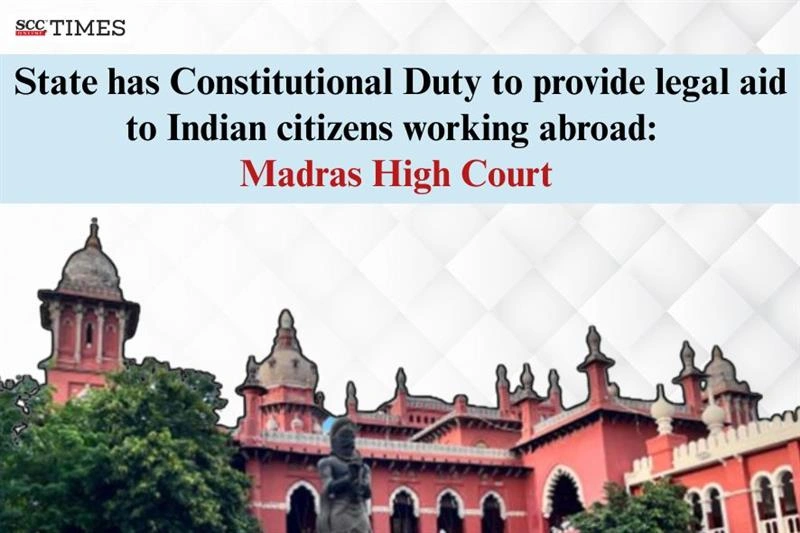
Madras High Court: In a writ petition seeking a writ of mandamus directing the Union of India to intervene and assist an Indian citizen in securing compensation arising out of overseas employment when the citizen is unable to pursue remedies abroad, a Single-Judge bench of G.R. Swaminathan, J., held that Government of India has a constitutional duty to provide assistance, including legal aid, to Indian citizens not only within the territory of India but also outside it.
In the instant matter, the petitioner, a resident of Virudhunagar District, is the widow of an Indian citizen who was employed in the Republic of Cameroon, Central Africa. While in service with Africa First Matches Industry S.A., Yaounde, the petitioner’s husband passed away on 13-10-2021.
Following his death, the employer, by a letter dated 19-10-2021, undertook to pay a certain sum towards compensation for family support. However, the said undertaking remained unfulfilled. The petitioner, a poor widow with a young child to support, found herself incapable of pursuing remedies in a foreign jurisdiction and, therefore, submitted a representation dated 22-06-2022 seeking intervention by the Government of India for securing the compensation due to her.
Alleging inaction on the part of the authorities despite the clear hardship faced by her, the petitioner approached this Court under Article 226 of the Constitution, seeking a writ of mandamus directing the Union of India to consider her representation and release the compensation amount due.
The Court noted that the principal issues that fall for determination are —
-
Whether the Government of India has a constitutional duty to intervene and assist an Indian citizen in securing compensation arising out of overseas employment when the citizen is unable to pursue remedies abroad?
-
Whether the absence of a specific legislative framework governing legal aid or compensation enforcement outside India absolves the State of such responsibility?
The Court noted that both the petitioner and her deceased husband were Indian citizens and that the death occurred while the husband was in overseas employment. The Court observed that one could “safely assume that the petitioner’s husband’s employer is obliged to pay compensation to the petitioner.”
The Court rejected the contention that consular assistance had reached its limit, and held that the answer to the question of State responsibility “can be only one and that has to be in the affirmative.” Emphasising the nature of India as a welfare State, the Court referred to Article 38(1) of the Constitution and relied on Gaurav Kumar Bansal v. Union of India, (2015) 2 SCC 130, which recognised that a welfare State is the protector of life and liberty of its citizens not only within the country but also outside in certain situations.
The Court invoke doctrine of parens patriae and recognised the State as a protector acting as a parent, particularly where citizens are not in a position to protect themselves. The Court observed that where citizens are unable to assert and secure their rights, “the State must come into picture and protect and fight for the rights of the citizens.” The Court read together the Preamble and the Directive Principles under Articles 38, 39 and 39-A of the Constitution to reinforce this obligation.
The Court also referred to Anju Sharma v. Union of India, 2021 SCC OnLine Del 2464 and Jemima Arumaithai v. State, 2023 SCC OnLine Mad 6513, where proactive intervention by the Ministry of External Affairs had resulted in relief to widows of migrant workers who had died abroad.
Addressing the argument that the Legal Services Authorities Act, 1987 has no extraterritorial application, the Court held that the absence of a legislative framework could not justify sending the petitioner “empty handed.” Drawing inspiration from Vishaka v. State of Rajasthan, (1997) 6 SCC 241, the Court held that international conventions and norms could be relied upon to fill legislative voids, provided they are not inconsistent with constitutional values.
The Court referred to Article 71 of the International Convention on the Protection of the Rights of All Migrant Workers and Members of Their Families, which mandates State assistance in compensation matters relating to the death of migrant workers. The Court noted that though India is not a signatory, the provision be treated as a persuasive aid to constitutional interpretation.
The Court emphasised on the doctrine of Rajadharma, and stated that the ancient Indian legal thought consistently recognised the duty of the ruler to protect subjects. Quoting Kautilya, Manu, and references from the Shanthi Parva of the Mahabharatha, the Court observed that when the State derives benefit from overseas remittances, “it has a correlative and corresponding duty to rush to their rescue when issues arise out of such overseas employment.”
The Court held that the doctrine of parens patriae in the Indian constitutional scheme squarely places responsibility on the Government at all levels to protect its citizens, including those working abroad. The Court held that the Government of India has a constitutional duty to provide legal aid and proactive assistance to its citizens even outside the territory of India, and directed the Union Government to —
-
Play a proactive role in securing redress for the petitioner,
-
Take up the matter at the highest echelons of the Government of Cameroon, if necessary,
-
Explore all available avenues including issuance of legal notices, mediation, and, if required, formal legal proceedings, and
-
Carry out the entire process expeditiously, keeping in view that the petitioner is a poor widow whose survival and child’s future are at stake.
-
Come out with a comprehensive and feasible policy framework concerning legal aid and protection of Indian citizens working abroad.
[Malarvizhi v. Union of India, 2025 SCC OnLine Mad 13149, Decided on 16-12-2025]
Advocates who appeared in this case:
Mr. A. John Vincent, Counsel for the Petitioner
Mr. ARL. Sundaresan, Additional Solicitor General of India, assisted by Mr. K. Govindarajan, Deputy Solicitor General of India, Counsel for the Respondent No. 1 to 3
Mr. K.S. Selvaganesan, Additional Government Pleader, Counsel for the Respondent No. 4 to 6
Buy Constitution of India HERE