
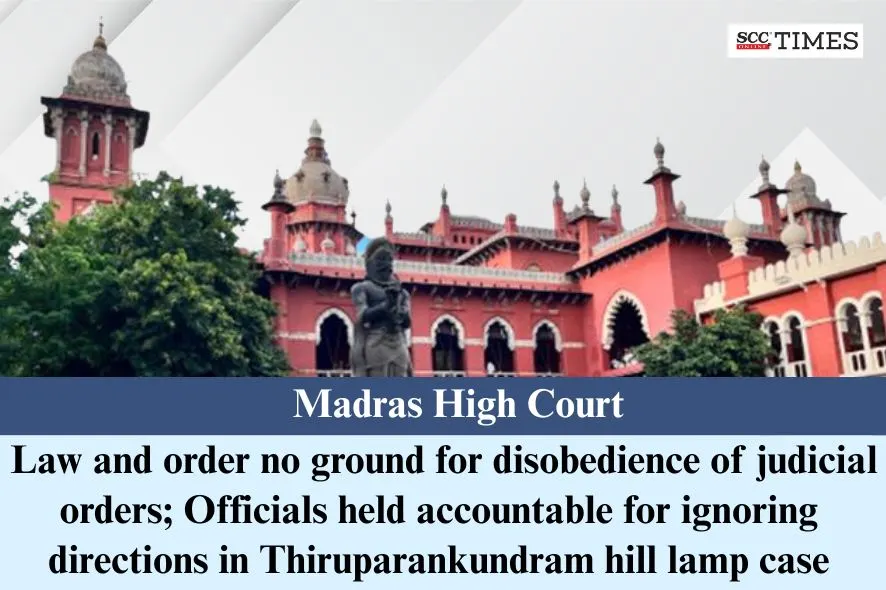
Madras High Court: While hearing contempt petitions filed under Section 11 of the Contempt of Courts Act, 1971, alleging willful disobedience of judicial orders passed in writ petitions, a Single Judge Bench of G.R. Swaminathan, J., held that citing law and order concerns as a justification for non-compliance with binding judicial directions is impermissible. The Court observed that unless stayed or set aside by a higher forum, court orders must be obeyed, and treating law and order as a ground for flouting such directions would be unacceptable, amounting to a breakdown of constitutional machinery.
Background:
The dispute arose when prohibitory orders were passed under Section 163 of Bharatiya Nagarik Suraksha Sanhita, 2023 (‘BNSS’), by district authorities, allegedly without independent application of mind but on instructions. In another related matter, revenue authorities failed to act against an illegal church construction despite an injunction order granted by the Court. Reports submitted indicated that enforcement of the injunction was resisted on the ground, and authorities claimed inability to implement the order due to law and order issues.
The petitioners argued that the respondents had deliberately disobeyed judicial directions, thereby undermining the authority of the Court. However, the respondents contended that while they had high regard for the judiciary, practical difficulties arising from law-and-order situations had to be considered when implementing orders.
Analysis and Decision:
The Court emphasised that when a judicial order has been issued, it must be obeyed unless stayed or set aside by a higher forum. The Court highlighted that law and order cannot be a ground for flouting a court’s order, as that would be inexcusable, amount to a breakdown of law and order, and ultimately lead to paralysis of the constitutional machinery. The Court observed that authorities appeared hesitant to take action against illegal constructions and noted that law and order was being used as a convenient fig leaf to justify inaction.
The Court further observed that in several cases, officers had to be hauled up for contempt, and expressed frustration at repeated disobedience. The Court noted that the authorities should have acted on their own against illegal constructions but failed to do so, compelling aggrieved parties to approach the Court.
The Court directed that the matter stand adjourned to 09-01-2026, with a specific direction to the Chief Secretary of Tamil Nadu to take a responsible stand in the forthcoming proceedings. The Court further directed that the contemnors shall remain present on the adjourned date, as their personal appearance has not been dispensed with.
[Rama Ravikumar v. K.J. Praveenkumar, 2025 SCC OnLine Mad 12986, decided on 17-12-2025]
Advocates who appeared in this case:
For the Petitioners: G. Karthikeyan, Senior Counsel, KPS. Palanivelrajan, Senior Counsel for RM. Arun Swaminathan
For the Respondents: J. Ravindran, Addl. Advocate General, S.S. Madhavan, Addl. Government Pleader, Vikas Singh, Senior Counsel, Veera Kathiravan, Addl. Advocate General, assisted by S. Ravi, Addl. Public Prosecutor, Jothi, Senior Counsel for V. Chandrasekar