


Disclaimer: This has been reported after the availability of the order of the Court and not on media reports so as to give an accurate report to our readers.
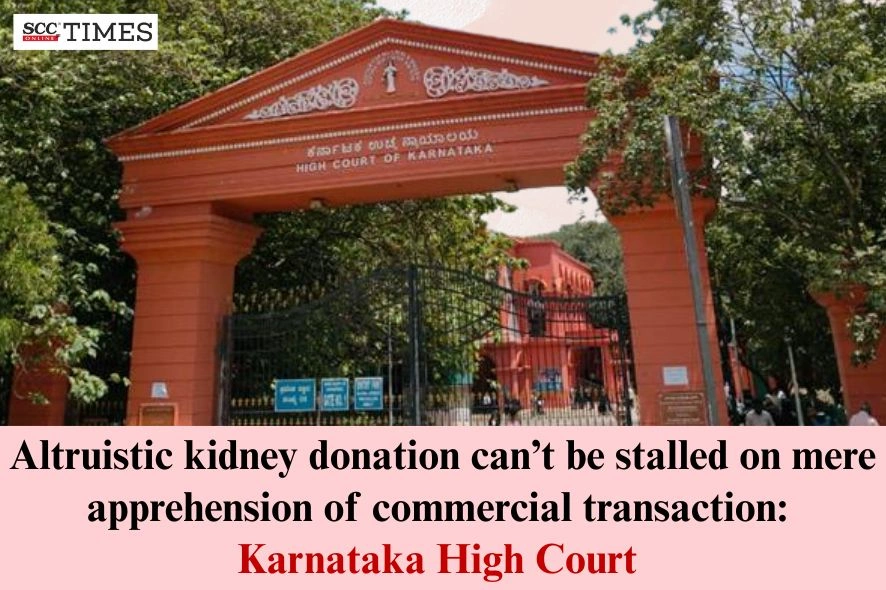
Karnataka High Court: In a petition filed under Articles 226 and 227 of the Constitution of India, seeking a direction to the respondent Hospital-Based Authorization Committee (HBAC) and Manipal Hospital to grant approval for donation of one of her kidneys altruistically to any deserving patient, without seeking or receiving any compensation of any nature, a Single-Judge bench of Suraj Govindaraj, J., allowed the donation and issued the directions.
The Court noted that the petitioner’s application for altruistic organ donation was not considered by the respondents. The Court noted that the petitioner was a doctor by profession, a major in age, fully aware of all medical and legal consequences of kidney donation and had expressed urgency on account of a family history of diabetes, which could affect the viability of donation at a later stage.
The Court noted that this was “one of the rare cases” where a petitioner had approached the Court with a request to donate a kidney altruistically and without seeking for any compensation of any nature. The Court found that the application had not been considered due to a misconception that the absence of prior knowledge between donor and donee could imply an impermissible transaction.
Rejecting such an approach, the Court observed that the petitioner had clearly stated that she was “not making any choice as regards who the donee has to be”, and that identification of the recipient could be left entirely to the hospital.
Taking note of the petitioner’s professional background and informed consent, the Court held that when a person, “being aware of all the aspects relating thereto, has come forward for donating her kidney of her own free will and volition,” such a request “has to be given due credence and accepted and put in action.” The Court also recognised the urgency expressed by the petitioner due to the likelihood of early kidney-related complications arising from her family history of diabetes.
The Court allowed the writ petition and issued the following directions —
-
The respondent hospital was directed to conduct all necessary medical tests on the identified potential donees to determine compatibility and suitability.
-
Upon completion of such tests, the results were to be placed before Respondent 1 (HBAC) for approval.
-
The Authorization Committee was directed to consider the same and pass necessary orders within one week of such submission.
-
All remaining procedures were to be carried out strictly in accordance with the applicable statutory framework.
[ABC v. Chairperson, Hospital Based Authorization Committee, 2025 SCC OnLine Kar 23109, Decided on 25-11-2025]
Advocates who appeared in this case:
Sri. Sripada Venkata Joga Rao, Counsel for the Petitioner
Sri. H. Mujtaba for Sri. K R Lakshmana Rao, Counsel for the Respondents
Buy Constitution of India HERE
