
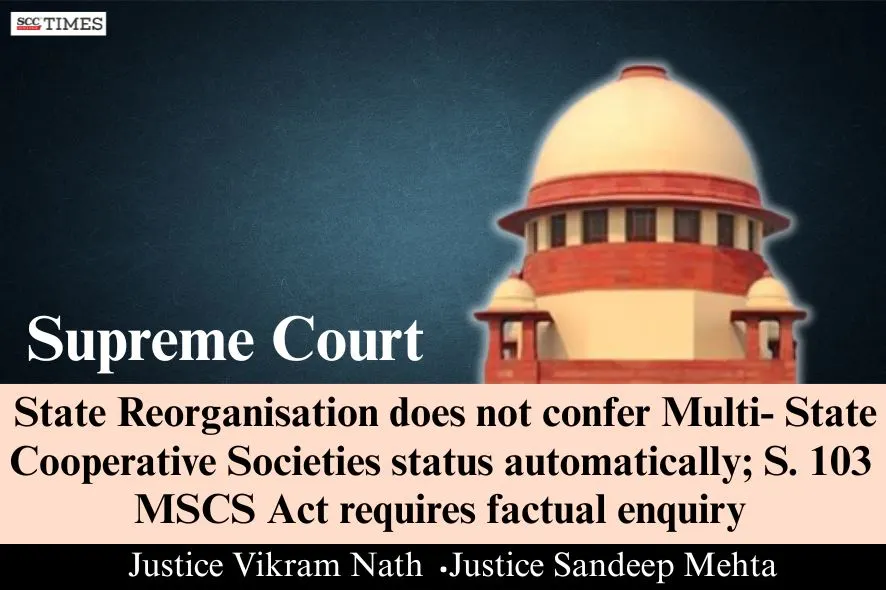
Supreme Court: While considering this appeal wherein the Court had to answer whether by virtue of Section 103 of the Multi-State Cooperative Societies Act, 2002, the subject cooperative society, though originally registered under the statute enacted by the State, stands transformed into a multi-State cooperative society on account of the State reorganization; the Division Bench of Vikram Nath* and Sandeep Mehta, JJ., held that Section 103 of the Multi-State Cooperative Societies Act, 2002 does not, by itself, confer an automatic or deemed status of a multi-State cooperative society upon every society registered under a State Cooperative Societies Act merely because the parent State has undergone reorganisation.
The Court further held that the applicability of Section 103 requires a factual enquiry in each case as to whether the objects of the society extend to more than one State. If the objects are found to span more than one State, the deeming fiction under Section 103 will operate and the society would be treated as a multi-State cooperative society. If the objects remain confined to only one State, the status of the society will remain unchanged.
Background:
Kisan Cooperative Sugar Factory Limited, having its registered office at Majhola, District Pilibhit, Uttar Pradesh, was originally registered under the provisions of the erstwhile Co-operative Societies Act, 1912. In 1965, State of UP enacted the Uttar Pradesh Cooperative Societies Act (“State Act”) whereby the earlier Co-operative Societies Act, 1912 stood repealed and was substituted by the State Act.
In 2000, the U.P. State Reorganization Act, 2000 (“Reorganisation Act”) came into force, by which the erstwhile State of Uttar Pradesh was bifurcated into the State of UP and the newly created State of Uttarakhand. At that time, the Multi-State Cooperative Societies Act, 1984 governed cooperative societies. Subsequently, in 2002, the Multi-State Cooperative Societies Act, 2002 (“Central Act”) was enacted, repealing the 1984 Act and consolidating the law relating to cooperative societies whose operations extended beyond a single State. The Central Act incorporated a deeming clause under Section 103, in terms of which certain cooperative societies, consequent upon the reorganisation of the State, would be treated as multi-State cooperative societies. By virtue of this legal fiction, such societies, though originally registered under the State Act, would fall within the ambit and application of the Central Act.
Thereafter, the State of UP undertook a series of measures regarding the restructuring and privatization of cooperative sugar mills which had become financially unviable. In the succeeding year, the State took a policy decision in principle to proceed with the privatization and sale of several cooperative sugar mills and directed that the said process be carried out through the Department of Disinvestment. on 7-8-2007, the State of UP issued the U.P. Cooperative Societies (Amendment) Ordinance, 2007, empowering the State Government to transfer cooperative sugar mills to entities in which the State held the majority shareholding, where such mills were found to be financially unviable.
The afore-stated action led to filing of writ petition before Allahabad High Court questioning the privatisation of the cooperative society. It was contended that upon the enactment of the Reorganisation Act, the State had ceased to possess any authority under the State Act and, consequently, lacked the competence to undertake the impugned measures.
The High Court via the impugned judgment allowed the writ petitions held that Section 103 of the Central Act, being a deeming provision, was fully attracted to the facts of the case and, therefore, the cooperative society had acquired the character of a multi-State cooperative society. Consequently, only the Union Government could exercise authority in respect of such society.
Aggrieved with the afore-stated decision, State of UP approached the Supreme Court with the present appeal.
Court’s Assessment:
Perusing the matter, the Court stated that appeals present an unusual situation concerning the interpretation of a law enacted by Parliament and whether its ambit extends to a corporate body originally registered under a State legislation. While there is no dispute as to legislative competency, the narrow issue that falls for consideration is whether, on the reorganisation of the erstwhile unified State of Uttar Pradesh, the subject cooperative society has assumed the character of a multi-State cooperative society.
Referring to Section 103 of the Central Act, the Court the Central Act came to be enacted by the Parliament to address the requirements of India’s federal structure, where it was considered necessary to make a special provision governing cooperative societies whose activities were not confined to a single State and which catered to members spread across more than one State. The Court explained that expression “multi-State cooperative society” in Section 3(p) means a society that has been registered or is deemed to be registered under the Act, and includes a national cooperative society as well as a federal cooperative. Likewise, the term “member” under Section 3(n) refers to a person who joins in the application seeking registration of a multi-State cooperative society and also includes anyone admitted to membership thereafter in accordance with the provisions of the Act, the Rules, and the bye-laws.
It was further explained that a conjoint reading of Section 5(1)(a) and Section 10(2)(b) makes it evident that once a society seeks registration as a multi-State cooperative society and prescribes its objects in the bye-laws, such objects must necessarily satisfy the mandate of Section 5(1)(a), namely, that its main objective should be to serve the interests of members in more than one State. Section 22 acknowledges the authority of a cooperative society to transform itself into a multi-State cooperative society. Accordingly, a multi-State cooperative society may come into existence in three distinct ways.
On the core issue of Scope of “deemed conversion” under Section 103, the Court noted that the Section provides for the conversion of a cooperative society registered under a State Cooperative Societies Act into a multi-State cooperative society. The provision is attracted when Parliament enacts a law for the reorganisation of a State. The second requirement is that the cooperative society must have had its objects confined to ‘one State’. The expression “one State” refers to the erstwhile undivided State which stands bifurcated into two or more States upon such reorganisation. The Court explained that it is a settled principle of statutory construction that a provision cannot be construed in isolation to fit a particular factual situation. Section 103 of the Central Act, therefore, cannot be construed in isolation. The geographical location or residence of the members is wholly irrelevant for determining whether a cooperative society attains the status of a multi-State cooperative society. The expression “more than one State” in Section 5 pertains to the principal objects of the cooperative society. Thus, unless the primary objects of the society operate in, and extend to, more than one State, registration as a multi-State cooperative society under the Central Act is impermissible. Consequently, the society is required to frame its bye-laws in terms of Section 10(2)(b) so as to reflect such objects.
The Court further noted that Section 103 uses the expression “object of the society” being confined to one State. The provision does not advert to the “area of operation”. Therefore, when Section 103 specifically employs the expression “object of the society”, the plain and natural meaning of that expression must be given effect to, and it would not be permissible, by interpretative process, to substitute or read into it the concept of “area of operation”.
The Court explained that conversion by operation of law under Section 103 of the Central Act must, therefore, be understood in the overall framework of the Central Act. “Upon reorganisation of a State by Parliamentary enactment, not every cooperative society functioning in the erstwhile undivided State would automatically stand converted into a multi-State cooperative society”.
Therefore, the Court also concluded that the residence or domicile of the members of the cooperative society has no bearing on determining whether the society is a multi-State cooperative society.
Section 5 of the Multi-State Cooperative Societies Act, 2002 mandates that a society may be registered as a multi- State cooperative society only when its principal objects, as reflected in its bye-laws, serve the interests of members in more than one State. It is, therefore, a pre-condition that the objects span more than one State.
Hence, with the afore-stated assessment, the Court set aside the High Court’s impugned judgment.
[State of Uttar Pradesh v. Milkiyat Singh, 2025 SCC OnLine SC 2802, decided on 15-12-2025]
*Judgment by Justice Vikram Nath
Advocates who appeared in this case :
For Appellant(s): Mr. Rana Mukherjee, Sr. Adv. Mr. Rohit K. Singh, AOR Ms. Sneha Ahmed, Adv. Ms. Oindrila Sen, Adv. Mr. Shivansh Pundir, Adv. Mr. Yashveer Singh, Adv. Mr. Kartikey Bansal, Adv.
For Respondent(s): Mr. P. Narasimhan, AOR Mr. P. K. Chakravarty, AOR Mr. Anuvrat Sharma, AOR Mr. Abhishek Kumar Singh, AOR Mr. Abhinav Jaganathan, Adv. Ms. Kritika Ranjan, Adv. Ms. Pallavi Singh, Adv. Ms. Anamika Yadav, Adv