


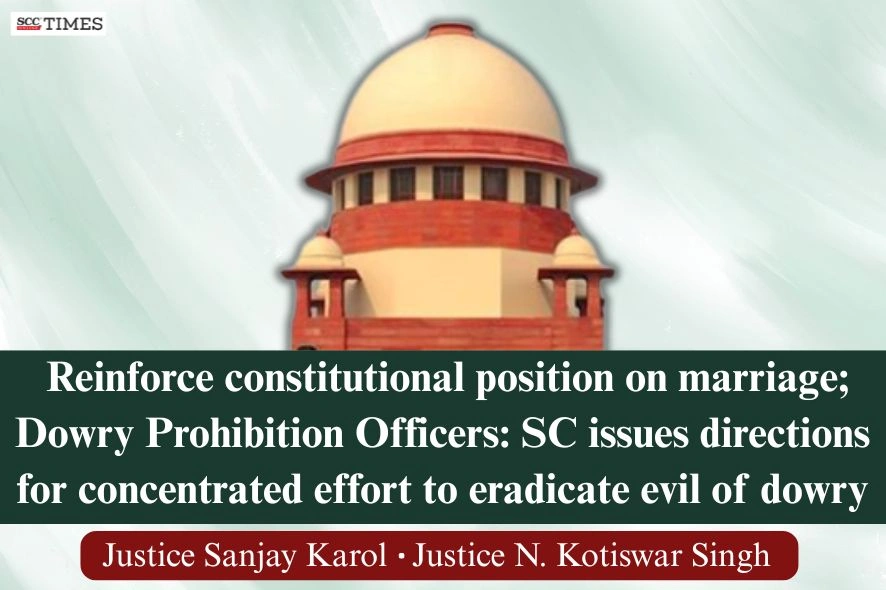
Supreme Court: While considering this challenge to the judgment of the Allahabad High Court acquitting the respondents for offences under Sections 498-A and 304-B, Penal Code, 1860 and Sections 3/4 of the Dowry Prohibition Act, 1961, the Division Bench of Sanjay Karol* and N. Kotiswar Singh, JJ., noted the rampant prevailing menace of dowry, ineffectiveness of the relevant laws and the misuse of Section 498-A and Dowry Prohibition Act and stated that, “This oscillation between ineffectiveness and misuse creates a judicial tension which needs urgent resolution”. Therefore, in order to bring about a concentrated effort to eradicate the evil of dowry on part of all the involved parties- Legislature, law enforcement, Judiciary, civil society organizations etc., the Court deemed it appropriate to issue the following directions:
-
States and even the Union Government to consider changes as are necessary to the educational curricula across levels, reinforcing the constitutional position that parties to a marriage are equal to one another and one is not subservient to the other as is sought to be established by giving and taking of money and or articles at the time of marriage. “To ensure that the change brought in is able to make an impact on the efforts to eradicate this evil, it is to be ensured that the future generation, youngsters of today, are informed and made aware about this evil practice and the necessity to eschew it”.
-
Taking note that the law provides for the appointment of Dowry Prohibition Officers in States. The Court directed that it is to be ensured that these officers are duly deputed, aware of their responsibilities and given the necessary wherewithal to carry out the duties entrusted to them. The contact details (name, official phone number and email ID) of such an officer designated to this position are disseminated adequately by the local authorities ensuring awareness of citizens of the area.
-
The police officials, as well as judicial officers dealing with such cases, should periodically be given training, equipping them to fully appreciate the social and psychological implications which are often at the forefront of these cases. This would also ensure a sensitivity of the concerned officials towards genuine cases versus those which are frivolous and abusive of the process of law.
-
The Court requested the High Courts to ascertain the number of pending cases dealing with Section 304-B, 498-A from the earliest to the latest for expeditious disposal
-
Recognizing that many people today are/have been outside the education fold, and that it is equally, if not more so, important to reach them and make accessible and comprehensible, the relevant information regarding the act of giving or taking of dowry as also other acts sometimes associated therewith, other times independent thereof (mental and physical cruelty) is an offence in law. The Court requested the District Administration along with the District Legal Services Authorities to conduct workshops/awareness programs at regular intervals, by engaging and involving civil society groups and dedicated social activists. “This is to ensure change at the grassroot level”.
Background:
The case began with the painful demise of a 20-year-old girl because her parents did not have the material means and resources to satisfy the wants of the husband’s family which included a coloured television, a motorcycle and Rs. 15,000. The deceased girl was burnt to death in 2001. This led to the registration of FIR.
The Trial Court examined 8 witnesses on behalf of the prosecution. The defense led no evidence other than deposing in statements under Section 313 Code of Criminal Procedure 1973 alleging false implication. The Trial Court found the Respondents (A and J) guilty, and they were sentenced to life imprisonment under Section 304-B, 3 years’ imprisonment under Section 498-A and 2 years’ imprisonment under Dowry Prohibition Act.
However, when the matter reached the High Court, the respondents were acquitted. Aggrieved with this decision, the State appealed before the Supreme Court via the present appeal.
Court’s Assessment:
Perusing the appeal, the Court began its assessment by underscoring that how dowry is a cross-cultural evil. The Court pointed out that this case represents, however, dowry is not a feature only amongst the Hindus, but it can also be found in other communities professing different faiths and religions. The Court noted that historically, dowry was most closely associated with Hindu caste society, but over a time it diffused into Muslim practices through processes of cultural assimilation, social emulation, and inter-community influence. The Court stated that as a result, mehr and dowry have come to coexist in complex ways. In many Muslim marriages in India, mehr continues to be stipulated, but often only in nominal terms. The real financial transfers flow from the bride’s family to the groom, effectively hollowing out the protective function of mehr. “This undermines the original Islamic intention of empowering women through property ownership, as the dowry frequently ends up under the control of the husband or his family”.
“Where dowry replaces or overshadows mehr, women lose an important bargaining tool and face greater economic vulnerability”.
The Court further noted that although the laws such as Dowry Prohibition Act and the relevant IPC provisions sought to prohibit the practice; dowry has persisted in society, slipping through the statutory definition, cloaked as “gifts” and social expectations. This practice is, at the most basic level, at odds with the values enshrined in the Constitution, i.e., the constitutional ethos of justice, liberty, and fraternity, and more particularly, Article 14, which guarantees equality before the law and equal protection of the laws, a principle directly undermined by a system that treats women as a source of financial extraction and reinforces structural discrimination.
“Eliminating dowry is not only a matter of enforcing the DPA 1961 but a constitutional imperative. It fulfils the Republic’s promise that every woman should enter marriage as an equal citizen and not as the bearer of an unjust financial burden”.
Coming onto adjudicating the appeal, the Court took note of the relevant IPC provisions and relevant precedents. The Court perused the witness statements made before the Trial Court and High Court and noted several inconsistencies. The Court thus had to consider the effect of effect of certain omissions or inconsistencies in the testimonies of witnesses.
The Court explained that the demand for dowry, and in particular, a motorcycle, a colour TV and Rs.15,000/- in cash, have been established beyond reasonable doubt. The said demand had been reiterated just a day prior to the deceased passing away. The Court noted that the presumption under Section 113-B of the Evidence Act, 1872 came into effect as soon as it stood proved that the deceased had been subjected to cruelty soon before her death, and went unrebutted by the defence, since no evidence was led by them.
The Court noted that there was certain discrepancy regarding PW-2 being the eyewitness to the incident, however, it was also noted that PW-2’s statement could not be shaken by cross-examination. The Court further noted that when the harassment for dowry is proved and so is the fact that such harassment was made soon before victim’s death, then a mere statement of one of the witnesses that she was apparently happy, would not save the Respondents from guilt.
The Court also observed that while reversing the findings of facts returned by the Trial Court, the High Court did not assign any reasons explicitly holding such findings to be erroneous/perverse or illegal.
Conclusion and Decision:
With the afore-stated assessment, the Court stated that the State’s appeals should be allowed and the High Court has erred in setting aside the judgment of conviction returned by the Additional District Judge, Bijnor, and acquitting the Respondents.
Therefore, the Court restored the Trial Court’s judgment insofar as it relates to the conviction of both the Respondents as also the quantum of sentence in respect of Respondent A was concerned. However, the Court noted that Respondent J was 94 years old and thus the Court refrained from incarcerating J, however, her conviction was restored.
[State of UP v. Ajmal Beg, 2025 SCC OnLine SC 2801, decided on 15-12-2025]
*Judgment by Justice Sanjay Karol
Advocates who appeared in this case:
For Appellant(s): Mr. Abhishek Saket, Adv. Mr. Sudeep Kumar, AOR Ms. Amruta Padhi, Adv. Ms. Chanchal Sharma, Adv. Ms. Manisha, Adv. Ms. Rupali, Adv.
For Respondent(s): Ms. Sadhna Sandhu, AOR Mr. Shekhar Kumar, AOR Mr. Bhanu Pratap Gupta, Adv. Ms. Shikha Sandhu, Adv. Ms. Rita Gupta, Adv. Mr. Nikhil Kumar Sharma, Adv.
Mr. Shantanu Krishna, AOR (A.C.)
Buy Penal Code, 1860 HERE
Need of the hour, considering the trauma through which the family of bridesuffer due to dowry n also the social stigma for not giving handsome gifts is an irony in the present days society specially amongst educated ones.. An over all endeavor is necessary in all spgeres of Societies to create awareness.