Disclaimer: This has been reported after the availability of the order of the Court and not on media reports so as to give an accurate report to our readers.
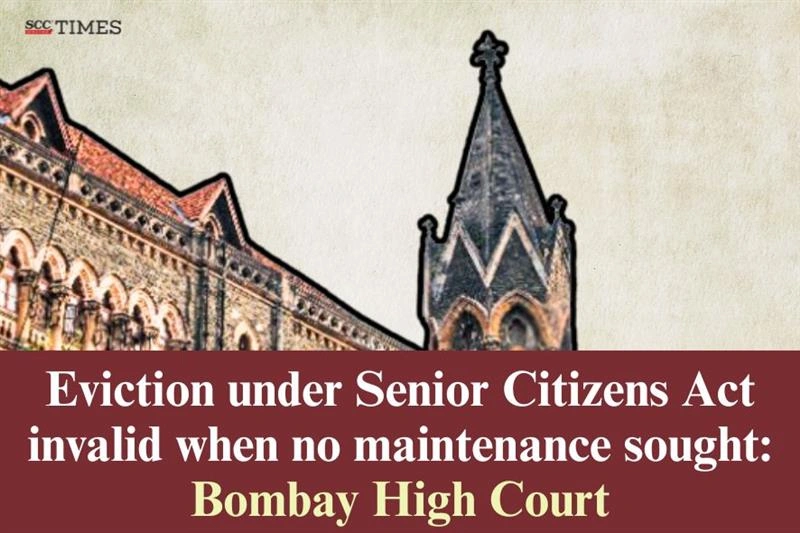
Bombay High Court: In a writ petition challenging Parents and Senior Citizens Tribunal’s eviction order dated 26-08-2025 and the appellate order dated 01-10-2025 affirming the eviction, under the Maintenance and Welfare of Parents and Senior Citizens Act, 2007 (the Act), a Division Bench of R.I. Chagla and Farhan P. Dubash,* JJ., quashed eviction ordered under the Act and held that eviction cannot be granted when no claim for maintenance is made and that the Act cannot be used as a tool for summary eviction in property disputes.
“The Act is a beneficial statute intended to safeguard the vulnerable (senior citizen), but it cannot be (mis) used by the senior citizen as a tool for summary eviction without the fulfilment of statutory requirements.”
Factual Matrix
In the instant matter, the petitioner resided in Bungalow which belonged to his father, Respondent 2, a 75-year-old retired IAS officer. The father filed an application under Section 5 of the Act, seeking eviction of the petitioner and alleging mental harassment.
The father admitted that he never resided in the subject premises and instead lived in 4-BHK flat with his wife. The father did not seek any maintenance, financial assistance, or monthly allowance from the petitioner. The Parents and Citizens Maintenance Tribunal (Tribunal) itself recorded that “the senior citizen has not made any claim or demand for maintenance.”
A written declaration dated 02-01-2013 was executed by the father allowing the petitioner and his wife to reside in the premises and conduct business “for as long as they want and without having to pay any monies.”
The petitioner had already filed Suit seeking partition of nine immovable properties claimed to be part of the Hindu undivided family (HUF). The senior citizen, in that suit, made a statement that he would not alienate property pending the suit. The father was financially well-to-do and owned several properties; the petitioner was unemployed and had no other residence.
Despite these facts, the Sub-Divisional Officer precising the Tribunal, vide order dated 26-08-2025, ordered eviction and held that due to arthritis, diabetes, and frequent medical travel of the father, “it would be proper that the petitioner be evicted.” The Appellate Authority upheld the impugned order vide order dated 01-10-2025.
Moot Point
Whether an eviction order can be passed under the Act without any claim towards maintenance being made by the senior citizen?
Court’s Analysis
Application under Section 5 was not maintainable
The Court emphasised that Sections 4 and 5 of the Act requires that the senior citizen be unable to maintain himself and make a claim for maintenance.
The Court recorded that the senior citizen never sought maintenance, a fact expressly mentioned in the eviction order itself. Moreover, the father did not alleged neglect under Section 9 and was financially well-off and lived separately.
The Court further noted that there was no pleading that his existing residence was unsuitable. The only assertion made was that it would be “convenient” for him to stay on the ground floor of the bungalow in view of health concerns and the Court found this “a vague assertion… completely bereft of any details and particulars.” The Court noted that the authorities nonetheless proceeded to evict the petitioner. The Court questioned the very maintainability of such an application under Section 5 and observed that
“We fail to see how the said application… is maintainable, in the first place.”
Relying on S. Vanitha v. Deputy Commissioner, Bangalore Urban District, AIR 2021 SC 177, the Court held that eviction can only be granted as an incident of maintenance, not in isolation. The Court asserted that when the Tribunal had expressly said maintenance was not sought, then eviction alone could not stand.
The Court took note of written declaration dated 02-01-2013, and stated that the same was a crucial document contradicting the senior citizen’s plea. The Court further noted that the correspondence written by the senior citizen to public authorities revealed that the petitioner was paying all expenses relating to the property, contradicting the senior citizen’s pleadings.
The Court asserted that the eviction petition seems to be an attempt to use the Act as a counter-blast to property litigation, The Court held that “this fact is clearly borne out… that the said application is nothing but a counter blast” to the partition suit. The Court emphasised that the Act is a beneficial legislation, intended to safeguard senior citizens, not a mechanism to settle property disputes or secure summary eviction while proprietary rights are sub-judice before a civil court.
“…the Act cannot be employed as a means to secure the Respondent’s summary eviction… while proprietary rights are sub-judice.”
The Court further noted that no allegations of cruelty, harassment, or neglect were made by the senior citizen and the complaint only suggested “mental pressure” due to litigation filed by the son, The Court opined that the same did not satisfy the statutory thresholds of Section 9 of the Act.
The Court held that the Tribunal and Appellate Tribunal failed to record any finding of neglect, which is a mandatory requirement for invoking the act for eviction. The Court held that the entire approach of the Tribunal and Appellate Tribunal was contrary to the scheme of the Act, resulting in orders unsustainable in law.
The Court also observed that the petitioner had no other place to reside, whereas the senior citizen possessed multiple properties and enjoyed financial stability and stated that the authorities failed to weigh competing equities.
The Court quashed and set aside both the eviction order and the appellate order.
[Jitendra Gorakh Megh v. Additional Collector, 2025 SCC OnLine Bom 4956, Decided on 08-12-2025]
*Judgment by Justice Farhan P. Dubash
Advocates who appeared in this case:
Mr. Suraj Gupte, AGP, Counsel for the Respondent 1
Mr. Kapil Moye a/w. Ms. Eesha Jaifalkar i/b. Mr. S.R. Page, Counsel for the Respondent No. 2