
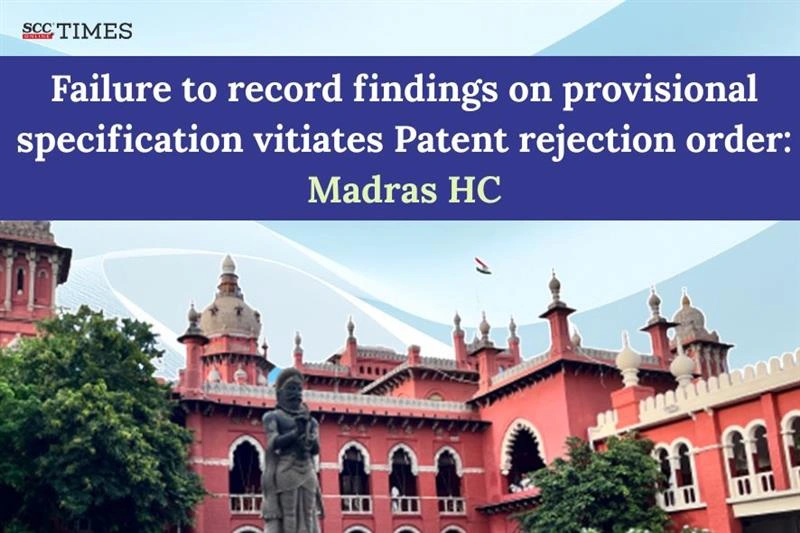
Madras High Court: While considering an application filed in 2014 seeking patent protection for a herbicidal emulsifiable concentrate (‘EC’) combining pendimethalin and metribuzin, a Single Judge Bench of Senthilkumar Ramamoorthy, J., held that the rejection order was vitiated as it failed to record findings on significant objections. The Court observed that the provisional specification disclosed only a suspo-emulsion (‘SE’) formulation and even asserted that SE was superior to EC and emphasised that later claims referring to EC formulations were not fairly based on the provisional specification. Noting further that several prior art documents and affidavits were ignored, the Court set aside the order and directed that the matter be reconsidered by a different officer through a speaking order within four months.
Background:
In 2014, an application was filed for a herbicidal composition in the form of an EC that combined pendimethalin and metribuzin. After examination, objections were raised that the invention lacked novelty, inventive step, and was not patentable under the Patents Act, 1970 (‘Patents Act’). During the process, oppositions were also filed challenging the claims.
The objections mainly pointed out that similar combinations of pendimethalin and metribuzin had already been disclosed in earlier documents, and that the ranges of concentration claimed in the application overlapped with those in the prior art. It was argued that the claimed invention did not establish synergistic or surprising effect from the ingredients of the composition and, therefore, was not patentable under Section 3(e) of the Patents Act.
In response, the applicant amended the claims and specifications, stating that the earlier documents referred only to a SE formulation and not to an EC formulation. It was also asserted that the claimed invention used different excipients and that EC formulations could not contain insoluble particles. Supporting affidavits were filed to demonstrate these differences. Despite this, the objections continued to maintain that the invention was anticipated by earlier disclosures and did not involve an inventive step.
Analysis and Decision:
The Court emphasised that the principal ground of rejection was anticipation and obviousness in view of the prior art. The Court noted that the applicant had raised a preliminary objection that the provisional specification disclosed only a SE formulation and not an EC formulation.
The Court observed that Section 11(2) of the Patents Act requires that a claim be “fairly based” on the matter disclosed in the provisional specification to reckon priority. The Court highlighted that the provisional specification described only SE and even asserted that SE was superior to EC. The Court further highlighted that later claims referred to EC formulations, but this was not fairly based on the provisional specification.
The Court noted that the order under challenge failed to record any finding on this objection, despite its significance. The Court further observed that the order discussed only a limited set of prior art documents, while ignoring several others and affidavits placed on record. The Court held that the failure to consider these objections and documents vitiated the order.
The Court therefore set aside the order and remanded the matter for reconsideration by a different officer, directing that a speaking order be issued within four months.
[Rallis India Ltd. v. Controller of Patents and Designs, 2025 SCC OnLine Mad 11657, decided on 20-11-2025]
Advocates who appeared in this case:
For the Appellant: Adarsh Ramanujan representing Khurana & Khurana, Tarun Khurana, Tapan Shah, P. Subburaj
For the Respondent: A.R. Sakthivel SPCGSC, Shravan Kumar Bansal, Somnath De, Bhavik Patel assisted by Heena Patel