
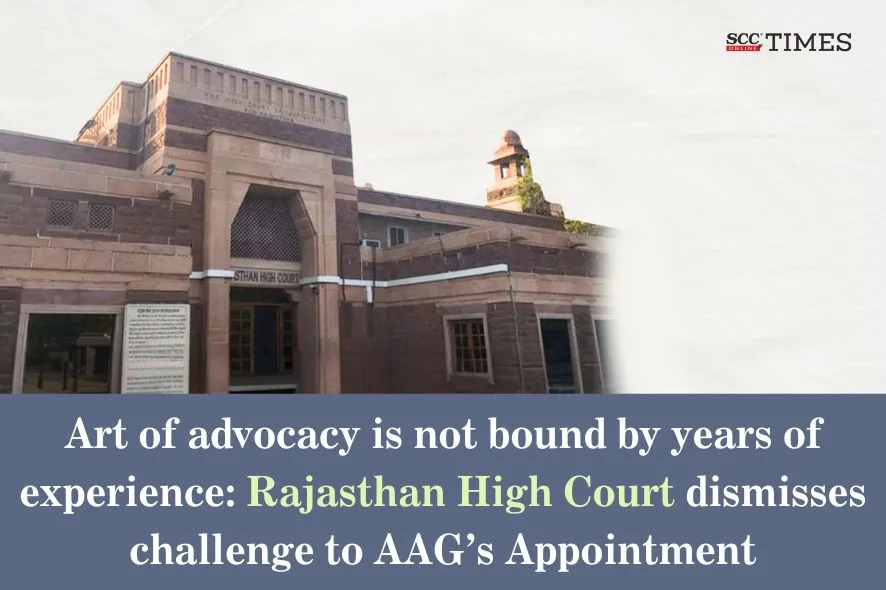
Rajasthan High Court: In a special appeal filed by a practicing advocate challenging the order passed by the Single Judge who dismissed his writ petition challenging minimum requisite experience of practice that Respondent 2 possessed upon his appointment as Additional Advocate General (‘AAG’), the Division Bench of Sanjeev Prakash Sharma* Acting CJ. and Baljinder Singh Sandhu, J., held that the art of presentation of a case and the art of advocacy is not bound by years of experience.
The Court stated that there should not be any hard and fast rule laid down for appointing any persons such as Advocate General (‘AG’), AAG, or any other government lawyer with a different nomenclature, and it is best left for the litigant to decide. Thus, dismissed the appeal at hand.
Background
In the present case, the appellant had filed a writ petition stating that Respondent 2 did not possess the minimum requisite experience of practice of ten years as an Advocate for being appointed as an AAG based on the State Litigation Policy, 2018. He further challenged Clause 14.8 of the Litigation Policy, by terming it arbitrary, illegal, and invalid.
Thereafter, the Single Judge held that the post of the AAG was not a public office, and regarding Clause 14.8, he stated that inference could not be drawn of arbitrariness or of colorable exercise of power by the State. Aggrieved, the appellant approached the High Court.
Analysis and Decision
The Court noted that any person could file a petition seeking a writ of quo warranto against any person who held a public post. Further, the Court stated that the post of AG, having been construed from Article 165 of the Constitution, fell in the category of a public post, and he would be categorized as holding a public office as he possesses administrative powers.
However, the posts of AAG and the Government Counsels do not fall in the same category. They are lawyers appointed to assist the office of the AG and in Rajasthan, these posts are categorized under different nomenclatures such as Government Counsel, Government Advocate, Additional AG, Assistant to Additional AG, Additional Government Counsel, Deputy Government Counsel, Additional Government Advocate, Deputy Government Advocate, and Assistant Government Advocate. Further, in the District Courts, Public Prosecutor (‘PP’) and Additional Public Prosecutor (‘APP’) are appointed under the Rules framed under the Proviso to Article 309 of the Constitution relating to Special Public Prosecutor Rules. Such persons appointed through the State machinery are governed by the State Service Rules. In addition, the State Government also appoints Special Public Prosecutor and Special Government Advocates who are assigned specific work for appearance in Courts in relation to a particular department or a particular case. Thus, such appointments could be case or department centric.
In the High Court, there are lawyers specifically appointed for dealing with criminal cases, and for them, approval, under Section 18 of the Bharatiya Nagarik Suraksha Sanhita, 2023 (‘BNSS’), from the High Court is required. Another set of lawyers is appointed by the State Government to deal with different kinds of cases. AAG are assigned different departments for whom they appear in the Court, and their departments are changed from time to time as per the directions of the State Government. Their tenure is not fixed, and therefore, they cannot be said to be responsible for any Government action, and their arguments depend entirely on the brief provided to them.
The Court specified that not every kind of policy wielded statutory force and thus stated that policy was a guideline which advised how the State as a litigant should function. Further, the Court noted that even the circulars issued prior to the State Litigation Policy had been allowed to continue. Thus, the framers nowhere intended for it to become a hard and fast rule. If the State wanted to make a rule, it could always make a rule in terms of Proviso to Article 209 of the Constitution which would have resulted in creation of posts.
Regarding amendments in Clause 14.8, the Court stated that it should be treated as statutory amendment and would, therefore, be amenable to writ jurisdiction as it had acquired enforceable status. The notification regarding the same as issued by the State Government in the Gazette was not an amendment in the Rule and was only to notify the new clause which was added to the litigation policy. Such notification did not, therefore, come within the four corners of an amendment in the Rule. Further, the Court noted that the petitioner himself accepted the notification to be not an amendment in the Rule and therefore, challenged the same before the Single Judge instead of challenging the vires before the Court, which would have come before the Division Bench. Thus, the Court estopped him as the same would make the litigation policy come within the Rules.
The Court held that the State Litigation Policy, 2018, was not enforceable in law and the writ of quo warranto would not lie, thus, the Court would not examine the eligibility and qualifications of Respondent 2 for being appointed as an AAG of the State to argue cases in Supreme Court. It is otherwise also not for this Court to examine whom the State Government considers proper to be an expert, in their opinion, for arguing their cases and presenting them before the Court.
The Court stated that “The art of presentation of a case and the art of advocacy is not bound by years of experience”. Years of experience would have its own importance for assessing the knowledge of an individual, however, for the purpose of litigation, a person who may be having vast knowledge, like a professor of law, might not be suitable to argue cases in the Court. Therefore, the Court opined that there should not be any hard and fast rule laid down for appointing any persons such as AG, AAG, or any other government lawyer with a different nomenclature, and it is best left for the litigant to decide. A writ of quo warranto would, therefore, not lie.
The Court upheld the reasoning of Single Judge held that the nomination of Respondent 2 as AAG for the Supreme Court by the State Government, in terms of the State Litigation Policy and departing from the general rules, could not be said to be illegal, arbitrary, unjustified, or whimsical in any manner. A writ of quo warranto filed by the appellant based on an unenforceable State Litigation Policy which does not have any statutory character, was therefore rightly dismissed by the learned Single Judge. Thus, the Court dismissed the present appeal.
[Sunil Samdaria v. State of Rajasthan, 2025 SCC OnLine Raj 6122, decided on 2-12-2025]
*Judgement authored by Acting Chief Justice Sanjeev Prakash Sharma
Advocates who appeared in this case:
For the Appellant: Sunil Samdaria, Advocate
For the Respondent: Vigyan Shah, AAG, Priyam Agarwal, Rohit Tiwari, AGC, Ritika Naruka, Tanvisha Pant, Vivek, Kshitij Jain, Gagan Gupta, Sr. Adv. and Shashwat Purohit
Buy Constitution of India HERE