
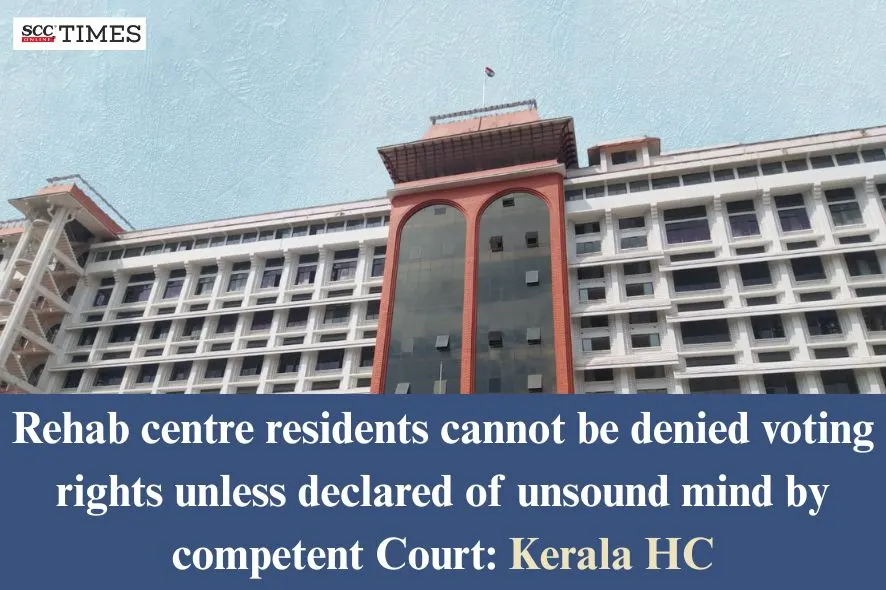
Kerala High Court: In a case raising a question whether the votes of people residing in a rehabilitation centre for persons with mental challenges should be classified as challenged votes and be recorded on a separate electronic voting machine, a Single Judge Bench of P. V. Kunhikrishnan, J., dismissed the writ petition at the admission stage, holding that the alleged voters were not impleaded as parties and further that without any documentary evidence or declaration by a competent court, such voters could not be presumed to be of unsound mind.
Background:
The petitioners, the permanent residents of Ward 7 of Pala Municipality, challenged the inclusion of approximately 60 voters, identified as residents of ‘Mariya Sadhanam Rehabilitation Centre’, for persons with mental challenges, in the draft voter’s list. The petitioners contended that voters listed from Serial Nos. 349 to 358 and 360 to 407 were mentally challenged persons who could not cast their votes according to their will, and hence, they approached the Election Registration Officer preparing the final voters’ list, to remove these persons from the list. After enquiry, the officer only deleted Voter No. 349 because he was no more. The petitioners contended that the said voters were not the permanent residents of the building but were only living there for the treatment.
The petitioners also approached the District Collector, Kottayam, and the Joint Director, Rural Development Department, for the removal of their names, but received no response. They prayed that a direction must be issued that the votes of those voters must be kept separately and classified as challenged votes, and that these should be recorded on a separate electronic voting machine.
Analysis and Decision:
The Court opined that persons with mental illness or intellectual disabilities are also citizens of this country. Even though the said voters were staying in a rehabilitation centre for mentally challenged persons, it could not be presumed that they were mentally challenged persons or were suffering from mental illness, as it would be an insult to them if the Court proceeded like that, especially when they were not made a party. The Court further opined that even if it was assumed that they have some mental ailments, that alone would not disqualify them for registration in an electoral roll.
The Court noted that Section 74(1)(b) of the Kerala Municipality Act, 1994 (‘1994 Act’), clearly provides that a person shall be disqualified for registration in an electoral roll if he is of unsound mind and stands so declared by a competent Court, but no such declaration by a competent Court existed in this case.
The Court clarified that the Mental Health Care Act, 2017 (‘2017 Act’) itself states how to determine the mental illness and there is a legal presumption that every person, including a person with mental illness, shall be deemed to have the capacity to make decisions regarding their mental health care or treatment, if such person has the abilities mentioned in sub clauses (a) to (c) of Section
The Court emphasised that in a democratic process, it is necessary that ineligible persons are not included in the electoral roll, but that does not mean that anyone can declare a person to be of unsound mind and approach the Court with a prayer to exclude them from the regular voters and to place them in a separate class, allowing them to vote on a separate electronic voting machine.
The Court dismissed the writ petition in limine, with heavy costs, as the alleged mentally ill persons were not made parties to the proceedings, either personally or through a fit person, nor were the authorities of the rehabilitation centre itself impleaded. Further, the Court observed that mental illness is not a sin and can happen to anyone, and traits such as arrogance, jealousy, deriving pleasure from other’s misfortune or cruelty are more dangerous than the mental illness defined under the 2017 Act. The Court urged the petitioners and the society to hold such persons close to their heart, to motivate and support them rather than deny them their valuable right to vote.
[Jomon Jacob v. State Election Commission, 2025 SCC OnLine Ker 12458, decided on 13-11-2025]
Advocates who appeared in this case:
For the Petitioners: Joseph T. John, Advocates.
For the Respondents: Deepu Lal Mohan, SC, Deepa K R, Spl. G.P.