
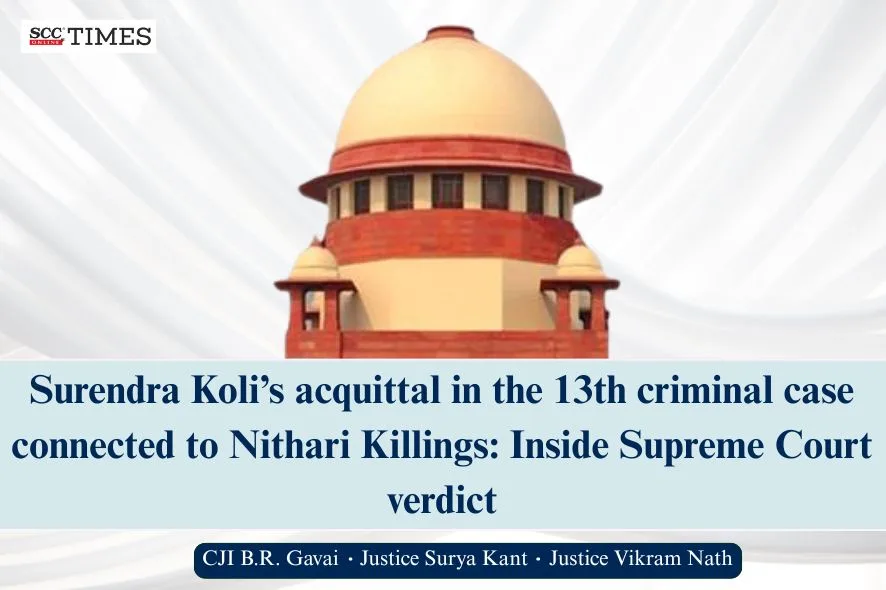
Supreme Court: While considering this petition filed by Surendra Koli, whose conviction in Rimpa Haldar case was affirmed by the Supreme Court whilst his acquittal in 12 companion prosecutions connected to Nithari Killings was upheld; the 3-Judge Bench of B.R. Gavai, CJI, Surya Kant and Vikram Nath*, JJ., allowed the curative petition and acquitted Surendra Koli of the charges under Sections 302, 364, 376 and 201 of the Penal Code, 1860 (IPC), thereby allowing him to go free in the 13th criminal case related to the horrific Nithari Killings.
The Court stated that to allow a conviction to stand on evidentiary basis that Supreme Court itself has since rejected as involuntary or inadmissible in the very same factual matrix, offends Article 21 of the Constitution. It also violates Article 14 of the Constitution, since like cases must be treated alike. Arbitrary disparity in outcomes on an identical record is inimical to equality before the law. “The curative jurisdiction exists to prevent precisely such anomalies from hardening into precedent”.
Background and Legal Trajectory:
Surendra Koli (petitioner) was employed as a domestic help at House D5, Sector 31, Noida. The house was owned and occupied by Koli’s employer Moninder Singh Pandher. From early 2005 residents of Nithari began reporting that women and children were missing. In March 2005, children in the neighbourhood playing cricket noticed a human hand in the narrow open strip between Houses D5 and D6 and the Jal Board residential quarters. Drain cleaning on the main road in front of the row of bungalows D1 to D6, revealed several more human remains.
On 29-12-2006, the local police took the petitioner into custody concerning the disappearance of one of the victims. On the same day Pandher was detained outside D5. Digging of the open strip between D5, D6 and the Jal Board compound led to recovery of multiple skulls and bones with footwear and clothes; furthermore, a knife was recovered from beneath the terrace water tank of D5. On 31-12-2006 further human remains and articles were taken out from the covered storm water drain in front of Houses D1 to D6. Multiple FIRs were registered for different missing persons.
In 2007, the State transferred investigation to the Central Bureau of Investigation under the Delhi Special Police Establishment Act, 1946. Teams from the All-India Institute of Medical Sciences and the Central Forensic Science Laboratory assisted the CBI in searches at and around D5 through mid-January 2007.
Nithari Killings eventually led to the initiation of 13 trials based on common evidentiary foundation that comprised the alleged disclosure leading to recoveries and the confessional statement under Section 164 of the Code of Criminal Procedure, 1973 (CrPC).
In Rimpa Haldar case, the petitioner’s conviction and death sentence was affirmed by the Supreme Court in Surendra Koli v. State of U.P., (2011) 4 SCC 80, and dismissed the review petition in 2014. On 28-01-2015, the High Court commuted the death sentence to imprisonment for life. However, the petitioner was acquitted by the High Court in 12 companion prosecutions on 16-10-2023, and on 30-07-2025 and the Supreme Court dismissed the State appeals and affirmed those acquittals.
Petitioner’s Assertion:
Therefore, the petitioner preferred the present curative petition which concerns the verdict in Rimpa Haldar case. The petitioner asserted that two sets of outcomes resting on the same evidentiary foundation cannot lawfully coexist. Such inconsistency engages the guarantees of equality and due process under Article 14 and Article 21 of the Constitution and warrants consideration ex debito justitiae.
Issue Framed:
Whether two sets of outcomes of Supreme Court can stand together when they rest on an identical evidentiary foundation?
Court’s Assessment:
Perusing the case, the Court firstly reiterated the rationale behind the exercise of curative jurisdiction as espoused in Rupa Ashok Hurra v. Ashok Hurra, (2002) 4 SCC 388. “The guiding principle for the exercise of curative jurisdiction is the duty of this Court to avert manifest injustice”. The Court thereafter took note of the petitioner’s plea and observed that petition carries the averments and certification required by Order XLVIII of the Supreme Court Rules, 2013 and has been placed in accordance with the prescribed procedure. Therefore, the Court was satisfied that the threshold for invoking the curative jurisdiction was met and proceeded to examine the merits.
Perusing the issue framed, the Court noted that the first decision in Surendra Koli v. State of U.P., (2011) 4 SCC 80 affirmed the petitioner’s conviction and death sentence on the strength of a Section 164 CrPC confession and supposed discoveries under Section 27 of the Evidence Act; and secondly there is the order of July 2025, which dismissed the State’s appeals challenging petitioner’s acquittal in 12 related cases where the very same confession and the very same class of Section 27 material were rejected as legally unreliable. “The tension is not peripheral. It goes to the integrity of adjudication. In such a situation, the curative jurisdiction recognised in Rupa Ashok Hurra (Supra) is rightly invoked”. The Court pointed out that the object is not to reopen evidence as in a second appeal. The object is to cure a manifest miscarriage of justice where inconsistent results persist on the same foundation and undermine public confidence in the administration of justice.
Therefore, the Court began testing the petitioner’s conviction against the legal defects that led the High Court, and thereafter Supreme Court, to discard the common evidentiary pillars in 12 companion matters. The Court noted that the defects were structural infirmities inherent in the mode of proof relied upon across the Nithari prosecutions. It was observed that petitioner’s Section 164 CrPC statement was recorded after about 60 days of uninterrupted police custody without meaningful legal aid. The recording Magistrate did not record the clear, unqualified satisfaction that the statute demands. The Investigating Officer’s proximity to the recording process compromised the environment of voluntariness. The text of the statement itself repeatedly adverted to tutoring and to prior coercion. The confession that anchored the conviction was found to be legally tainted.
Thereafter, the Court tested the conviction against the alleged discoveries and recoveries under Section 27 of the Evidence Act. It was pointed out that High Court found that no contemporaneous disclosure memo was proved. The narrative in the later-prepared seizure memorandum conflicted with the remand papers, which recorded a joint disclosure by both accused. The evidence also showed that the police and members of the public already knew that bones and articles lay in the open strip and that excavation had begun before the petitioner arrived. These features negated the essential element of discovery by the accused and reduced the exercise to a seizure from an already known place. These findings were upheld when the State’s appeals were dismissed in July 2025. It was noted that the present conviction rested on the same recovery architecture. Once the disclosure is not contemporaneously proved, once prior knowledge is established, and once contradictions infect the record, Section 27 of the Evidence Act ceases to operate. The legal conclusion cannot change from case to case when the premise is identical. Thus, the supposed discoveries did not satisfy the statutory preconditions for admissibility.
Furthermore, extensive searches of D-5 by expert teams did not yield human bloodstains, remains, or transfer patterns consistent with multiple homicides and dismemberment inside the house. DNA work undertaken by the Centre for DNA Fingerprinting and Diagnostics in Hyderabad linked certain remains to families of missing persons, and this aided only with the identification and did not prove authorship of homicide by the petitioner within D-5. It was observed that no credible chain of custody or expert testimony establishing that a domestic help with no medical training could perform the precise dismemberment as was described in the forensics. These gaps were central to the acquittals in the 12 cases and the Court noted that they are equally present in the Rimpa Haldar case.
“High Court’s critique of the investigation was not rhetorical excess. It was anchored in record-based deficiencies that bear directly on fairness and reliability (…) The same infirmities, viewed through the lens of the present record, cannot yield a different legal conclusion”.
Therefore, the Court held that the petitioner has established a fundamental defect that impeached the integrity of the adjudicatory process and that relief is warranted ex debito justitiae within the parameters of Rupa Ashok Hurra (Supra).
The Court acknowledged of the gravity of Nithari Killings and the trauma that was caused to the victims’ families. “It is a matter of deep regret that despite prolonged investigation, the identity of the actual perpetrator has not been established in a manner that meets the legal standards”. The Court remarked that it was genuinely unfortunate that in the present matter negligence and delay corroded the fact-finding process and foreclosed avenues that might have identified the true offender. “Each lapse weakened the provenance and reliability of the evidence and narrowed the path to the truth”.
Decision:
Therefore, the Court deemed it appropriate to recall and set aside its decision in Surendra Koli v. State of U.P., (2011) 4 SCC 80 and acquitted the petitioner of all charges in the 13th prosecution case. It was directed that the petitioner shall be released forthwith, if not required in any other case or proceeding. The Registry shall communicate this judgment forthwith to the Superintendent of the jail concerned and to the Trial Court for immediate compliance.
[Surendra Koli v. State of Uttar Pradesh, 2025 SCC OnLine SC 2384, decided on 11-11-2025]
*Judgment by Justice Vikram Nath
Advocates who appeared in this case :
For Petitioner(s): Mr. Yug Mohit Chaudhary, Adv. Ms. Payoshi Roy, Adv. Mr. Siddhartha Sharma, Adv. Mr. Prabhu Ramasubramaniam, Adv. Mr. N. Sai Vinod, AOR Mr. Bharatimohan M, Adv. Ms. Kanu Garg, Adv.
For Respondent(s): Mr. Raja Thakare, A.S.G. Mr. Nachiketa Joshi, Sr. Adv. Mr. Mukesh Kumar Maroria, AOR Mr. K. Parameshwar, Adv. Mr. Praneet Pranav, Adv. Mr. Rajendra Singh Rana, Adv. Ms. Vaishali Verma, Adv. Mr. Rohit Khare, Adv. Ms. Astha Singh, Adv. Mr. Rishikesh Haridas, Adv. Mr. Kritagya Kumar Kait, Adv.
Buy Code of Criminal Procedure, 1973 HERE
Buy Penal Code, 1860 HERE