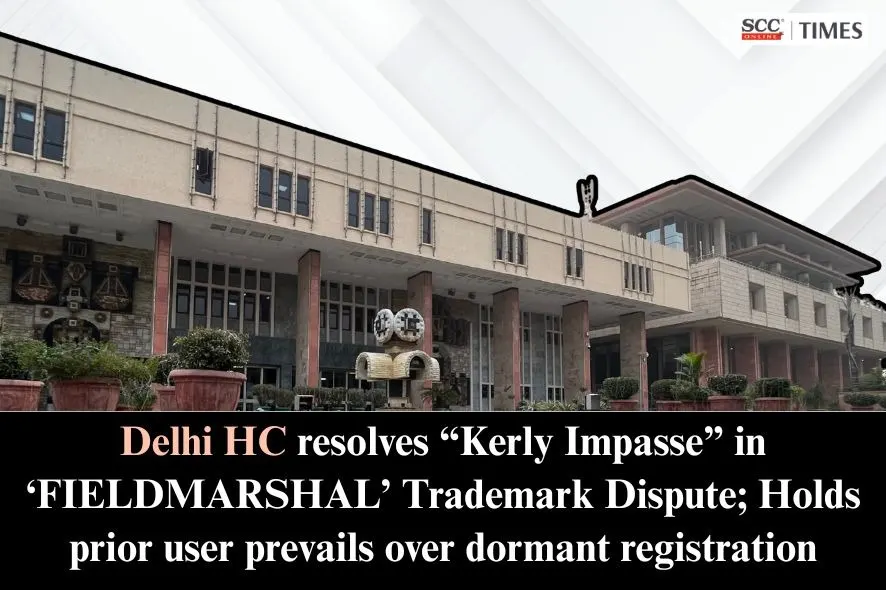
Delhi High Court: While hearing a batch of intra-court appeals and connected commercial matters arising from long-standing trademark disputes regarding competing claims of statutory trademark rights and common-law goodwill in respect of the mark FIELDMARSHAL, the Division Bench of *C. Hari Shankar, J and Om Prakash Shukla, J, held that the mere fact of registration cannot defeat an action for passing off. The Court stated that an injunction may be issued against the registered proprietor where the plaintiff establishes prior goodwill through sustained and uninterrupted use.
Background
Jain Industries was the original registered proprietor of the mark ‘FIELD MARSHAL’ in Class 7 in respect of centrifugal pumps, with registration dating back to 1965. However, it was undisputed that Jain Industries never commercially used the mark for centrifugal pumps or any allied goods at any point in time.
PM Diesels Pvt. Ltd. (‘PMD’), on the other hand, had commenced the use of the mark ‘FIELDMARSHAL’ in relation to diesel engines as early as the 1960s. Over time, PM Diesels had expanded the use of the mark to centrifugal pumps, starting from the mid-1970s. The mark came to be extensively used, advertised and commercially exploited by PM Diesels, resulting in significant goodwill and market recognition, particularly in rural and semi-urban markets.
In 1986, Jain Industries had assigned its registered trademark ‘FIELD MARSHAL’ to Thukral Mechanical Works. Following the assignment, Thukral Mechanical Works had begun the commercial use of the mark in relation to centrifugal pumps in or around 1988. This had led to multiple rounds of litigation between the parties, including suits for infringement and passing off, rectification proceedings seeking removal of the registration on the ground of non-use, and writ petitions challenging decisions of trademark authorities.
Earlier proceedings had culminated in a judgment of Thukral Mechanical Works v. PM Diesels, (2009) 2 SCC 768, wherein the Supreme Court had held that PM Diesels’ use of the mark infringed the statutory registration held by Jain Industries. However, the Supreme Court had expressly left open the issue of passing off and prior user rights.
The present proceedings before the Court arose from a consolidated judgment of the Single Judge adjudicating infringement suits, passing off claims, rectification petitions and related challenges, which was carried in appeal before the Division Bench.
Issues
-
Whether a registered proprietor or its assignee, who had never commercially used the trademark, could restrain another party that had acquired goodwill through prior and continuous use of the mark, on the basis of passing off.
-
Whether diesel engines and centrifugal pumps constitute allied and cognate goods, such that use of an identical or deceptively similar mark in relation to one would result in actionable confusion in respect of the other.
-
Whether assignment of a registered trademark by a proprietor who had not used the mark could confer enforceable goodwill upon the assignee so as to defeat the prior user’s claim.
-
Whether rectification of the trademark register on the ground of non-use could be sustained in proceedings where the original registrant had not been impleaded.
-
How competing claims of statutory infringement and common-law passing off were to be reconciled in a situation where both parties asserted legally cognisable but conflicting rights.
Analysis, Law and Decision
The Court held that the statutory framework of the Trade Marks Act, 1999 (‘Act’) itself recognises and preserves the supremacy of prior user rights over registration. The Court placed primary reliance on Section 27(2) of the Act, which expressly saves the common-law remedy of passing off notwithstanding registration, and observed that the provision makes it clear that no person acquires immunity against passing off merely by securing registration of a mark. The Court further relied on Section 34, which protects the rights of a prior user against a registered proprietor, holding that registration cannot interfere with the use of a trademark by a person who has been continuously using it from a date prior to either the use or registration by the proprietor.
Applying these provisions, the Court held that PMD had established long, continuous and bona fide use of the mark ‘FIELDMARSHAL’ commencing in the 1960s, much prior to any actual commercial use by Jain Industries or its assignee. Such use, the Court held, resulted in accrual of substantial goodwill and reputation in the market, which constitutes a proprietary right enforceable through an action for passing off. The Court reiterated that goodwill is generated by trade and customer association, not by statutory registration, and that it is this goodwill which passing off law seeks to protect.
The Court examined the interplay between Section 28 of the Act, which confers exclusive rights upon a registered proprietor, and Sections 27(2) and 34 of the Act, and held that Section 28 of the Act must be read subject to the express statutory preservation of prior user rights. The exclusivity conferred by registration was therefore held not to be absolute, but conditional upon absence of superior prior user claims. The Court held that statutory infringement and passing off are conceptually distinct causes of action, governed by different legal tests, and that success in one does not preclude success in the other.
On this basis, the Court recognised the present case as a classic example of what is described in Kerly’s Law of Trade Marks and Trade Names as the ‘Kerly impasse’, namely a situation where the registered proprietor may succeed in an infringement action under Section 29 of the Act, while the prior user succeeds in a passing off action by virtue of earlier goodwill. The Court held that Indian trademark law, particularly through Sections 27(2) and 34 of the Act, consciously accommodates such coexistence.
Addressing the nature of the goods, the Court held that diesel engines and centrifugal pumps constitute allied and cognate goods, applying settled principles governing likelihood of confusion. The Court noted that both goods are used together, sold through overlapping trade channels, cater to the same class of consumers, and are functionally complementary. Consequently, use of an identical mark in relation to such goods was held to satisfy the misrepresentation element of passing off, with a real likelihood of consumer deception and diversion of trade.
On the issue of assignment, the Court examined Sections 37 and 38 of the Act, which recognise the assignability of registered trademarks. However, the Court held that assignment of a mark does not automatically carry with it goodwill unless such goodwill exists in the hands of the assignor. Since Jain Industries had never used the mark ‘FIELD MARSHAL’ in commerce, it had not acquired any goodwill capable of being transferred. The Court held that an assignee cannot be placed in a better position than the assignor, and that assignment of a ‘bare mark’ without goodwill cannot defeat the superior rights of a prior user in a passing off action.
With respect to rectification proceedings, the Court examined the plea of non-use under the statutory scheme governing removal of marks for non-use. The Court held that allegations of non-use are intrinsically tied to the conduct of the registered proprietor and require adjudication with the registrant before the Court. In the absence of impleadment of the original registrant, rectification on the ground of non-use was held to be procedurally untenable and contrary to principles of natural justice.
Reconciling the competing claims, the Court held that relief must be moulded in accordance with the nature of the rights established. While the registration continued to subsist, the superior goodwill and prior user rights of PM Diesels entitled it to protection against passing off. The Court therefore upheld the injunction restraining the registered proprietor and its assignee from representing their goods in a manner calculated to deceive or cause confusion with the goods of the prior user.
The Court concluded by reaffirming that the Act embodies a deliberate balance between statutory monopoly and commercial honesty, and that the Register cannot be used as an instrument to defeat long-standing, bona fide trade practices grounded in prior use and accrued goodwill.
[Thukral Mechanial Works v. PM Diesel Pvt. Ltd., 2026 SCC OnLine Del 445, decided on 6-2-2026]
*Judgment Authored by: Justice C. Hari Shankar
Advocates who appeared in this case:
For the Appellant: Hemant Singh, Sachin Gupta, Rohit Pradhan, Ajay, Prashansa Singh, Adarsh, Mahima Chanchalani, Advocates
For the Respondent: N. Mahabir, P.C. Arya, Noopur Biswas, Udit Gupta, Advocates