Disclaimer: This has been reported after the availability of the order of the Court and not on media reports so as to give an accurate report to our readers.
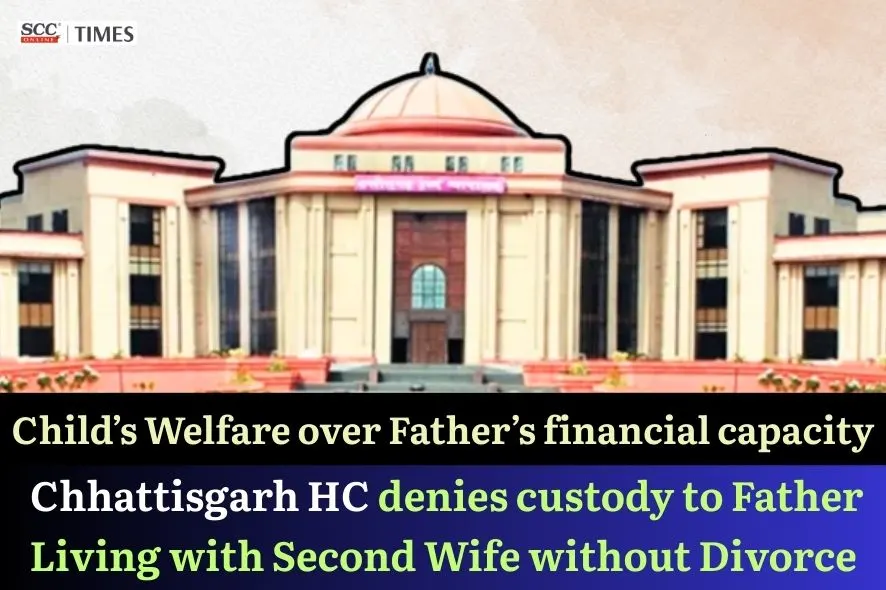
Chhattisgarh High Court: In an appeal filed by a father who was denied custody of his minor son because he was living with a second wife without a divorce from the mother, the Division Bench of Sanjay K. Agrawal* and Arvind Kumar Verma, JJ., rejected the appeal and upheld the impugned order. The Court held that it could not be oblivious to the uncertainty that the child would receive better love, affection, and a good atmosphere from his step-mother, in comparison to what he had been receiving from his mother since birth. The Court stated that giving sole or more importance to the superior financial capacity of the father would not be proper and hence, denied custody to father living with second wife without divorce.
Background
The parties got married in 2013 and had two sons, aged 7 and 3.5 years old. One year after the marriage, disputes started arising between the couple, and the mother went to live in her maternal house with the younger son. Later, she filed a complaint before the Mahila Thana, and the father handed over the older son to the mother. Aggrieved with the loss of both children, he filed an application under Section 6 of the Hindu Minority and Guardianship Act, 1956 (“HAMA”), seeking custody of his minor son aged 7 years.
The mother contended that the husband was living with another woman, a second wife, without taking a divorce from her. The Family Court rejected the father’s application, holding that since the father had brought another woman who is residing with him in his house as his second wife, without obtaining any decree of divorce, it amounted to cruelty and misconduct on his part. Merely because he was financially better equipped than the mother, he could not be entitled to custody of the minor son.
Analysis
At the outset, the Court perused Sections 6(a) and 13(1) of the HAMA and stated that the welfare of the child is determined neither by the economic affluence nor by a deep mental or emotional concern for the well-being of the child. The answer depends on the balancing of all these factors and determining what is best for the child’s total well-being. In this regard, the Court referred to Sheoli Hati v. Somnath Das, (2019) 7 SCC 490, and Shyamrao Maroti Korwate v. Deepak Kisanrao Tekam, (2010) 10 SCC 314.
The Court noted that the father himself admitted in his cross-examination that he was having a love affair with another woman, and he, admittedly, made a statement before the Sakhi One Stop Center that he married that woman at a temple. Additionally, the mother also made similar statements in her affidavit under Order 18 Rule 4 of the Civil Procedure Code, 1908 (“CPC”) that the father had kept that woman as his second wife, which remained uncontroverted in the cross-examination.
Accordingly, the Court noted that the Family Court, relying upon the aforesaid statements, recorded the finding that since the father was residing with another woman, it would be inappropriate to grant him the custody of the minor son, and it would be in the best interest of the child to stay with his mother. In this regard, the Court relied on Athar Hussain v. Syed Siraj Ahmed, (2010) 2 SCC 654, wherein the Supreme Court held that the second marriage of the father is an important factor for consideration while granting custody of the child, and denied the custody to the father where he has already entered into a second marriage.
Thus, the Court held that it was established that the father was residing with another woman for a fairly long time, and the minor son, who was residing with his mother, was in a good atmosphere as he was getting love and affection from her.
The Court held that it could not be oblivious to the uncertainty that the child would receive better love, affection, and a good atmosphere from his step-mother, in comparison to what he had been receiving from his mother since birth. Though it has been contended on behalf of the father that he was financially more capable of fulfilling the needs of the minor child, as the mother did not have any source of income, the Court stated that giving sole or more importance to the superior financial capacity of the father would not be proper.
The Court placed reliance on Dhanwanti Joshi v. Madhav Unde, (1998) 1 SCC 112, in this regard and reiterated that the welfare of the child depends upon balancing all the factors, i.e., physical, mental, and emotional, and determining what is best for the child’s total well-being.
Accordingly, the Court upheld the Family Court’s decision and rejected the appeal.
[Laxmikant Joshi v. Lokeshwari, 2026 SCC OnLine Chh 915, decided on 14-01-2026]
*Judgment authored by: Justice Sanjay K. Agrawal
Advocates who appeared in this case :
For the appellant: Bharat Rajput
For the respondent: Aman Tamboli