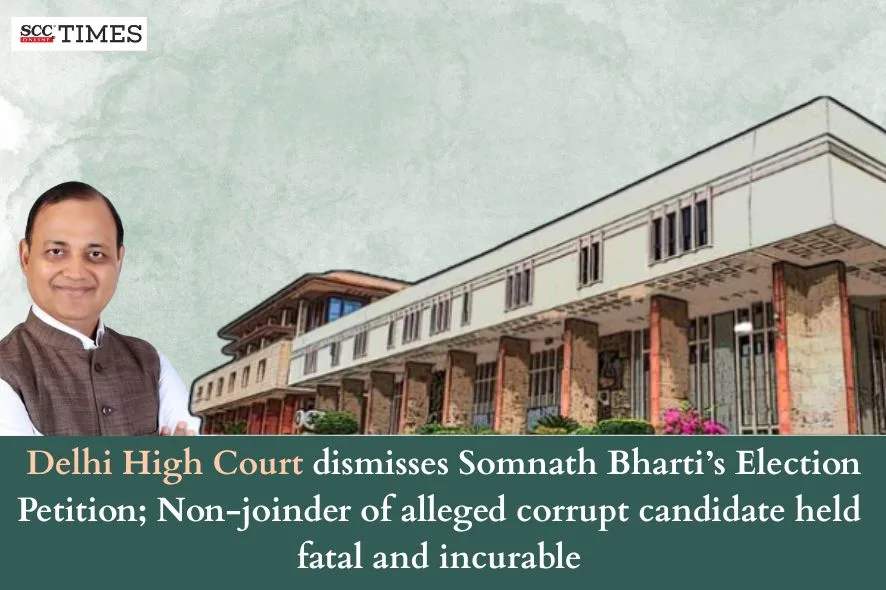
Delhi High Court: In an election petition filed under Sections 80, 80-A and 81 of the Representation of the People Act, 1951 (ROPA) seeking to declare the election of the respondent as null and void, alleging that the election was vitiated by corrupt practices within the meaning of Sections 123, 127-A and 130 of the Representation of the People Act and was liable to be set aside under Section 100(1)(b) and (d), a Single-Judge Bench of Jasmeet Singh, J., dismissed the petition and held that Jitender Kumar Kochar (Congress Candidate) was a necessary party and petitioner’s failure of his mandatory impleadment under Section 82(b) ROPA within the statutory period constituted an incurable defect, attracting the mandatory dismissal under Section 86(1).
In the instant matter, the petitioner, Somnath Bharti, a three-time Member of the Legislative Assembly from Malviya Nagar Constituency (AC-43) and former Law Minister in the Delhi Government, contested the Delhi Legislative Assembly Election, 2025 as the official candidate of the Aam Aadmi Party for the fourth time. The respondent, Satish Upadhyay, contested from the same constituency as the official candidate of the Bharatiya Janata Party.
The petitioner alleged, inter alia, that —
-
The respondent deployed his agents to transport voters to polling booths in cars, thereby committing corrupt practice under Section 123(5).
-
The Congress candidate ran an election campaign directed exclusively against the petitioner and not against the respondent, which was part of a “deliberate and coordinated strategy” with the respondent to divide the secular vote.
-
The respondent had allegedly given large sums of money and funded the election campaign of Congress candidate to cut into the petitioner’s votes and defeat him which amounts to a corrupt practice as per section 123(1)(A)(a).
-
The respondent manipulated the voters’ list and failed to disclose his election expenditure.
The Court reiterated that an election petition is not an ordinary lis but a special statutory proceeding where the people’s mandate can be interfered with only in strict compliance with ROPA.
“In a democratic republic, the electorate exercises its sovereign will by choosing its representatives through the election process. The ROPA permits judicial interdiction of the people’s mandate only in exceptional circumstances and strictly in accordance with the statutory framework governing elections.”
The Court noted that the Representation of the People Act is a self-contained code, and its provisions require strict compliance. The Court held that Sections 81, 82 and 86 form a closed procedural code and compliance with Section 82 is a condition precedent for maintainability.
The Court held that the allegations therein clearly attributed active participation and complicity to the Congress candidate in furtherance of the alleged corrupt practice. The Court observed that the test under Section 82(b) is not whether the allegation will ultimately succeed, but whether the petition contains allegations of corrupt practice “against” a candidate.
The Court rejected the petitioner’s argument that accepting money does not constitute a corrupt practice and noted that Section 123(1) was amended in 1958 to expressly include “receipt of, or agreement to receive, any gratification”. On comparison of the pre- and post-amendment provisions, the Court held that the allegations squarely fell within Section 123(1)(B)(b).
The Court further held that “once a candidate is alleged to have participated in the corrupt practice whether by act, omission, or conspiracy, Section 82(b) mandates that such candidate be impleaded as a respondent.”
The Court referred to Mohan Raj v. Surendra Kumar Taparia, 1968 SCC OnLine SC 282, where the Supreme Court held that “when the Act makes a person a necessary party and provides that the petition shall be dismissed if such a party is not joined, the power of amendment or to strike out parties cannot be used at all.”
The Court held that once a candidate against whom corrupt practice is alleged is not impleaded within 45 days, the defect becomes fatal and incurable. The Court emphasised that it has no power to invoke CPC provisions, equity, or inherent jurisdiction to save such a petition.
“Once the 45 days limitation period expires, the Court does not have jurisdiction to allow such amendment. Allowing the same would amount to rewriting the statute and defeating the legislative intent of section 86(1) of the ROPA. The dismissal is not discretionary but imperative upon non-compliance. Thus, the Court cannot cure or condone the defect either by invoking inherent powers or by applying principles of equity.”
The Court held that the non-joinder of Shri Jitender Kumar Kochar, against whom allegations of corrupt practice had been made, constituted an incurable defect under Section 82(b) attracting mandatory dismissal under Section 86(1).
Accordingly, the Court dismissed the election petition.
[Somnath Bharti v. Satish Upadhyay, 2026 SCC OnLine Del 223, Decided on 17-01-2026]
Advocates who appeared in this case :
Mr. Somnath Bharti-in-Person with Mr. Anand Prakash Gautam, Counsel for the Petitioner
Mr. Rajiv Nayar, and Mr. Jayant Mehta, Sr. Advs. with Mr. Saurabh Seth, Mr.Sumer Dev Seth, Ms. Neelampreet Kaur, Mr. Abhiroop Rathore, Counsel for the Respondent