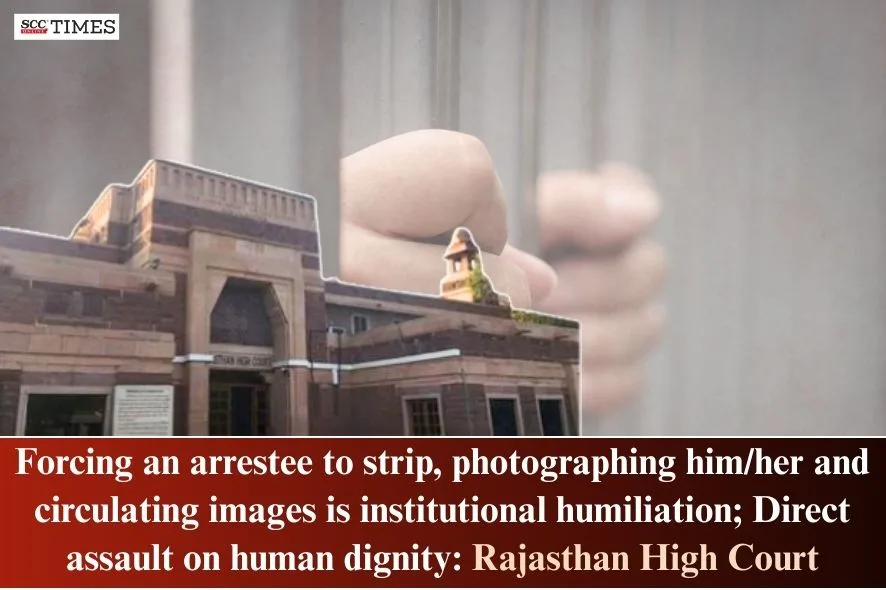
Rajasthan High Court: While considering a petition raising disturbing practice alleging that whenever a person is arrested, the police compel such arrestees to sit at the police station and strip, thereafter, taking colored photographs and circulating the same widely through newspapers and various social media platforms, a Single Judge Bench of Farjand Ali, J., held that forcing an arrestee to strip or partially disrobing such person, photographing him or her in a degrading condition, and thereafter circulating those images on social media or in newspapers, amounts to institutional humiliation and a direct assault on human dignity.
Background
In the present case, it was alleged that whenever a person was arrested on accusation of commission of an offence, the police compelled such arrestees to sit at the entrance or in front of the gate of the police station, thereafter taking colored photographs and circulating the same widely through newspapers and various social media platforms.
It was further alleged that in certain instances, the accused persons were forced to strip themselves and were made to sit in a humiliating state, dressed only in undergarments, while photographs were taken and disseminated.
The petitioner placed photographs on record showcasing several women sitting at the entrance of a police station and stated that among them were unmarried young girls, whose photographs were circulated indiscriminately on social media platforms and in local newspapers, thereby portraying them as criminals before the public at large.
A counsel present in the Court mentioned about a news item published (‘News report’) in Dainik Bhaskar, reporting the arrest of a practicing advocate by a Police Station, Jodhpur wherein the advocate was made to sit in front of the police station gate and his photograph was made viral.
Analysis and Decision
The Court reiterated that an accused is merely an accused and not a convict and stated that “The constitutional presumption of innocence remains intact unless displaced by a finding of guilt recorded after a fair trial. Any act which publicly parades an accused as a culprit, prior to such adjudication, strikes at the very root of constitutional morality and rule of law.”
The Court further stated that Article 21 of the Constitution guarantees not merely the right to life, but the right to live with dignity, honour, and self-respect. The right to dignity does not evaporate upon arrest. The Court stated that “Even a person accused of an offence continues to be clothed with basic human rights.” Further, the Court emphasized that forcing an arrestee to sit on the floor, stripping or partially disrobing such person, photographing him or her in a degrading condition, and thereafter circulating those images on social media or in newspapers, amounts to institutional humiliation and a direct assault on human dignity.
The Court further stated that the damage caused by such acts is neither speculative nor transient. Once such photographs are released into the digital and public domain, the stigma attaches permanently. In the case of unmarried women, the consequences can be devastating, affecting their prospects of marriage, social acceptance, and psychological well-being. Even if the accused is ultimately acquitted, the scar inflicted upon reputation and social standing is often irreparable. The Court stated that “The Constitution does not countenance such irreversible injury at the hands of the State.”
Further, the Court emphasized that neither the Criminal Procedure Code 1973, the Bharatiya Nagarik Suraksha Sanhita 2023, nor the Police Act 1861 or the Rules framed thereunder confer any authority upon the police to indulge in such conduct. The Court held that the said acts are prima facie arbitrary, illegal, and reflective of unbridled caprice, wholly unbecoming of a disciplined force entrusted with the protection of citizen’s rights.
The Court opined that any infringement of fundamental rights cannot be tolerated being a sentinel and the guardian of constitutional liberties. The issue raised in the petition at hand disclosed a serious and systemic threat to the fundamental right to life with dignity.
The Court took cognizance of the News report and stated that it raised serious concerns touching upon the fundamental rights of citizens. Considering a submission that within jail premises also, arrestees were allegedly compelled to strip and remain in undergarments while confined in cells, the Court stated that such conduct was plainly inhuman, degrading, and violative of the bare minimum human rights guaranteed to every individual, irrespective of the accusations against him.
Thus, the Court directed the Superintendent of Police, Jaisalmer, to file an affidavit specifically responding to and negating the aspersions levelled in the present petition. The Court further directed him to make all necessary arrangements to ensure immediate deletion and removal of photographs and related content of arrested persons from web portals, social media handles, and other platforms, if uploaded on their behalf.
The Court directed Commissioner of Police, Jodhpur to immediately remove the photographs of the advocate from all web portals, social media platforms, and any other medium where the same is available within 24 hours. The Court further directed him to file a detailed reply stating the adequate, effective and institutional safeguards put in place to ensure that such incidents are not repeated in future within the jurisdiction of Police Commissionerate, Jodhpur.
The Court adjourned the matter to 28-1-2026.
[Islam Khan v. State of Rajasthan, 2026 SCC OnLine Raj 409, decided on 20-1-2026]
Advocates who appeared in this case :
For the Petitioner: Sarwar Khan, Rajak Khan and Devkinandan Vyas, Advocates
For the Respondent: Deepak Choudhart, AAG and SR Choudhary, PP
Amicus Curiae: Devkinandan Vyas, Advocate