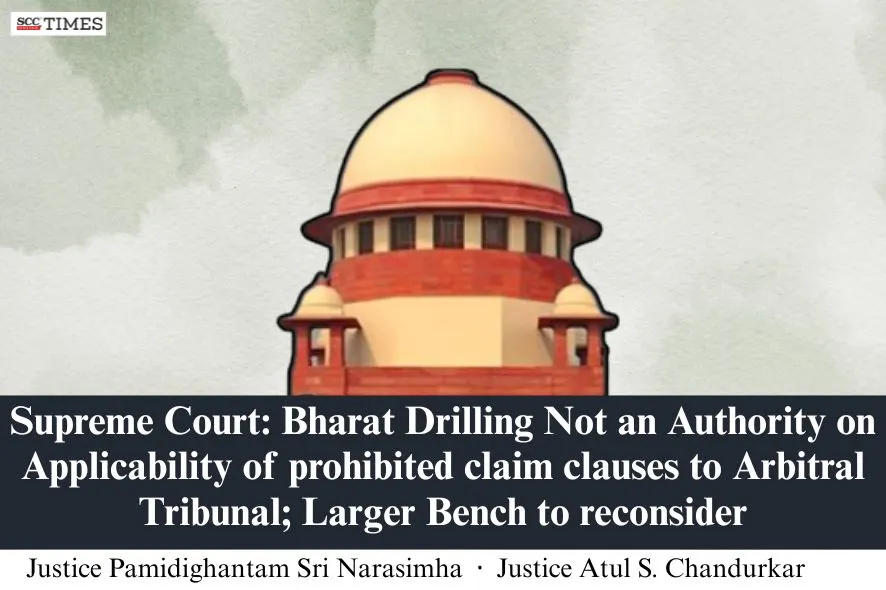
Supreme Court: In a case dealing with applicability of prohibitory clauses in arbitration, the bench of Pamidighantam Sri Narasimha* and Atul S. Chandurkar, JJ., has found that the law laid down in Bharat Drilling & Foundation Treatment Pvt. Ltd. v. State of Jharkhand (2009) 16 SCC 705 requires reconsideration as is not in tune with the principles laid down by this Court in the recent decisions of Cox and Kings Ltd. v. SAP India Private Ltd., (2024) 4 SCC 1 and In Re: Interplay Between Arbitration Agreements Under Arbitration and Conciliation Act, 1996 and Stamp Act, 1899, 2023 SCC OnLine SC 1666 and has hence, referred the matter to a larger bench.
Background of the Case
In the case at hand, the Indian Builders Jamshedpur i.e. the contractor made some claims against the State of Jharkhand under a construction contract. The Arbitral Tribunal allowed certain claims relating to underutilised overheads, loss due to underutilised tools and machinery, and loss of profit. The State of Jharkhand, however, objected to these claims under Section 34 of the Arbitration and Conciliation Act, 1996, contending that they were expressly barred by contractual clauses i.e. Clause 4.20.2 prohibited claims for idle labour and machinery, and Clause 4.20.4 prohibited claims for business loss or similar losses. The Civil Court set aside these claims.
The Jharkhand High Court, relying on Bharat Drilling & Foundation Treatment Pvt. Ltd. v. State of Jharkhand (2009) 16 SCC 705, restored the claims without examining the contractual clauses in detail, based on the impression that the issue was conclusively covered by the said decision.
The State of Jharkhand challenged the same on the ground that the Bharat Drilling decision is fact-specific and not a binding precedent for all government contracts.
Supreme Court’s Analysis
The Court observed that contractual clauses that limit claims are founded on freedom to contract. They are agreements that crystalise informed choices of parties. It was further stated that applicability of excepted or prohibitory clauses would primarily depend upon the agreement between the parties, which alone is the guiding principle for the Arbitral Tribunal.
The Court placed reliance on Central Organisation for Railway Electrification (CORE) v. Union of India (2024 INSC 857), which underscores party autonomy as the “brooding and guiding spirit” of arbitration.
The Court noted that in Bharat Drilling, the Court had not examined the contractual clauses that the Court was examining in the case at hand were not examined. The said decision had relied on Board of Trustees For The Port of Calcutta v. Engineers-De-Space-Age, (1996) 1 SCC 516 concerning payment of interest, which stands on a completely different footing from prohibitory clauses.
The Court observed that as the issues relating to payment of interest arising under Section 31(7) of the Act stand on a different footing from that of contractual clauses excepting or prohibiting certain claims, the judgment in Bharat Drilling, relying on the judgment in Board of Trustees For The Port of Calcutta v. Engineers-De-Space-Age, (1996) 1 SCC 516, dealing with the principle of grant of interest pendente lite, was not appropriate.
The Court, hence, observed that
“In view of our opinion that Bharat Drilling is not an authority for the proposition that an excepted clause or a prohibited claim in a contract applies only to the employer and not to the Arbitral Tribunal”
Hence, in order to obviate uncertainty and for clear declaration of law, the Court referred Bharat Drilling to a larger bench for reconsideration and authoritative decision.
[State of Jharkhand v. Indian Builders, 2025 SCC OnLine SC 2717, decided on 05.12.2025]
*Judgment authored by: Pamidighantam Sri Narasimha
Advocates who appeared in this case:
For Appellant(s): Mr. Rajiv Shankar Dwivedi, Adv. Ms. Tulika Mukherjee, AOR Mr. Beenu Sharma, Adv. Mr. Venkat Narayan, Adv.
For Respondent(s): Mr. Manoj C. Mishra, AOR Mr. Vishesh Jain, Adv. Mr. Chandan Kumar, Adv. Mr. Rajesh Gupta, Adv.
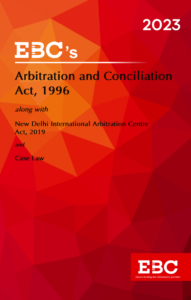
Buy Arbitration and Conciliation Act, 1996 HERE