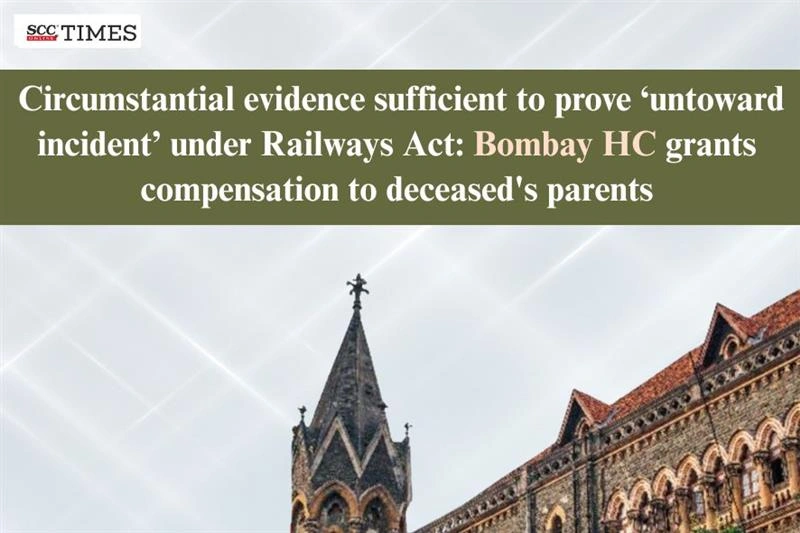
Bombay High Court: In a case revolving around the question whether the death of a 17-year-old boy, who fell from a moving local train, could be classified as an ‘untoward incident’ under the Railways Act, 1989 (‘Railways Act’), the Railway Claims Tribunal (‘Tribunal’) had dismissed the family’s claim of compensation. However, a Single Judge Bench of Jitendra Jain, J., while allowing the appeal, quashed the Tribunal’s order, holding that the incident amounted to an ‘untoward incident’ and that the deceased was a bona fide passenger, thereby granting compensation of Rs 4 lakh with interest, subject to a cap of Rs 8 lakh.
Background:
On 05-09-2008, the deceased, a 17-year-old boy, was traveling with his friends by local train to take darshan of Lord Ganesh at Lalbaug. Due to rush in the train, he fell off between Elphinstone and Lower Parel railway stations. His friends, instead of informing the station officials about the incident, took him to the KEM Hospital, where he was declared dead on arrival by the doctors.
The parents of the deceased (‘appellants’) claimed compensation from the respondent on account of their son’s death under the Railways Act and the Railway Claims Tribunal Act, 1987. However, the Tribunal, vide order dated 29-01-2016, dismissed their claim on the grounds that the deceased was not a bona fide passenger, and that the incident was not reported to railway officials, and no Station Master’s report existed.
Analysis and Decision:
Regarding the non-reporting of the incident by the friends of the deceased to the nearest railway station officials, the Court opined that the deceased and his friends were in the age group of 17-18 years and when the deceased fell from the train, his friends might be shocked and frightened and therefore, instead of informing the station officials, they rushed back to the spot and took him to the hospital.
The Court noted that the incident was recorded in the inquest panchnama dated 06-09-2008. Further, one of the deceased’s friends who arrived at the hospital in the early hours of 06-09-2008, narrated the incident to the police officials and doctor present at the KEM hospital, which was also a circumstantial evidence. The postmortem report prepared by the hospital stated the cause of death as head injury, which was most likely to happen when a person fell from a moving train. The incident was documented in reports by IPF/Headquarter/BCT and the Railway Police Inspector, and also recorded at Mumbai Central Police Station, which directed Dadar police to KEM Hospital.
The Court opined that the circumstantial evidence, referred above, clearly indicated that the incident had happened and at the first available instance, the same was narrated to various authorities. The Court observed that the circumstantial documentary evidence and the examination and evidence led by the appellants showed that the incident had happened. However, the only fault of the friends was that they did not inform the station officials, though they did inform the police authorities at the KEM hospital, and the other authorities also reported it. Therefore, it could not be said that there was no ‘untoward incident’ which resulted in the death of the deceased on account of fall from a moving train.
The Court emphasised that the Railways Act is a beneficial legislation, and even in criminal matters, circumstantial evidence is taken into consideration for deciding whether the offence was committed or not. Thus, the Court observed that circumstantial evidence could be considered for deciding whether an ‘untoward incident’ occurred or not, more so when there was no indication that the present application was fraud.
The Court opined that while adjudicating criminal matters, the dying declaration plays a very important role as it is based on the principle that a person at the last stage of his life would always speak the truth, and consequently, observed that when the accident happened, the statements made at the first available instance before the State authorities must be accepted as an important piece of evidence for adjudicating the occurrence of an ‘untoward incident’.
The Court relied on Har Parshad Nanda v. Union of India, 2018 SCC OnLine P&H 1952, wherein it was observed that the non-reporting of an incident to the Station Master is not fatal to the claim, as in such a situation, the primary concern is to save the injured and not to go to the authorities to lodge the incident.
Regarding whether the deceased being a bona fide passenger or not, the Court noted that the deceased’s friend gave a statement that all of them had purchased a railway ticket to go to Lalbaug. The Court followed Union of India v. Rina Devi, (2019) 3 SCC 572, and concluded that the condition of a bona fide passenger was also satisfied in the case, and that demanding the production of a physical ticket in 2014 which was purchased in 2008, could not be permitted in appeal.
Consequently, the Court, while allowing the appeal, quashed and set aside the Tribunal’s order and ordered compensation of Rs 4 lakh to be paid to the appellants, along with 6 percent interest from the date of the accident till the date of payment, subject to a cap of Rs 8 lakh.
[Dhondu Sakharam Tambe v. Union of India, 2025 SCC OnLine Bom 4610, decided on 21-11-2025]
Advocates who appeared in this case:
For the Appellants: Balasaheb Deshmukh i/by Deepak T. Ajagekar.
For the Respondent: T. J. Pandian a/w. Gautam Modanwal a/w. Noorjahan Khan