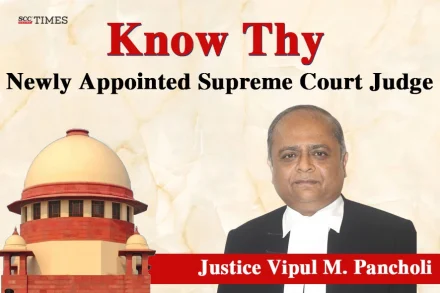
Know Thy Newly Appointed Supreme Court Judge: Justice Vipul M. Pancholi
Justice Vipul M. Pancholi’s journey to the Supreme Court of India is a testament to his legal expertise and steadfast commitment to the principles of justice.

Bringing you the Best Analytical Legal News


Justice Vipul M. Pancholi’s journey to the Supreme Court of India is a testament to his legal expertise and steadfast commitment to the principles of justice.
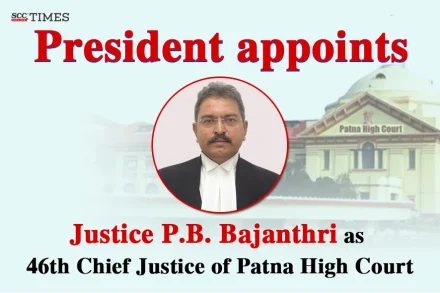
Appointed by the President in exercise of powers under Article 217(1) of the Constitution, Justice Bajanthri will be succeeding Justice Vipul M. Pancholi, who was recently elevated to the Supreme Court.
“Any attempt to stigmatize or marginalize an entire class of persons offends the guarantee of equality before law under Article 14 and freedom of expression with reasonable restrictions under Article 19(2).”
“Maintenance claims require disclosure affidavits of assets and liabilities, balanced assessment of needs and quantum based on factors like parties’ status, reasonable need and income.”
“As there is conflicting view upon the same by co-ordinate benches, in such circumstances this Court is of the view that the issue should be examined by a larger bench.”

“The doctrine of reasonable restriction under Article 19(6) of the Constitution permits the State to impose limitations on such trade in the interest of public peace and security.”
Appointments for Acting Chief Justices for Bombay and Patna High Courts were made in consequence of their Chief Justices being elevated to the Supreme Court.
“As per Section 12 of the Act, bail to the Juvenile is a rule and refusal of the same is an exception.”
The Court expressed dissatisfaction over the en-passant, unnecessary, and adverse remarks against a Judicial Officer without affording him any opportunity.
The Court directed the Registrar General to collect and collate a comprehensive report to specifically inform the Court about the appointment of counsellors in the Family Courts across the State.
The Court held that a woman having lived as a wife, borne children, and been deserted without support, falls within the protective umbrella of Section 125 CrPC and the technical plea of invalidity of marriage cannot be a valid ground to deny her maintenance.
“No society can afford to punish its children. Punitive approach towards children in conflict with the law would be self-destructive for the society.”
“In the garb of running orchestra/dance groups, minor children are subjected to trafficking and exploitation, which is impermissible and if allowed to be continued unchecked, would only lead to frustration of the very policy for protecting the children.”

“A mere excess or overreach in the performance of official duty does not, by itself, disentitle a public servant from the statutory protection mandated by law.”
Patna High Court held that smiling and merely folding hands in Pranaam Mudra in standing position could not be construed by any prudent imagination to be an insult to the National Anthem.
The Patna High Court relying upon the Supreme Court’s decisions in Debendra Nath Padhi, (2005) 1 SCC 568 and Bhajan Lal, 1992 Supp (1) SCC 335, acquitted the female gynaecologist in the alleged kidney removal during surgery medical negligence case.
“A few moral lapses and a return back to a normal life cannot be said to be living in adultery. If the lapse is continued and followed up by a further adulterous life, the woman can be said to be ‘living in adultery.’”
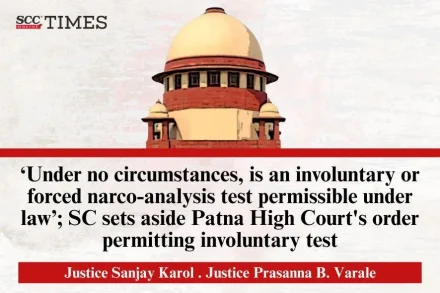
The High Court in direct contravention of the Selvi v. State of Karnataka, (2010) 7 SCC 263 accepted the submission of the Sub-Divisional Police Officer, Mahua, that she would conduct narco-analysis test of all the accused persons and other witnesses, during the investigation.
“In the government, there is no system of rectification of any return once it is filed. However, petitioner had submitted application to rectify GST 3B on par with the GSTR 1 relating to certain total taxable value, total integrated tax, total CGST, total SGST.”
“The J.J. Act, 2000 is based on our belief that children are the future of the society and in case they go into conflict with law under some circumstances, they should be reformed and rehabilitated and not punished. No society can afford to punish its children”.