Know what led the Supreme Court to set aside private tutor’s conviction in 1996 Rape Case
Supreme Court concluded that both the Courts below “completely misread the material available on record”.
“Revisional jurisdiction is basically supervisory in nature and may be exercised only when there is glaring defect in procedure or there may be a manifesting error on a point of law, resulting in a flagrant miscarriage of justice.”
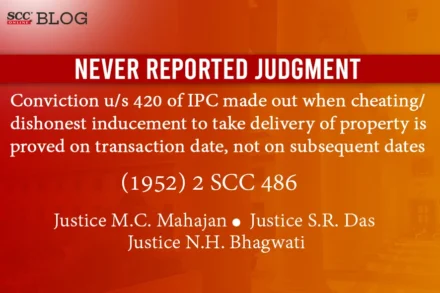
This report covers the Supreme Court’s Never Reported Judgment dating back to the year 1952 on Section 420 of the Penal Code, 1960.
“Credible evidence even of a hostile witness can form the basis for conviction in a criminal trial and his/her evidence can be accepted, if he/she is a natural and independent witness.”
Calcutta High Court upheld the lower courts’ conclusion regarding the unreliability of Exhibit A and Exhibit B as the petitioners’ defense did not raise a reasonable doubt.
Mere accompaniment of uncle to visit court for recording statement under section 164 of CrPC is not good ground or submission to hold that the child was tutored.
Calcutta High Court found no loopholes in the trial court’s analysis of the evidence, concluding that the appellant’s guilt under Section 304 IPC was proved beyond a reasonable doubt.
The Calcutta High Court stated that Mens rea, a crucial element for a criminal offense, was not established merely by the omission of the license number.
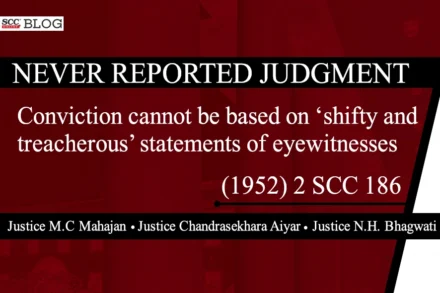
This report covers the Supreme Court’s Never Reported Judgment dating back to the year 1952 on credibility of the witness.
The case at hand presents a tragedy, wherein the continuous demands of dowry made by the appellant pushed the deceased into a despair so profound that she felt compelled to take her own life. This serves as a reminder of how the forces of greed can often eclipse the sanctity of human life and the bonds of matrimony.
“Presumption is that every witness is impartial and independent, unless proved contrary. There is no presumption for doubting the credibility of official witnesses, in principle.
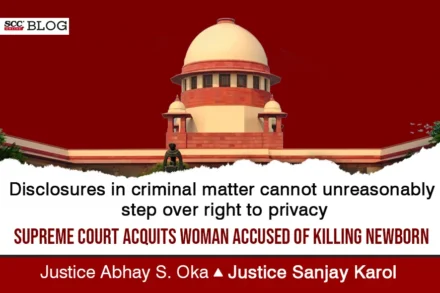
“Thrusting upon a woman the guilt of having killed a child without any proper evidence, simply because she was living alone in the village, thereby connecting with one another two unrelated aspects; reinforces the cultural stereotypes and gendered identities which the Court has explicitly warned against.”
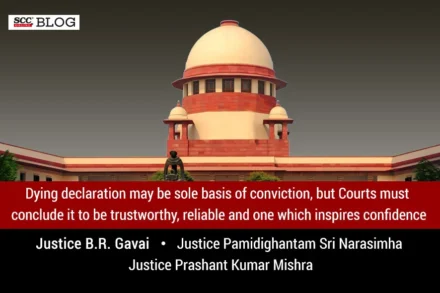
“No doubt, that a conviction can be solely recorded on the basis of dying declaration. However, for doing so, the court must come to a conclusion that the dying declaration is trustworthy, reliable and one which inspires confidence.”
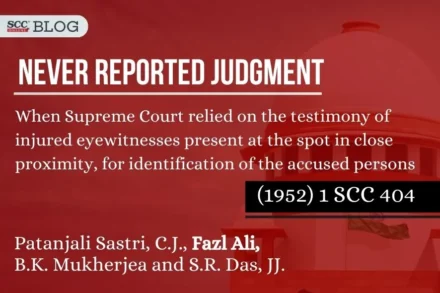
This report covers the Supreme Court’s Never Reported Judgment dating back to the year 1952 on the credibility of injured eyewitnesses.
This report covers the Supreme Court’s Never Reported Judgment dating back to the year 1952 on Section 32(1) of the Evidence Act, 1872.
Bombay High Court expressed that it was persuaded to stay her conviction due to the fact that she was employed as a sweeper and had to provide for basic needs of her grandchildren.
Calcutta High Court held that there does not appear to be any discrepancies in the statements and evidence provided, therefore the same can be considered reliable and trustworthy, beyond all reasonable doubt.
Supreme Court opined that the Trial Court, as well as, the Bombay High Court have rightly appreciated the evidence and convicted the convict for the offence punishable under Sections 307 and 332 of the IPC
This report covers the Supreme Court's Never Reported Judgment dating back to the year 1952 on duty of appellate court under Criminal Procedure Code, 1898.
“Nothing has improved even after more than a decade of “Nirbhaya”. Women also have the right to life and liberty. They also have the right to be respected and treated as equal citizens. Their honour and dignity cannot be touched or violated”.