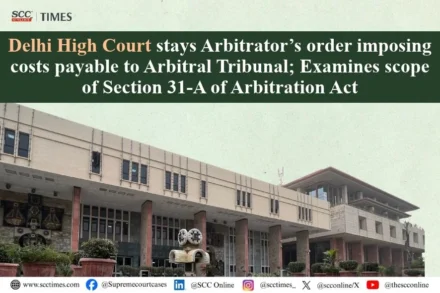
Section 31-A Arbitration Act
Case BriefsHigh Courts

Delhi High Court stays orders imposing costs payable to the Arbitral Tribunal, observing that the issue warrants consideration under Section 31-A of the Arbitration and Conciliation Act, 1996.
SCC Times NewsflashWATCH NOW

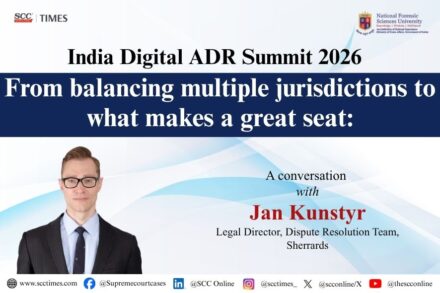
Watch Jan Kunstyr, Legal Director, Dispute Resolution Team, Sherrads, discusses how counsels navigate disputes across borders, what makes London an important seat,

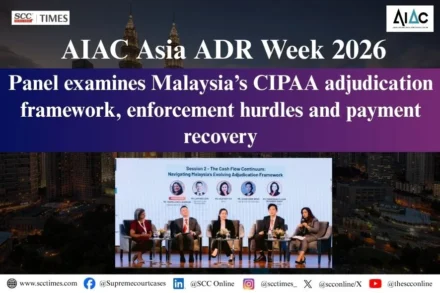
AIAC Asia ADR Week 2026 CIPAA adjudication
Asia ADR WeekEvents & CollaborationsInternational

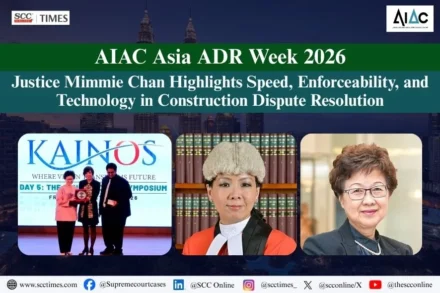
In a panel discussion conducted at the AIAC ADR Week 2026 on the topic “The Cash Flow Continuum: Navigating Malaysia’s Evolving Adjudication Framework”, the panellists delved into the operation of the Construction Industry Payment and Adjudication Act in Malaysia, appointment and role of adjudicators, procedural efficiency, use of AI, applications for stay and setting aside, and much more.

Asia ADR Week 2026
Asia ADR WeekEvents & CollaborationsInternational

The discussions examined statutory adjudication, enforcement of payment determinations, judicial intervention in construction disputes, and the use of building information modelling (BIM), online dispute resolution, and AI to improve efficiency, reduce costs and facilitate early settlement.

Supreme Court September 2026
Legal RoundUpSupreme Court Roundups

From quashing FIRs arising from NEET-UG 2026 protests and strengthening safeguards against re-arrest after violation of Article 22, to rejecting AI-generated fake citations, taking suo motu cognizance of crimes against women and children, protecting human-rights remedies and permitting direct access to Human Rights Courts, the Supreme Court’s September 2026 rulings span constitutional rights, criminal law, elections, arbitration, family law, labour, environment and writ jurisdiction.

SCC Times NewsflashWATCH NOW

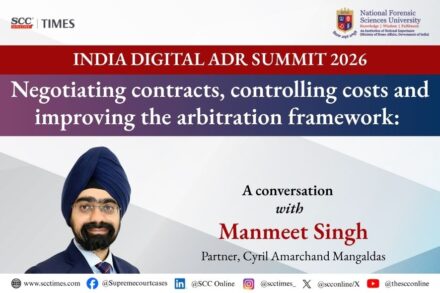
In this conversation, Manmeet Singh, Partner at Cyril Amarchand Mangaldas, discusses how dispute resolution clauses are negotiated, controlling costs in high value

Commercial Mediation Conclave 2026
DomesticEvents & CollaborationsMCI: The PACT- Poovayya Commercial Mediation Conclave

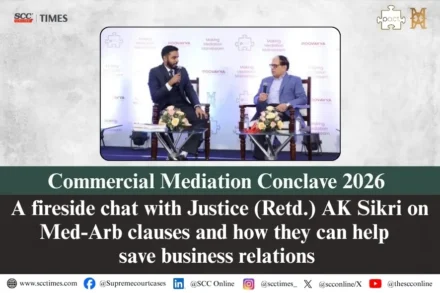
In a fireside chat at the Commercial Mediation Conclave 2026, curated and hosted by The PACT, Justice (Retd.) Arjan Kumar Sikri discussed with Jonathan Rodrigues why med-arb clauses remain rare in commercial contracts, when a mediator can properly go on to act as arbitrator in the same dispute, and why the caucus session is the reason the two roles are usually kept apart.

Nyaya Nirmaan 2026
DomesticEvents & Collaborations

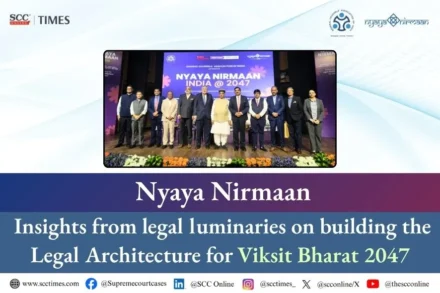
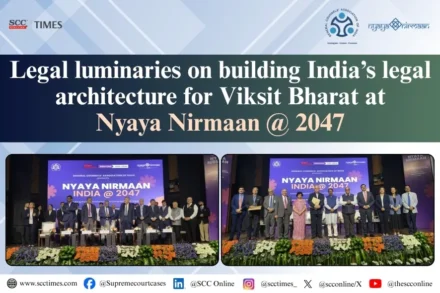
The General Counsels’ Association of India (GCAI) organised the fifth edition of Nyaya Nirmaan 2026: India @ 2047 on 24 September 2026 at the Dr. Ambedkar International Centre, New Delhi, on the theme “Building the Legal Architecture for a Connected Global Economy”.

Judicial Intervention in Arbitral Proceedings
Case BriefsHigh Courts

Articles 226 and 227 should ordinarily not be used to correct interlocutory procedural orders of an Arbitral Tribunal unless there is a patent jurisdictional defect or exceptional perversity.

Nyaya Nirmaan 2047
DomesticEvents & Collaborations

The General Counsels’ Association of India (GCAI) organised the fifth edition of Nyaya Nirmaan 2026: India @ 2047 on 24 September 2026 at the Dr. Ambedkar International Centre, New Delhi. Held under the theme “Building the Legal Architecture for a Connected Global Economy”

2026 SCC Vol 7
Cases ReportedSCC Weekly

Key Supreme Court rulings on Section 36 in Arbitration and Conciliation Act, bail, sale of assets of corporate debtor, suit for injunction, etc.

Nyaya Nirmaan 2047
DomesticEvents & Collaborations

The General Counsels’ Association of India (GCAI) organised the fifth edition of Nyaya Nirmaan 2026: India @ 2047 on 24 September 2026 at the Dr. Ambedkar International Centre, New Delhi. Held under the theme “Building the Legal Architecture for a Connected Global Economy”

2026 SCC Vol 7
Cases ReportedSCC Weekly

Key Supreme Court rulings on Article 21, bail, money laundering, arbitral tribunal, etc.

India Digital ADR Summit 2026
Events & CollaborationsIndia Digital ADR Summit

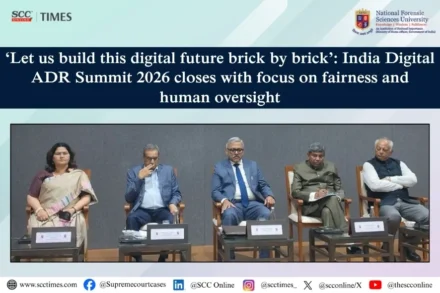
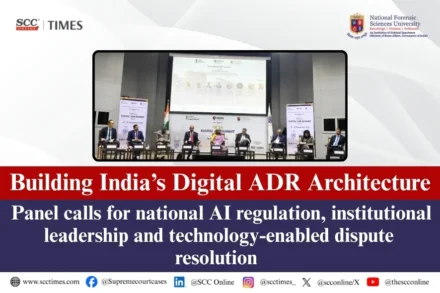
At the valedictory ceremony of the India Digital ADR Summit 2026, speakers emphasised that technology must strengthen, rather than replace, human judgment, procedural fairness and institutional accountability, while calling for greater trust in digital arbitration and mediation.

India Digital ADR Summit 2026
DomesticEvents & CollaborationsIndia Digital ADR Summit

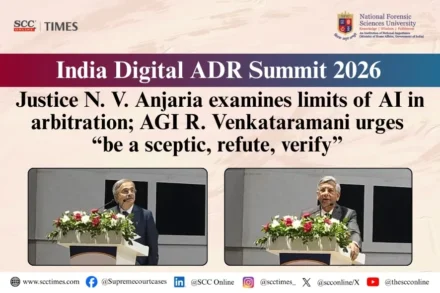
At the India Digital ADR Summit 2026, Attorney General R. Venkataramani and Justice N. V. Anjaria highlighted the potential of artificial intelligence in arbitration while stressing the need for human judgment, verification, fairness, confidentiality and control over AI-assisted decision-making.

DomesticEvents & CollaborationsIndia Digital ADR Summit

At the India Digital ADR Summit 2026, Justice M R Shah, Justice Rajesh Bindal, Justice Soniaben Gokani and leading arbitration professionals discussed the need for a coordinated digital ADR framework, safeguards for human judgment, common cybersecurity standards, institutional control over technology and India’s potential to contribute to international rule-making.

DomesticEvents & CollaborationsIndia Digital ADR Summit

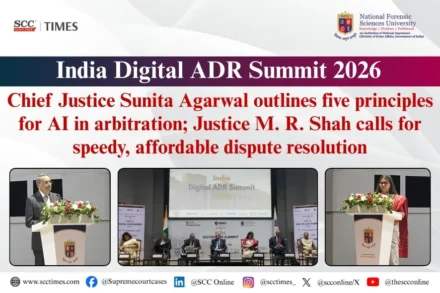
Chief Justice Sunita Agarwal highlighted the need to balance the use of artificial intelligence in arbitration with human judgment, while Justice M. R. Shah stressed that AI should not replace the human mind.

India Digital ADR Summit 2026
DomesticEvents & CollaborationsIndia Digital ADR Summit

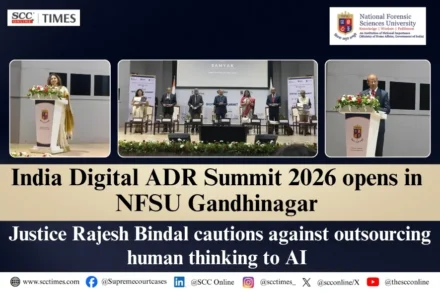
At the summit’s inaugural ceremony, marked by the ceremonial lighting of the lamp and the unveiling of SAMYAK, IDDRC’s new ODR platform, Prof. Purvi Pokhariyal outlined NFSU’s plans to digitise dispute resolution from filing to award.

HNLU Team Runner-Up APCMC ADC ICC 2026
Law School NewsMoot Court Achievements & Reports

The team comprised Arushi Yadav, Karnika H. Gaira, and Prashansa Verma, who represented HNLU throughout the competition.

SCC Times NewsflashWATCH NOW

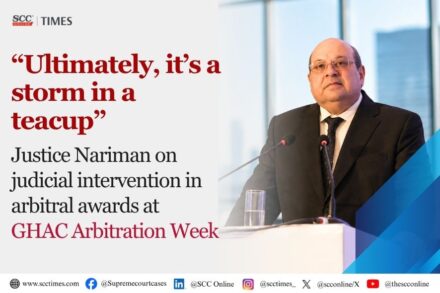
Justice Nariman reflects on judicial intervention in arbitral awards, the limits of court interference, and when matters should be sent back to