Disclaimer: This has been reported after the availability of the order of the Court and not on media reports, so as to give an accurate report to our readers.
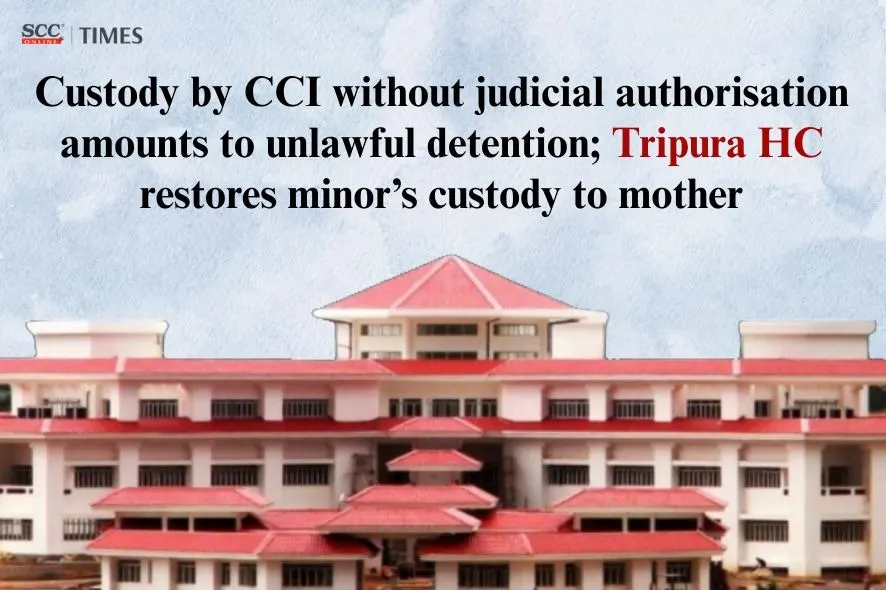
Tripura High Court: In a writ petition filed under Article 226 of the Constitution seeking issuance of a writ of habeas corpus for production and custody of a minor child, the Division Bench of Dr. T. Amarnath Goud* and S. Datta Purkayastha, JJ., held that the continued custody of the minor girl by a private child care institution without judicial authorisation was unlawful. The Court directed that the custody of the child be handed over to her biological mother, observing that the mother, being the natural guardian, was entitled to lawful custody and that the paramount consideration in such cases is the welfare of the child.
Background
The petitioner-mother approached the High Court alleging illegal detention of her minor daughter by Christian Medical College, Vellore (Respondent 8) and thereafter by Hope House, Vellore (Respondent 9) which is a boys’ hostel. The child had initially been taken to various hospitals for treatment of medical complications and was eventually admitted to CMC, Vellore.
The petitioner alleged that she was wrongfully prevented from meeting and breastfeeding the child, that false allegations under the Protection of Children from Sexual Offences Act (POCSO Act) were lodged against her and her husband, and that the hospital authorities questioned her biological motherhood and mental fitness. It was further contended that despite several correspondences by Tripura authorities, custody of the child was not restored to her.
The respondents contended that the child had suffered severe injuries consistent with abuse and that, pursuant to intervention by the Child Welfare Committee (CWC), Vellore, custody was lawfully assumed and later entrusted to Hope House for continued care. It was further asserted that the child required specialised multi-disciplinary medical and psychological care and that change of environment could adversely affect her development.
During the pendency of the writ petition, a DNA test was conducted pursuant to the dispute. The forensic report conclusively established that the petitioner was the biological mother of the child.
Analysis
At the outset, the Court addressed the preliminary objection regarding territorial jurisdiction. The Court held that a High Court may exercise jurisdiction where the cause of action arises wholly or in part within its territorial limits. Since the petitioner and the child were natives of Tripura, and the cause of action originated there, and the respondents had participated in proceedings before the Court, the objection on jurisdiction was liable to be rejected.
Moreover, the Court remarked that a case concerning the bondage and affection of a mother is not to be decided on the “technicalities of jurisdiction”. It recognised that the welfare of the child must guide the adjudication.
“The Mother and child love and affection is more relevant than anything else. The laws are made for the citizens but citizens are not born for the laws. No law can deprive the child or mother from their bondage, love and affection and the relation cannot be denied.”
Regarding custody of the child, the Court stated that“it is a humane problem and is required to be solved with human touch.” It was asserted that while deciding custody cases, the Court is “neither bound by statutes nor by strict rules of evidence or procedure nor by precedents”. While selecting a guardian for the minor, the court is expected to give due weight to a child’s ordinary comfort, contentment, health, education, intellectual development and favourable surroundings. The Court further emphasised that,
“The child is not a chattel or a ball that is bounced to and fro. It is only the child’s welfare which is the focal point for consideration. Parliament rightly thinks that the custody of a child less than five years of age should ordinarily be with the Mother and this expectation can be deviated from only for strong reasons.”
While examining the nature and scope of habeas corpus jurisdiction in child custody matters. the Court referred to Tejaswini Gaud v. Shekhar Jagdish Prasad Tewari, (2019) 7 SCC 42, and reiterated that habeas corpus is maintainable in child custody cases where detention is illegal and without lawful authority. The Court further referred to Elizabeth Dinshaw v. Arvand M. Dinshaw, (1987) 1 SCC 42, and reiterated that in custody matters, the paramount consideration is the welfare of the child and not merely the legal rights of parties. The Court emphasised that such jurisdiction is rooted in the Court’s parens patriae authority which is exercised to protect the minor ward.
Further, in Nithya Anand Raghavan v. State, (2017) 8 SCC 454, the Court observed that in habeas corpus proceedings concerning minors, the principal duty of the Court inquiry is whether custody is unlawful and illegal. Once it is established that the person retaining custody is not the natural guardian, custody may prima facie be regarded as unlawful unless supported by statutory authority.
The Court noted that the petitioner was the biological mother of the child, as conclusively established by DNA profiling. Under Section 6, Hindu Minority and Guardianship Act, the mother is the natural guardian of a minor child of tender age. The Court observed that there was no judicial order authorising the continued custody of the child with Respondent 9 during the pendency of the writ petition. It held that the shifting of custody from Respondent 8 to Respondent 9 without obtaining necessary judicial permission, while the matter was sub judice, was unauthorised, arbitrary and ultra vires.
The Court also recorded its own interaction with the child, both physically and virtually, and observed that the child appeared cheerful, mentally alert and physically stable. While noting medical opinions regarding earlier injuries and therapeutic requirements, the Court held that no material was placed to demonstrate that custody with the biological mother would be detrimental to the child’s welfare.
Based on the overall analysis, the Court allowed the writ petition and directed the respondents to handover the custody to the mother. It stated that non-compliance with this order in handling over the custody of the minor child would amount to violation and willful disobedience of this Court’s orders.
[Prabha Rani Das v. State of Tripura, 2026 SCC OnLine Tri 97, decided on 4-2-2026]
Also read: Custody of Children
*Judgment authored by Justice Dr. T. Amarnath Goud
Advocates who appeared in this case :
For the petitioner: P. K. Biswas, Senior Advocate; P. Majumder, R. Nath, Advocates
For the respondents: S. M. Chakraborty, Advocate General; R. Datta, Public Prosecutor; S. Lodh, Advocate; S. Majumder, Advocate