
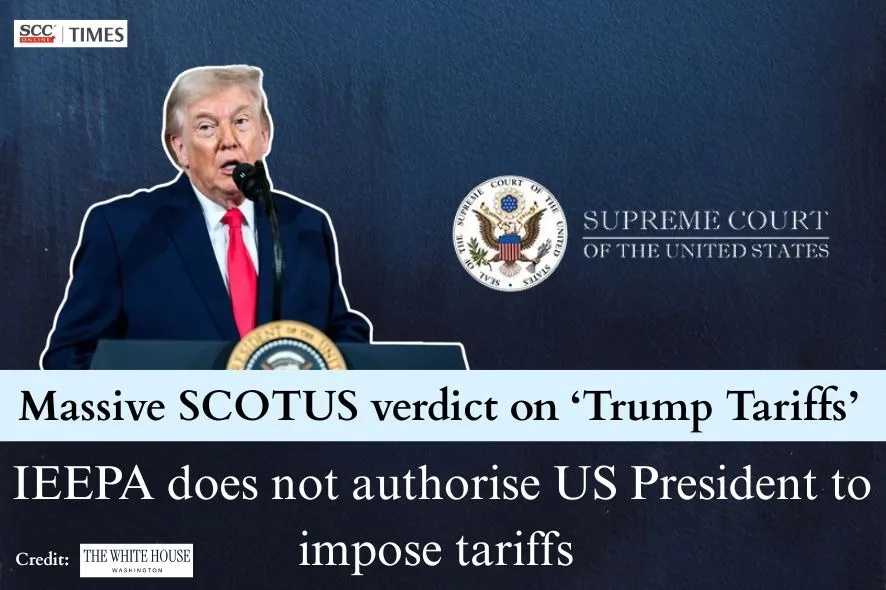
Supreme Court of the United States (SCOTUS): While considering the question whether the International Emergency Economic Powers Act (IEEPA) authorises the US President to impose tariffs, the 9-Judge Bench of the Court, with a ratio of 6:3, held that IEEPA does not authorise the President to impose tariffs.
The Court concluded that IEEPA authorises the President to, “investigate, block during the pendency of an investigation, regulate, direct and compel, nullify, void, prevent or prohibit (…) importation or exportation”.
Background
After taking office in 2024, President Donald Trump sought to address two foreign threats: the influx of illegal drugs from Canada, Mexico, and China and “large and persistent” trade deficits. The President determined that the drug influx had “created a public health crisis”, and that the trade deficits had “led to the hollowing out” of the American manufacturing base and “undermined critical supply chains”. The President declared a national emergency as to both threats, deeming them “unusual and extraordinary”, and invoked his authority under IEEPA to respond.
He imposed tariffs to deal with each threat. As to the drug trafficking tariffs, the President imposed a 25 per cent duty on most Canadian and Mexican imports and a 10 per cent duty on most Chinese imports. As to the trade deficit (reciprocal) tariffs, the President imposed a duty “on all imports from all trading partners” of at least 10 per cent, with dozens of nations facing higher rates. Since imposing each set of tariffs, the President has issued several increases, reductions, and other modifications.
Thus, suits were filed alleging that IEEPA did not authorise the reciprocal or drug trafficking tariffs. The matter reached United States District Court for the District of Columbia. That Court denied the Government’s motion to transfer the case to the United States Court of International Trade (CIT) and granted the plaintiffs’ motion for a preliminary injunction, concluding that IEEPA did not grant the President the power to impose tariffs. Another suit was filed by five small businesses and 12 States before the CIT, wherein a summary judgment for the plaintiffs was granted. The Federal Circuit, affirmed in relevant part, concluding that IEEPA’s grant of authority to “regulate importation” did not authorise the challenged tariffs, which “are unbounded in scope, amount, and duration.
Court’s Assessment
The SCOTUS Bench comprised of John Roberts, CJ., Clarence Thomas, Samuel Alito, Sonia Sotomayor, Elena Kagan, Neil Gorsuch, Brett Kavanaugh, Amy Coney Barrett and Ketanji Brown Jackson, JJ.
Roberts, CJ., delivered the Court’s opinion which stated that Article I, Section 8 of the Constitution of the United States (US) specifies that “The Congress shall have Power To lay and collect Taxes, Duties, Imposts and Excises.” The Framers recognised the unique importance of this taxing power which included the power to impose tariffs. However, the Framers did not vest any part of the taxing power in the Executive Branch. “The Government thus concedes that the President enjoys no inherent authority to impose tariffs during peacetime. It instead relies exclusively on IEEPA to defend the challenged tariffs.”
Furthermore, Roberts, CJ., and Gorsuch and Barrett, JJ., concluded that when Congress has delegated its tariff powers, it has done so in explicit terms and subject to strict limits.
Against that backdrop of clear and limited delegations, SCOTUS noted that the Government read IEEPA to give the President power to unilaterally impose unbounded tariffs and change them at will. “That view would represent a transformative expansion of the President’s authority over tariff policy. It is also telling that in IEEPA’s half century of existence, no President has invoked the statute to impose any tariffs, let alone tariffs of this magnitude and scope”.
It was pointed out that the lack of historical precedent, coupled with the breadth of authority that the President now claims, suggests that the tariffs extend beyond the President’s legitimate reach.
The Court further opined that there is no exception to the Major Questions Doctrine for emergency statutes. The Framers gave “Congress alone” the power to impose tariffs during peacetime. It was further pointed out that the foreign affairs implications of tariffs do not make it any more likely that Congress would relinquish its tariff power through vague language, or without careful limits. Accordingly, the President must “point to clear congressional authorization” to justify his extraordinary assertion of that power.
It was pointed out that had the Congress intended to convey the distinct and extraordinary power to impose tariffs, it would have done so expressly, as it consistently has in other tariff statutes. “Many statutes grant the Executive the power to “regulate”. Yet the Government cannot identify any statute in which the power to regulate includes the power to tax”. The Court thus expressed its doubt that in IEEPA, the Congress hid a delegation of its birth-right power to tax within the quotidian power to “regulate”.
While taxes may accomplish regulatory ends, it does not follow that the power to regulate includes the power to tax as a means of regulation. When Congress addresses both the power to regulate and the power to tax, it does so separately and expressly. That it did not do so here is strong evidence that “regulate” in IEEPA does not include taxation. Perusing the IEEPA, with various methods of interpreting a statute, the Court again emphasised that when Congress grants the power to impose tariffs, it does so clearly and with careful constraints. It did neither in IEEPA.
Taking note of the Government’s argument that “regulate” naturally includes tariffs because the term lies between two poles in IEEPA, the Court opined that although, tariffs may be less extreme than an outright compulsion or prohibition, it does not follow that tariffs lie on the spectrum between those poles; they are different in kind, not degree, from the other authorities in IEEPA. Tariffs operate directly on domestic importers to raise revenue for the Treasury and are a branch of the taxing power.
Kagan, Sotomayor and Jackson, JJ., agreed that IEEPA does not authorise the President to impose tariffs but concluded that the Court need not invoke the Major Questions Doctrine because the ordinary tools of statutory interpretation amply support that result.
Meanwhile Thomas, Alito and Kavanaugh, JJ., dissented with the majority.
[Learning Resources Inc. v. Trump, 2026 SCC OnLine US SC 1, decided on 20-2-2026]