
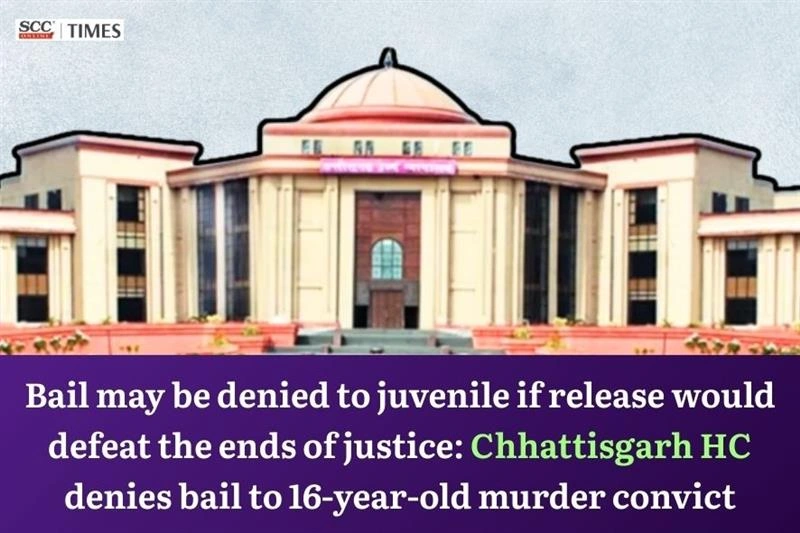
Chhattisgarh High Court: In a criminal revision petition filed under Section 102 of the Juvenile Justice (Care and Protection of Children) Act, 2015 (“JJ Act”) against the rejection of bail to a juvenile convicted of murder, a Single Judge Bench of Arvind Kumar Verma, J., rejected the petition, holding that grant of bail would defeat the ends of justice.
Background:
The case arose out of an incident wherein the juvenile convict, along with two other persons, abused and assaulted the victim (“the deceased”), eventually stabbing him, resulting in his death. The juvenile convict’s guardian sought bail via an application before the Juvenile Justice Board (“JJ Board”), but it was rejected via the impugned order. Hence, the present appeal.
Analysis:
The Court considered Section 12 of the JJ Act which deals with grant of bail to a juvenile and opined that though the consideration for bail of delinquents was entirely different, it still had to consider whether their release would defeat the ‘ends of justice’. The Court explained that the words ‘ends of justice’ should be confined to the fact which demonstrates that grant of bail itself is likely to result in injustice. This is substantiated by the exception to Section 12(1) which allows refusal to grant bail if the Court finds that the release would defeat the ends of justice.
Furthermore, the Court opined, contrary to usual practice of granting bail to juveniles irrespective of gravity of offence, that bail cannot be claimed by a juvenile as a matter of right and cannot be granted without considering the nature and gravity of offence. This is substantiated by the legislative intent behind adding the exception to Section 12(1) wherein bail could be denied to a juvenile. In this regard, the Court referred to Om Prakash v. State of Rajasthan, (2012) 5 SCC 201, wherein the Supreme Court observed that the gravity of offence and nature of crime cannot be ignored.
On the merits, the Court noted that the juvenile convict was alleged to have played an active role in inflicting fatal injuries with a sharp-edged weapon. Furthermore, the plea of private defence taken by the juvenile was not supported by material collected during investigation. The Court also noted that the Social Investigation Report indicated a lack of proper supervision, adverse influence, and likelihood of the juvenile convict associating with undesirable elements if released at this stage. The report also mentioned the necessity of supervision and corrective measures.
Reaffirming the Trial Court’s order, the Court remarked that the JJ Board and Trial Court rightly prioritized child protection over routine bail for the heinous offence of murder.
“Philosophical reflection reveals such acts as profound societal ruptures-violating the innate dignity and inviolabilities of childhood, echoing Kantian imperatives against treating humans as means, and underscoring eudemonia as communal virtue demanding collective vigilance to restore moral order.”
The Court further remarked that since the juvenile convict was 16 years old at the time of the offence, if he had been released on bail, it would have defeated the ‘ends of justice’ and frustrated the confidence reposed in the society. The act of the convict itself shakes the conscience of society and is heinous in nature. Thus, granting him bail would defeat the ends of justice.
“No doubt, the JJ Act is a beneficial legislation intended for reformation of the juvenile/child in conflict with law, but the law also demands that justice should be done not only to the accused, but also to the accuser.”
Accordingly, given the nature and gravity of offence, manner of commission, time and place of occurrence, and the evidence, the Court held that grant of bail at this stage would defeat the ends of justice.
Thus, the revision petition was rejected.
[A v. State of Chhattisgarh, 2026 SCC OnLine Chh 3142, decided on 13-02-2026]
Advocates who appeared in this case:
For the Appellant: Advocate Hemant Gupta
For the Respondent: Vivek Sharma Panel Lawyer
Buy Juvenile Justice (Care and Protection of Children) Act, 2015 HERE