The term “asynchronous” refers to actions that can be performed independently of scheduled hearing dates.
Introduction
The Indian judicial system is recognised for its constitutional independence, but it continues to grapple with structural inefficiencies that cause long delays in the delivery of justice. As per recent observations from judicial data and internal studies, over 60 per cent of the time of courts is consumed between the issuance of summons and the declaration of the accused as a proclaimed person.1 This period, which involves service of notices, verification of addresses, and payment of process fees, often extends over several hearing dates, each consuming valuable judicial time and adding to pendency.
The conventional model of judicial workflow is synchronous, meaning each procedural action is tied to a specific hearing date. When a procedural defect arises, such as an undelivered summons or unpaid process fee, the matter is adjourned to the next available date, often weeks later. This pattern repeats causing avoidable delays that contribute significantly to the backlog.
From date-driven to task-driven justice: Asynchronous case progression
Understanding asynchronous judicial actions
The term “asynchronous” refers to actions that can be performed independently of scheduled hearing dates. In a judicial context, this means that Judges, lawyers, and litigants can continue procedural steps between hearings, without waiting for the case to be called in open court.2 Such actions can be recorded, verified, and acknowledged digitally, maintaining judicial oversight while avoiding unnecessary adjournments.
By enabling asynchronous functioning, routine administrative steps such as verification of addresses, reissuance of summons, or payment of process fees can occur in real time. This transforms the case flow from a linear, date-dependent system into a continuous, responsive process.3
The two key enablers of asynchronous judicial functioning
The transition from a conventional, date-driven judicial workflow to an asynchronous model of judicial functioning rests on two foundational enablers. These enablers, described as the key unlocks, are essential for modernising case flow management and for addressing the most time-consuming procedural stages in trial courts particularly those relating to the issuance and service of summons, notices, and warrants.
1. Enabling asynchronous judicial actions
The first and most critical reform is the enablement of asynchronous judicial actions, whereby courts, lawyers, and litigants are empowered to act on judicial directions immediately upon communication, rather than waiting for the next formal hearing date. Under the traditional system, when a court issues directions such as reissuance of summons, verification of addresses, or payment of process fees the implementation of such directions ordinarily takes place only on the next date of hearing, often several weeks later. This leads to procedural stagnation and repeated adjournments without any adjudication on merits.
Under the asynchronous model, every judicial direction becomes digitally actionable in real time. By way of illustration, in a complaint under Section 138, Negotiable Instruments Act, 1881, the Magistrate, upon taking cognizance issues summons to the accused and fixes a hearing date after a few weeks. If the summons is returned unserved within a few days for instance, due to an incomplete address the system automatically notifies the complainant through the courts digital platform to rectify the defect. Upon submission of the corrected address and payment of the requisite process fee online, the summons is reissued immediately, without awaiting the next hearing.
Further, if the accused acknowledges receipt of the summons electronically through ePost, a digital signature, or other authenticated means the acknowledgement is automatically captured and recorded in the case management system. As a result, procedural steps that would ordinarily require three or four hearing dates can be completed within days, without judicial delay or unnecessary adjournments. Asynchronous functionality thus ensures that case progression continues dynamically between hearings, transforming the workflow from a rigid, date-dependent process into a continuous and responsive one.
2. Seamless digital communication with ePost and police authorities
The second key enabler is the establishment of seamless digital communication between courts, India Post’s ePost system, and police service portals. One of the primary sources of delay in both civil and criminal proceedings is the manual, opaque, and unreliable service of summons, notices, and warrants. In the existing framework, physical dispatch through postal channels or local police stations often lacks real-time tracking, and courts may remain unaware for months whether service has been effected.
Digital integration directly addresses this systemic inefficiency. When a Magistrate issue summons, the order can be transmitted electronically through the ePost platform, generating a unique digital tracking number. This enables courts and litigants alike to monitor the status of service in real time. Upon delivery, acknowledgement whether by digital signature, biometric verification, or photographic evidence is automatically uploaded to the Court’s case management system.
Similarly, in criminal proceedings requiring police service, digital linkage allows investigating officers to confirm service of summons or execution of warrants instantaneously, eliminating delays caused by manual reporting. Through such integration, the entire chain from issuance to service and acknowledgement becomes transparent, time-stamped, and legally verifiable. Judges can review service records at any stage, including between hearings, and issue further directions where necessary.
This seamless communication ensures reliability, accountability and near real-time compliance, effectively transforming one of the slowest procedural stages in judicial proceedings into one of the most efficient.
Illustrative example: A timeline of asynchronous case progression
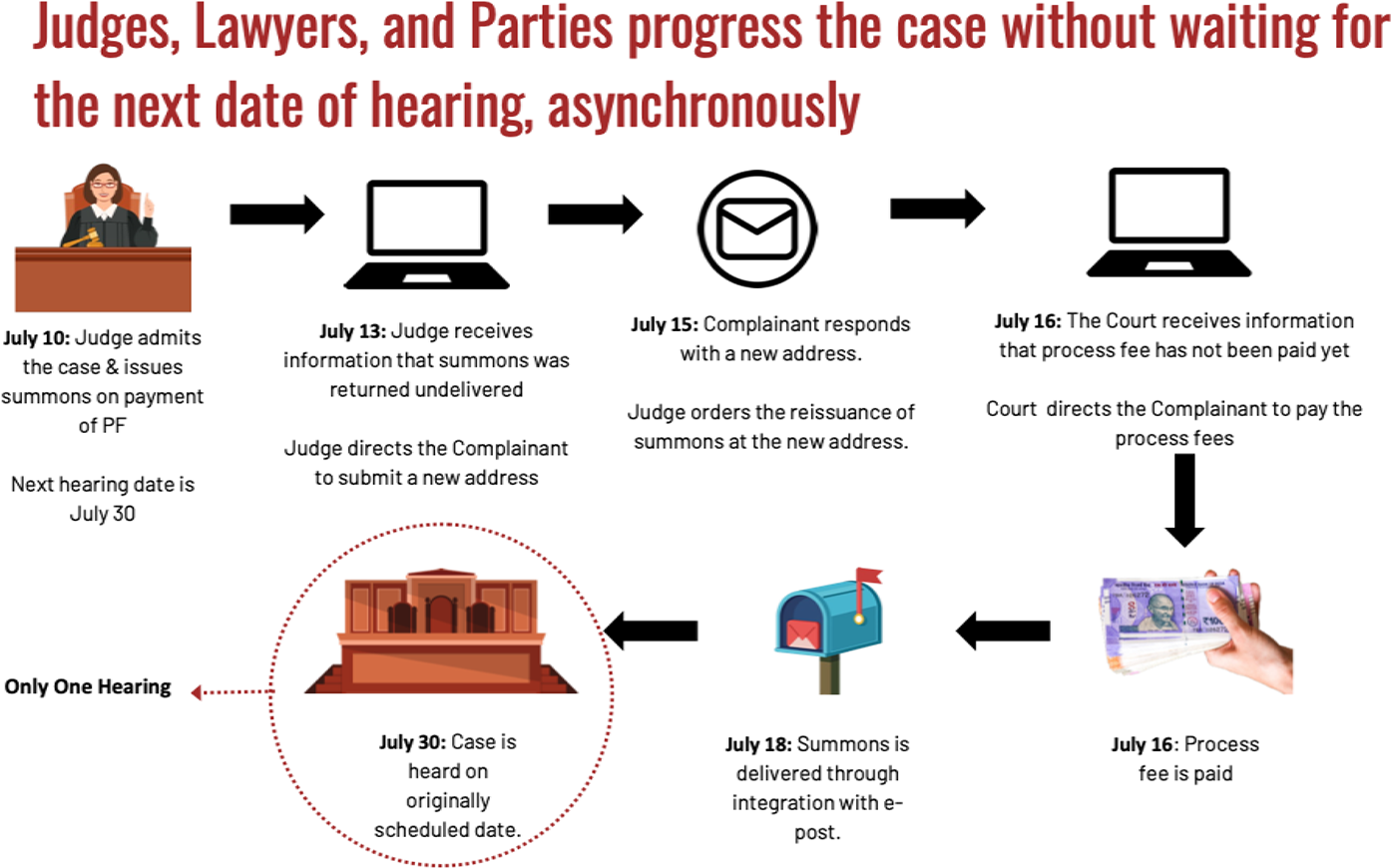
To illustrate the potential of this approach, consider the following example of a case that progresses asynchronously between 10 July and 30 July:
1. July 10: The Judge admits the case and issues summons upon payment of the process fee (PF). The next hearing date is fixed for July 30.
2. July 13: The Judge receives electronic information that the summons was returned undelivered. Instead of waiting for the next date, the Judge directs the complainant online to submit a new address.
3. July 15: The complainant promptly responds with the updated address. The Judge, through the system, orders reissuance of the summons to the new address.
4. July 16: The court system receives an automated alert that the process fee has not been paid. The Judge directs the complainant to pay the fee immediately, and the complainant complies on the same day.
5. July 18: Through digital integration with ePost, the summons is successfully delivered and confirmed electronically.
6. July 30: The case proceeds to hearing on the originally scheduled date. All procedural defects and delays that would have led to multiple adjournments are resolved asynchronously between hearings.
Thus, only one hearing was needed instead of the usual three or four. Each procedural step was addressed promptly, without waiting for the next court date.
The adoption of the asynchronous model in judicial processes, thus, offers several significant advantages in terms of efficiency, transparency, and legal certainty. First and foremost, it leads to a substantial reduction in procedural delays. Traditionally, the progress of a case has been constrained by fixed hearing dates, resulting in weeks of idle time between procedural steps such as reissuance of summons, address verification, or payment of process fees. Under the asynchronous framework, these actions can occur dynamically within days rather than weeks, ensuring that the case continues to move forward even when not listed before the court.
Secondly, the model leads to enhanced judicial productivity. Judges are empowered to issue directions and monitor compliance electronically, enabling continuous oversight and progress without the need for repeated oral hearings. This transformation allows courts to reserve their physical sittings for substantive adjudication rather than routine procedural management. Consequently, judicial time is optimised, and the effectiveness of each hearing is greatly improved.
A further advantage lies in increased transparency and accountability. The integration of court systems with digital communication channels such as ePost and police networks ensures that the process of service of summons and notices is electronically logged and verifiable. Each step from dispatch to delivery can be digitally tracked, thereby minimising disputes regarding service and eliminating accountability gaps.
Additionally, the asynchronous model contributes directly to the reduction of pendency and workload. By resolving procedural steps outside the conventional hearing schedule, courts are able to free up substantial portions of their calendar for effective hearings and adjudication on merits. This not only accelerates the disposal rate of cases but also helps in systematically addressing the chronic backlog in courts without compromising principles of due process.
Finally, the model reinforces compliance and legal certainty. Every asynchronous action, be it a judicial order, compliance submission, or service confirmation is digitally recorded, time-stamped, and certified within the case management/information system. This ensures adherence to the procedural requirements under the Civil Procedure Code, 1908 (CPC) and the Criminal Procedure Code, 1973 (CrPC)/Nagarik Suraksha Sanhita, 2023 (BNSS). The digital authentication and preservation of orders strengthen the integrity of judicial proceedings and ensure that the entire process remains transparent, verifiable, and legally robust.
In essence, the asynchronous model represents a paradigm shift from a date-driven to a task-driven judicial process, one that aligns efficiency with fairness, and technology with the fundamental principles of justice.
Legal and technological viability of the asynchronous model
The proposed system does not demand statutory amendment. The current legal framework already empowers courts to issue electronic summons, accept online submissions, and communicate digitally. The Information Technology Act, 2000, in conjunction with procedural rules and e-court guidelines, provides a robust legal basis for implementing these changes.
From a technological perspective, the National Judicial Data Grid (NJDG) and E-Courts Mission Mode Project already provide foundational digital infrastructure. The next step is the integration of external communication channels notably, ePost and police service portals to create a seamless and automated flow of information.
Roadmap for implementing asynchronous judicial processes
The successful implementation of asynchronous judicial processes requires coordinated and structured action at multiple institutional levels. At the policy level, judicial and administrative reforms under the aegis of the e-Committee of the Supreme Court of India can formally recognise and incorporate asynchronous workflows into procedural guidelines and e-court protocols. Such policy endorsement would provide uniformity and clarity in the adoption of asynchronous practices across courts.
Equally important is capacity building. Judges, advocates, and court staff must be provided with targeted, hands-on training to effectively manage digital communication platforms, electronic case management systems, and real-time procedural compliance tools. Without adequate training, the benefits of technological reform may remain underutilised.
From a technological standpoint, the development of secure application programming interfaces (APIs) linking court information systems with India Post’s ePost platform and police service portals are essential. Such integration would enable end-to-end digital tracking of summons, notices, and warrants, ensuring transparency, accountability, and timely compliance at every stage.
Finally, the adoption of asynchronous case management should be introduced through pilot projects in select district and subordinate courts. These pilot initiatives would allow the judiciary to empirically assess efficiency gains, identify operational challenges, and refine workflows before scaling the model nationwide. Evidence-based implementation would ensure that the transition to asynchronous judicial processes is both effective and sustainable.
Conclusion
The introduction of asynchronous actions and seamless digital communication represents a transformative shift in judicial process management. By enabling Judges, lawyers, and litigants to perform procedural actions between hearings, the judiciary can substantially reduce pendency, improve access to justice, and make efficient use of judicial resources.
As a direct consequence of adopting this asynchronous workflow, the stage of summons consumes far less of the courts time, as procedural communication and compliance occur dynamically rather than awaiting formal hearing dates. The number of hearings devoted merely to securing the appearance of the accused or parties is drastically reduced, thereby freeing substantial judicial time for substantive adjudication.
In a system where over 60 per cent of court’s time was traditionally consumed by the process of service of summons and declaration of proclaimed persons, this procedural reform holds the potential to redefine how justice is delivered in India. The asynchronous model ensures that justice does not wait for the next date of hearing, but progresses continuously aligning judicial functioning with the efficiency, transparency, and responsiveness demanded in the digital era.
*OSD, Punjab and Haryana High Court, ACJ (SD), Chandigarh, Author can be reached at: guddijia@gmail.com.
1. Dhananjay Joshi, “Relevance of Issuing Proclamations in Criminal Proceedings for Securing the Presence of Accused Persons”, Bar and Bench (21-10-2020) available at <https://www.barandbench.com/columns/relevance-of-issuing-proclamations-in-criminal-proceedings-for-securing-the-presence-of-accused-persons>.
2. Richard E. Susskind, Online Courts and the Future of Justice (Oxford University Press 2019) 52-55; see also Richard Susskind, “Written Evidence to the Justice Committee on Court Reform” (UK Parliament, 2021) para 10.
3. Richard E. Susskind, Online Courts and the Future of Justice (Oxford University Press 2019) 52-55; see also Richard Susskind, “Written Evidence to the Justice Committee on Court Reform” (UK Parliament, 2021) para 10.