
Disclaimer: This has been reported after the availability of the order of the Court and not on media reports so as to give an accurate report to our readers.
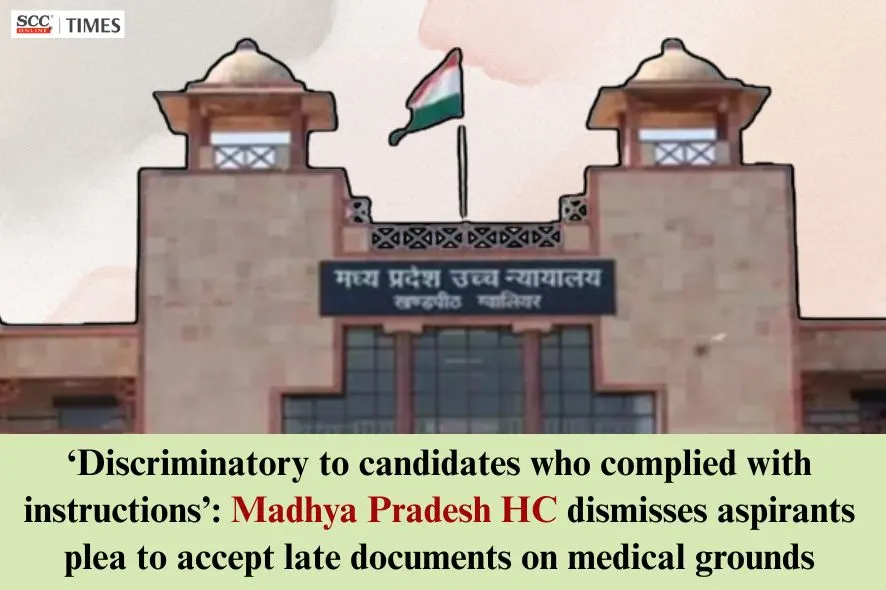
Madhya Pradesh High Court: In a petition under Article 226 of the Constitution , praying to direct the Madhya Pradesh Public Service Commission to accept documents after the expiry of prescribed time on medical ground, the court rejected a plea for late document submission and reinforced that recruitment authorities cannot relax deadlines unless the rules expressly allow it. The Single Judge Bench of Jai Kumar Pillai J., held that granting such relief would not only be unacceptable in eyes of law, as there is no clause for such relaxation in the official advertisement, but also discriminatory to candidates who complied with Commission’s instructions despite their personal challenges. In view of the settled law in this context, the Court found no reason to interfere with the recruitment process which had attained finality and thereby dismissed the petition.
Background
The petitioner, a candidate for the post of Assistant Professor, sought relief under Article 226 of the Constitution to direct Madhya Pradesh Public Service Commission (‘MPPSC’) to allow her to submit documents after she missed the deadline.
The MPPSC had previously extended the last date twice subject to some late fees. However, she failed to submit her documents in time, citing her medical condition as the reason for delay. But the same was not accepted by the commission.
Aggrieved by the MPPSC’s decision, she approached the High Court. As an interim relief, she was allowed to participate in the interview round subject to the final outcome in the matter.
Issues & Analysis
-
Whether the Court can interpret the terms and conditions of recruitment laid down in official Advertisement?
The Court examined the clauses of the official advertisement and observed that there was no scope for interpretation by the Court, as they were comprehensive. The Court also noted that the Advertisement created a statutory obligation binding upon the candidate, and their participation in the recruitment process implied their acceptance of these obligations. The Court then relied upon the judgment of the Supreme Court in Thahira P. v. Administrator, Union Territory of Lakshadweep, (2018) 6 SCC 446, to hold that it is no longer res integra that “terms of an Advertisement are sacrosanct and cannot be diluted by judicial interpretation”.
-
Whether relaxation can be granted to a candidate, on medical grounds, in complying with terms of the recruitment process?
The Court noted that, where the terms of the recruitment expressly disqualify a candidate on account of failure to comply with the instructions given by the recruiting authority, no relief can be granted in any individual case. Further, it was noted that the candidate failed to submit her documents before the last date, even after the deadline was extended twice. The Court stated that “once the final date expired, the Commission became functus officio in so far as the petitioner’s candidature was concerned”.
The Court observed that such relief cannot be granted for two main reasons. Firstly, due to the view taken by the Supreme Court in the judgment of Bedanga Talukdar v. Saifudaullah Khan, (2011) 12 SCC 85, that “appointments to public office must strictly follow the advertised selection procedure and no relaxation can be granted unless power is expressly provided in the rules or the Advertisement”. Secondly, to avoid any injustice or discrimination against the candidates who duly complied with the instructions.
The Court thus held that medical difficulty cannot be availed by the candidates when the recruitment authority does not allow it.
-
Whether participation in a selection process pursuant to the interim relief, confers any equitable rights to the candidate?
The Court held that it is a settled position of law that participation in the further selection process of recruitment, on the basis of an interim order, is done at the candidate’s own risk since the actual relief is subject to final disposal of the case. The Court referred the judgment of the Supreme Court in State of Rajasthan v. Hitendra Kumar Bhatt, (1997) 6 SCC 574, wherein this view was taken.
-
Whether a recruitment process can be re-examined after it has attained finality in pursuance of the rules advertised?
The Court opined that once a selection cycle has been completed, it should be left undisturbed, especially when no illegality or arbitrariness is proved by the petitioner.
The Court stated that it is the responsibility of the candidates to act vigilantly to fulfil the requirements of the recruiting authority. The Court thus held that any interference by the Court would dilute the provisions of recruitment, which is against the settled legal position.
Therefore, the Court finally held that the recruitment authority became functus officio for the candidate on the expiry of the prescribed time. No relief can be granted to the candidate in the absence of any specific provision for that relief in the advertised terms and conditions. Further, the interim relief was conditional and subject to the final view taken by the Court while disposing the matter.
Hence, the Court disposed of the petition by dismissing it.
[Aaradhna Buj v. State of Madhya Pradesh, 2026 SCC OnLine MP 394, decided on 21-01-2026]
Advocates who appeared in this case:
For the petitioner: Shri Prasanna R. Bhatnagar
For the respondent no. 1: Drishti Rawal
For the respondent no. 2: Vindhyavashini Prasad Khare
Buy Constitution of India HERE