
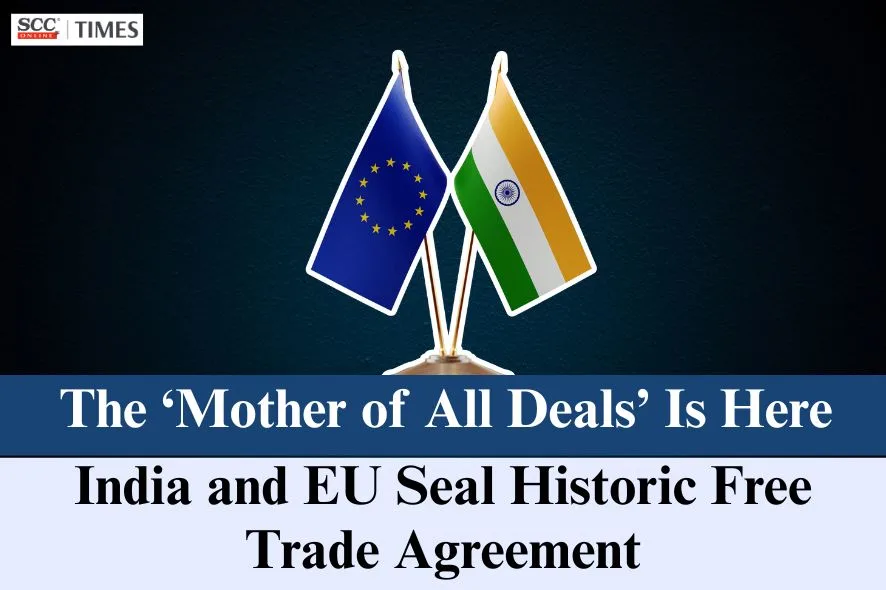
On 27-1-2026, India and the European Union (‘EU’) announced the conclusion of the India—EU Free Trade Agreement (India—EU FTA) at the 16th India—EU Summit. This marks a significant step in India—EU economic relations and trade engagement.
Jointly declared by Hon’ble Prime Minister Narendra Modi and European Commission President H.E. Ms. Ursula von der Leyen the agreement has been termed the “Mother of All Deals.”
This landmark pact grants India preferential access to nearly the entire EU market while safeguarding sensitive domestic sectors. It reflects a strategic vision of integrating the Indian economy with global value chains, empowering MSMEs, and creating new opportunities for farmers, manufacturers, and service providers.
With bilateral trade already valued at ₹11.5 lakh crore ($136.5 billion) in 2024—25, the agreement is expected to transform India—EU relations into a multifaceted partnership.
Key Highlights of the India—EU FTA:
India’s Gains:
-
Immediate duty elimination on 70.4% of tariff lines, covering 90.7% of India’s exports (textiles, leather, footwear, tea, coffee, spices, gems & jewellery, marine products).
-
Zero duty access over 3—5 years for 20.3% of tariff lines (processed food, marine products, arms).
-
Preferential access/TRQs for 6.1% of tariff lines (cars, steel, poultry, shrimps).
India’s Offer to EU:
-
92.1% of tariff lines offered, covering 97.5% of EU exports.
-
49.6% immediate duty elimination, 39.5% phased elimination (5—10 years).
-
TRQs for sensitive fruits (apples, pears, peaches, kiwi).
Sectoral Gains
-
Agriculture: Preferential access for tea, coffee, spices, grapes, cucumbers, dried onion, fresh vegetables, and processed foods; safeguards for dairy, cereals, poultry, soymeal, and sensitive fruits/vegetables.
-
Textiles & Apparel: Tariff cuts up to 12%, opening EU’s $263.5 billion import market.
-
Leather & Footwear: Tariffs up to 17% eliminated, unlocking EU’s $100 billion market.
-
Marine Exports: Tariffs up to 26% removed, boosting shrimp and seafood exports to EU’s $53.6 billion market.
-
Engineering Goods: Preferential access to EU’s $2 trillion import market.
-
Chemicals: Zero duty on 97.5% of India’s chemical export basket, enhancing competitiveness in EU’s $500 billion chemical market.
-
Jewellery: Tariffs up to 4% eliminated, strengthening India’s $2.7 billion exports.
-
Furniture & Home Decor: Tariff cuts up to 10.5%, supporting wooden, bamboo, and handcrafted furniture.
Services & Mobility
-
144 services subsectors covered, including IT, professional services, education, maritime, and financial services.
-
Ease of mobility for business visitors, intra-corporate transferees, contractual service suppliers, and independent professionals.
-
Framework for Social Security Agreements within 5 years.
-
Boost for AYUSH traditional medicine practitioners in EU markets.
Standards & Intellectual Property
-
Product Specific Rules (PSRs): Self-certification allowed, aligned with supply chains, MSME-friendly.
-
IPR Chapter: Cooperation on laws, recognition of India’s Traditional Knowledge Digital Library (TKDL).
-
SPS & TBT Measures: Equivalence on sanitary/phytosanitary standards, digitisation, and adherence to international norms.
Strategic Impact
The India—EU FTA is set to reshape bilateral trade dynamics by significantly expanding India’s export footprint in Europe. In 2024—25, India’s exports to the EU stood at ₹6.4 lakh crore ($75.85B), a figure expected to rise as labour-intensive industries such as textiles, leather, and marine products, alongside high-tech sectors, gain preferential access to European markets.
For MSMEs, the deal provides long-term stability, predictable market entry, and deeper integration into EU supply chains, strengthening global competitiveness. Consumers in both regions will benefit from reduced input costs and a wider variety of goods, ensuring inclusive growth.
This FTA is more than a trade pact; it is a forward looking partnership that is expected to transform India—EU economic relations, empower MSMEs, boost labour-intensive industries, and strengthen India’s position.
Frequently Asked Questions (FAQs)1 on India—EU Free Trade Agreement:
-
What is the bilateral merchandise trade between India and the EU?
India’s total merchandise trade with the EU reached USD 136.54 billion in 2024—25, with exports rising at a CAGR of 16.4% and imports growing at 11.2% since 2020—21.
-
What benefits will India receive from EU’s tariff concessions?
The EU will eliminate duties on 70.4% of tariff lines immediately, covering 90.7% of India’s export value, and phase out duties on 20.3% more. In total, concessions cover 97% of tariff lines and over 99% of trade value.
-
What tariff concessions is India offering to the EU?
India will give 49.6% of tariff lines duty-free access immediately, and place 39.5% under phased elimination (5/7/10 years). India’s total offer covers 92.1% of tariff lines and 97.5% of trade value.
-
What is the duration of the India-EU FTA?
The India-EU trade deal is valid for indefinite duration. Either Party may terminate the trade deal by providing written notification, with termination taking effect after the period specified in the trade deal.
-
What are the important categories of products excluded by EU from tariff concessions?
The EU has excluded items such as meat and meat offal, dairy products, Honey, rice, sugar, tobacco etc.
-
What are the Rules of Origin (‘RoO’) provisions?
RoO are designed to align with existing supply chains while ensuring adequate processing in India or the EU, with flexibility in sourcing inputs and streamlined origin certification.
-
Are there any safeguard mechanisms to protect the Indian domestic industry from surge in imports from EU?
Yes, in the event there is a surge in imports into India from the EU on account of tariff liberalisation commitments under the trade deal, so as to cause or threaten to cause serious injury to a domestic industry, the trade deal provides a bilateral safeguard mechanism.
-
What are technical barriers to trade and why is it important to address them in trade deal?
Technical Barriers to Trade (‘TBTs’) are behind-the-border rules related to product standards, technical product specifications (technical regulations) and tests or certificates (conformity assessment). While these measures are intended for legitimate goals like consumer protection or environment, they may sometimes create market barriers by increasing compliance costs and introducing complex regulatory procedures.
-
What is the scope of the Intellectual Property Chapter in the EU-India trade deal?
The IP chapter creates a unified framework for protecting and enforcing intellectual property to support innovation, creative industries, and technology access. It reaffirms TRIPS commitments and covers copyrights, trademarks, GIs, industrial designs, trade secrets, plant varieties, and enforcement measures. While it does not include a dedicated patent section, it contains a general provision on technology transfer.
-
How is transparency ensured under the India-EU trade deal?
The Transparency chapter promotes openness, predictability, and fairness in the administration of the trade deal. It requires both India and the EU to:
-
promptly publish measures of general application;
-
maintain enquiry mechanisms to respond to questions on laws, regulations, and administrative practices; and
-
administer measures in an objective and impartial manner, including providing for review and appeal procedures for administrative decisions.
-
-
What happens if India or EU face balance-of-payments or external financial difficulty?
In situations of serious balance-of-payments or external financial difficulties, a Party may adopt temporary and non-discriminatory restrictive measures in accordance with IMF rules and relevant WTO provisions. Such measures must be proportionate, transparent, and phased out as conditions improve.
-
How are disputes under the Legal and Institutional Provisions resolved?
Disputes relating to interpretation or application of the trade deal may be addressed through consultations in the Joint Committee or specialised committees. Where required, matters may be taken up under the Dispute Settlement mechanism of the trade deal, without prejudice to Parties’ right to approach the Rapid Reaction Mechanism.
-
How does the trade deal address the accession of a third country to the European Union/
The trade deal contains a dedicated provision on Future Accessions to the Union. Under this provision, the EU is required to:
-
notify India of requests for accession by third countries;
-
provide relevant information during accession negotiations, upon request;
-
take into account India’s concerns; and
-
put in place necessary amendments, adjustments, or transitional arrangements to address the effects of such accession on the FTA.
-
-
What is the Rapid Reaction Mechanism (‘RRM’)?
The RRM is a fast-track system to resolve regulatory or implementation issues that could disrupt India—EU trade. It addresses concerns about new or existing regulations and major FTA implementation challenges. It functions through three levels—specialised committee, senior officials, and finally the Joint Committee at the ministerial level, each with set timelines to ensure quick resolution.
-
Why is Sustainable Food Systems (‘SFS’) chapter included, and what does India gain from it?
The SFS chapter is a first-of-its-kind cooperation framework that helps India engage with the EU on sustainability issues in food systems without new obligations, boosting India’s export credibility, supporting public health and climate goals, and making sustainability a core part of trade cooperation
1. https://www.pib.gov.in/PressReleasePage.aspx?PRID=2220413®=3&lang=1