
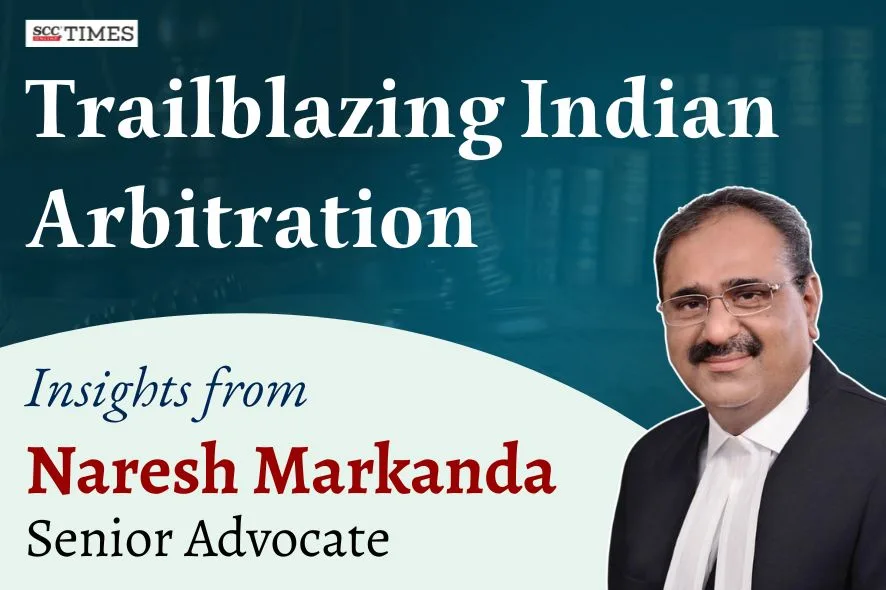
1. What was the journey behind establishing the legacy of “Markanda Advocates” as a household name in the field of arbitration?
The journey started in the year 1958 when my father, late Dr P.C. Markanda, came to Chandigarh from Jalandhar after completing his Diploma in Engineering. He joined as a Junior Engineer at Panjab University, which was in its nascent stages of construction. He acquired in-depth knowledge of Civil Engineering and rose to the rank of Executive Engineer. In 1985, after putting in 27 years of service, he sought voluntary retirement to pursue a career in law. He had earned his LLB degree by attending evening classes in the Panjab University in 1977-1978.
After entering the field of law, he developed immense interest in the subject of Arbitration, which was not a very popular specialisation in those days. By gainfully utilising his knowledge gained over 27 years of practical experience in the field of Civil Engineering, and with a lawyers’ license in hand, he was sought after by contractors who had gone in for arbitration for resolution of the disputes. In fact, due to the massive infrastructure created on account of the Asian Games of 1982 held in Delhi, there was a surfeit of arbitration cases related thereto. Dr Markanda was engaged as counsel by a few of the companies and with sheer dint of hard work and knowledge, he delivered good results, which resulted in his being engaged by a host of other companies.
Since his work picked up pace within 1-2 years of his joining the profession, he asked me to join him after completing my Engineering degree. I followed his sagacious advice and took a complete career turn from the field of Engineering to donning the lawyers’ robes. The rest, as they say, is history. The journey continues even as on date, with the addition of able associates in our office to assist us in this pleasant journey.
2. How was your experience from a young law student to a distinguished Senior Advocate like? Can you share how your law school journey and early days in profession shaped your views about life in law and alternative dispute resolution?
Even as a student of law, I made it a point to sit in my father’s office every evening to observe his style of working and deeply imbibe within myself his conduct and interactions with various clients. I also closely observed him while dictating briefs to the stenographer. What struck me at that time was the clarity of his thought process, which taught me the most important lesson in this profession, viz. unless you are clear on facts and law, your pleadings will not be up to the mark. Lack of proper pleadings sounds the death knell of even the best possible brief.
Interestingly, during my time at the law school (three-year course), the subject of arbitration/alternative dispute resolution was not even a part of the curriculum. The irony is that my chosen field of practice was not taught to me in the law school and whatever knowledge about the subject I gained was only through books and practical experience. In this light of the matter, it would be my sincere advice to all the budding lawyers to make it a habit to read books and also keep abreast of the development in their chosen subject of practice. One way of doing it would be to keep a track of latest judgments rendered by the Supreme Court and various High Courts. It would also be beneficial to read papers of various authors on the internet.
3. How has the Indian arbitration landscape evolved from the time of the birth of the Arbitration and Conciliation Act, 1996, to present day? What challenges do you face as an arbitrator?
When I started practice, the Arbitration Act, 1940 (1940 Act) was in vogue. The enactment of Arbitration and Conciliation Act, 1996 (1996 Act) was a sea change for us, who were initiated into the profession under the 1940 Act regime. However, as the saying goes, “Change is the only constant”, we were left with no option but to quickly switch on to the new Act, lest the people behind us in the queue leap-frog us. This was also imperative since I was assisting my father during the period of transition in the writing of 1st Edition of our book on Law of Arbitration and before the book could go to print, the new Act was enacted. Resultantly, we had to smoothly transition from the old Act to the new Act, but since the old Act would remain in vogue for on-going cases, care was taken to blend the old with the new.
Over a period of time, the 1996 Act has evolved through various pronouncements of the courts. The judgments rendered in the initial days of the 1996 Act have been overruled due to the experience gained over the years on the working of the Act. The very fact that the 1996 Act has already seen two Amendments in 2015 and 2019 and the third Amendment is in the works, it would be safe to say that the 1996 Act (including Amendments thereto) is of a dynamic nature, calling for constant updating of the provisions thereof to suit the pace of economic growth of the country and the influx of foreign capital. The antiquated legal system is a great deterrent to the foreign investors. The down-side is that despite many practical changes having been made to the Act, the implementation thereof leaves a lot to be desired. A glaring example of the inertia in the system is the snail’s pace at which the courts are deciding the proceedings under Sections 34 and 37 of the Act. Despite a salutary provision in Section 34 of the Act to the effect that the objections should be disposed of within one year of the appearance of the respondent in the proceedings, there is not even a minuscule percentage of cases which adhere to this norm. There is no remedy in sight, leading to blocking of money for years together. Introduction of Section 36(3) by way of 2019 Amendment was a welcome step, but if the decree-holder has to enjoy the fruits of the decree, he has to furnish security to the court during the pendency of the Section 34 proceedings, which takes eons to be decided. There are more examples of the tardiness in the proceedings, but it would take hours to enumerate. In short, though there have been commendable efforts to make ADR a viable option, but the results are not commensurate with the efforts. However, I am an eternal optimist.
4. Can you share a memorable case, a landmark victory, or a turning point in your career that significantly influenced your approach to arbitration advocacy?
The initial days in the profession were a part of the learning curve. At that stage, the endeavour of every young advocate is to assimilate as much knowledge as is possible by keenly observing the court proceedings and the interaction between the judge and the lawyer. I was also a keen observer in the initial days and the habit has lasted till date. I would not like to single out any particular case as being the source of inspiration or influence in my career. Here I would like to specifically mention that one learns more from those cases which do not go in your favour since you learn not to commit the same mistakes or advance the same arguments in a subsequent matter. It also teaches you to prepare the brief from the point of view of the opposite side so that you have all your defences ready at the time of arguments. I distinctly remember having assisted my father in a case in the Himachal Pradesh High Court which was decided against us, but the knowledge of law that I gained while assisting the Senior Counsel helped me in many subsequent cases which went in our favour. Another example would be a case conducted by me in the Delhi High Court where the issue of limitation was involved. I made an in-depth study pertaining to the law of limitation and made a brief note for the facility of the Court citing therein various judgments. The case was decided in my favour and the judge was greatly assisted by the self-speaking short synopsis submitted by me. Since that day, it has been a regular practice in our office to prepare a brief note/synopsis for the facility of the court/Arbitral Tribunal.
5. Being re-elected for a third consecutive term to the Governing Body of the Indian Council of Arbitration (ICA) is a significant milestone that reflects the immense trust the legal fraternity places in your leadership. What was the most memorable experience being at the helm of ICA? As you enter this new term, what key policy reforms or structural changes do you intend to champion?
This is my third term as a member of the Governing Body of the ICA. Unfortunately, about two years were lost due to COVID and its after effects, inasmuch as physical meetings were not held. ICA is the primary organisation of arbitration in the country having more than 7000 members, including distinguished jurists, bureaucrats, engineers, lawyers, chartered accountants, etc. The Chambers of Commerce and Industry of various States are also members of ICA. Heads of the leading industrial houses are also members. With such elite gathering, ICA has grown leaps and bounds in the last nearly two decades. ICA has organised conferences in various cities across the country as well as abroad to spread the utility of ADR mechanism. The conferences have been addressed by Judges of the Supreme Court and High Courts, who have shared their experience with the participants. There has been a constant encouragement to propagate the benefits of ADR mechanism. A conference was held in Chandigarh by ICA in September 2024, which attracted encouraging participation across various fields. The present Chief Justice of India was the lead speaker at the conference and offered detailed insight about some of his leading judgments in arbitration.
One change which I would personally like to see is that the panel of arbitrators maintained by ICA, which contains people of immense repute in their chosen disciplines, is circulated amongst all the High Courts in the country and appointment of arbitrators is made from this panel. Presently, the High Courts are appointing arbitrators from their own panels, which is primarily region-based. The ICA panel is more wide-ranging, thereby offering a much larger choice of persons.
I am also a vocal protagonist of the Arbitral Tribunals being broad based rather than comprising only of jurists or engineers or the like. From personal experience, I can safely say that any tribunal comprising of people from the same profession is not fully abreast of other fields, leading to procedural mistakes or wrong decisions due to lack of knowledge of the proper procedure/law. There is a tendency to appoint only retired judges as arbitrators, with which I have no quarrel, but in a matter which involves technical disputes, a retired judge would not have the wherewithal to handle the same in an effective manner. The subject-matter and nature of the dispute should form the bedrock of the appointment process.
I have also stated in various meetings of the Governing Body that in the light of the judgment of the Constitution Bench of the Supreme Court in Central Organisation for Railway Electrification v. ECI SPIC SMO MCML (JV) A Joint Venture Company4, where the Supreme Court has frowned upon appointment of arbitrators from the curated panels of various organisations, the ICA panel of arbitrators would act as the perfect panel ensuring independence and impartiality, which is the very foundation of arbitrations. ICA has made commendable efforts to this end and I am sure that in the coming days, the fruits would be there for all to see.
There are many other initiatives which ICA has taken, but it will take time for the same to fructify. I am of the view that it should form a separate topic of discussion rather than being confined to a straitjacket answer to a question.
6. Late Dr P.C. Markanda, fondly remembered as the “Father of Indian Arbitration”, set forth the foundation of arbitration law in India. Can you share a personal memory or a piece of advice from Dr P.C. Markanda, which shaped your philosophy, something that you imbibe deeply in your life and legal practice?
I have said enough about my association with Dr P.C. Markanda, who played a dual role, a hard taskmaster in the office and a father outside it. The delicate balance between a father and a senior was ably maintained by him, which, in itself, was a great learning experience. I would be dishonest in saying that I have been able to maintain that balance in my office, since both my son and nephew are in the office. My father had always advised me to keep my thinking cap on at all times since you never know as to from which source you can gain knowledge, which may stand you in good stead in the future. Though he had given me a lot of freedom with respect to professional matters, but I was always advised to show him the final draft before being filed before the court/Arbitral Tribunal. As I have said before, it is not always the spoken word which shapes your thought process, even observing your senior at work can be a lifelong lesson.
7. How do you see the future of Indian arbitration building and how can India position itself as a preferred seat for international commercial arbitration?
The future of Indian Arbitration is too difficult to predict at the present stage. On the one hand, there have been lengthy sermons by judges, politicians, and academicians eulogising the benefits of ADR mechanism, on the other hand, the Central Government and some of the State Governments have issued circulars/notifications removing the arbitration clause from the contracts. This would mean clogging the already choked courts. The day is not far off when the system would collapse under its own weight. Further, the interminable court proceedings would frustrate and harass the litigants, who would have got a decision in a much lesser time-frame through arbitration. What such a step would do to the influx of foreign companies and capital investment in the country does not require much guesswork. The withdrawal of arbitration clause is a retrograde step, which deserves severe condemnation. I, sincerely hope that there would be court intervention to thwart such an ill-conceived step.
What to talk of India being a preferred destination for international commercial arbitration, it would be a miracle if the ADR mechanism itself survives the onslaught of State excesses. To this extent, I am quite sceptical about India being a preferred arbitration destination. In the near future, Singapore will continue to be the prime location of international arbitrations.
8. What reforms or innovations do you feel India should strive for to improve the overall accessibility and efficiency of arbitration? What role do you think technology and artificial intelligence will play in the next decade of arbitration practice in India?
I have dealt with the pitfalls in the system in sufficient detail while answering the previous questions. My foremost suggestion would be to divest the courts at the district level from having any jurisdiction on any matter arising out of the Arbitration Act. The jurisdiction should exclusively vest in the respective High Courts, where there should be at least four dedicated Single Benches and two dedicated Division Benches to deal exclusively with matters arising out of the Arbitration Act. The strength of dedicated Benches can vary depending on the strength of the High Court. There must be strict timelines for disposal of matters. The exceeding of the timelines should be allowed only in exceptional circumstances and not as a matter of routine. There are a host of other suggestions, but it would take a long time to detail out the same. This may be a topic for discussion at a later date.
Technology and artificial intelligence (AI) are set to play a transformative role in arbitration practice in India over the next decade, drawing lessons from the way such tools have already been incorporated into dispute resolution and judicial systems in the United States of America. In the United States, technology is widely used for digital case management, virtual hearings, legal research, and data-driven analytical support, allowing decision-makers to handle complex disputes more efficiently and consistently. Similarly, in India, AI-assisted document review, research, and procedural management can significantly reduce time and cost, particularly in large, technical, and cross-border arbitrations. While these tools would result in enhanced efficiency, I feel that core functions such as assessing evidence, credibility, and legal reasoning will remain the domain of courts/Arbitral Tribunal, with AI operating as an enabling aid. The focus going forward must be on adopting clear institutional guidelines to address data protection, confidentiality, transparency, and due-process concerns, supported by informed oversight from arbitrators and counsel.
9. Lastly, considering the growing competition and rising avenues in the field of alternative dispute resolution, what advice would you give to young law students, lawyers and professionals aspiring to build a career in arbitration?
My advice would be the same as has been handed out over generations and it is that there is no substitute for hard work. The road to success is never smooth. There are numerous road blocks and only those who successfully navigate through these road blocks attain success. Every case should not be seen from the prism of victory and defeat. At the end of the day, one should self-introspect and assess whether they have assimilated anything new in the field of law. Knowledge once gained would be useful for all times to come. Another habit which should be inculcated in all new comers to the field should be to take down notes, be it by hand or digitally. Human memory, being what it is, tends to fade, but written notes remain forever. Arbitration is a highly specialised branch of law. It is more akin to proceedings in a trial court. Therefore, special emphasis has to be placed on drafting of pleadings, compilation of documents, and the like. Even though the Civil Procedure Code, 1908 (“CPC”, for short) and the Sakshya Adhiniyam, 2023 (“BSA”, for short) are not strictly applicable to arbitrations, but principles thereof are certainly applicable. The current day trend is that arbitrations have become like trials, with framing of issues, filing of evidence affidavits and cross-examination becoming an integral part of the proceedings. That being so, working knowledge of CPC and BSA has become all the more imperative. To this end, I am of the firm view that young lawyers should spend some quality time observing, and if possible, conducting cases in the trial court. I would also recommend young lawyers to associate themselves with senior lawyers who are arbitration practitioners to acquire in-depth knowledge of the subject and also the conduct of the arbitration proceedings. I am also of the view that those lawyers who wish to make a career out of arbitration practice should confine themselves, as far as reasonably possible, to this discipline rather than exploring multifarious opportunities in other disciplines of law. Though this is practically difficult, but over a period of time, the young lawyers would be benefitted to a great extent by specialising in one field rather than devoting time to other cases at the cost of arbitrations. I can vouch from personal experience that by restricting myself to the field of arbitration, I have gained immensely. Some well-wishers have also given me the tag of being an “expert”, which I do not agree with. All I can say is that I have some advantage over others as I have restricted myself to my chosen discipline of arbitration.
As a footnote, I may add here that there have been recent examples of elevations to the High Courts of lawyers specialising in arbitrations. Therefore, even if one confines oneself to arbitrations, the doors of elevation to higher judiciary are ajar.
Due to limited space for publication of this interaction, I have not expressed my views in extenso, but whosoever is interested in further conversation with me on any aspect of arbitration is most welcome to do so by reaching out through our website: https://markandalaw.com/#
1. Senior Advocate, High Court of Punjab and Haryana.
2. Student Ambassador, UILS, Panjab University, Chandigarh.
3. EBC Shadow Ambassador, 2025-2026.