
Disclaimer: This has been reported after the availability of the order of the Court and not on media reports so as to give an accurate report to our readers.
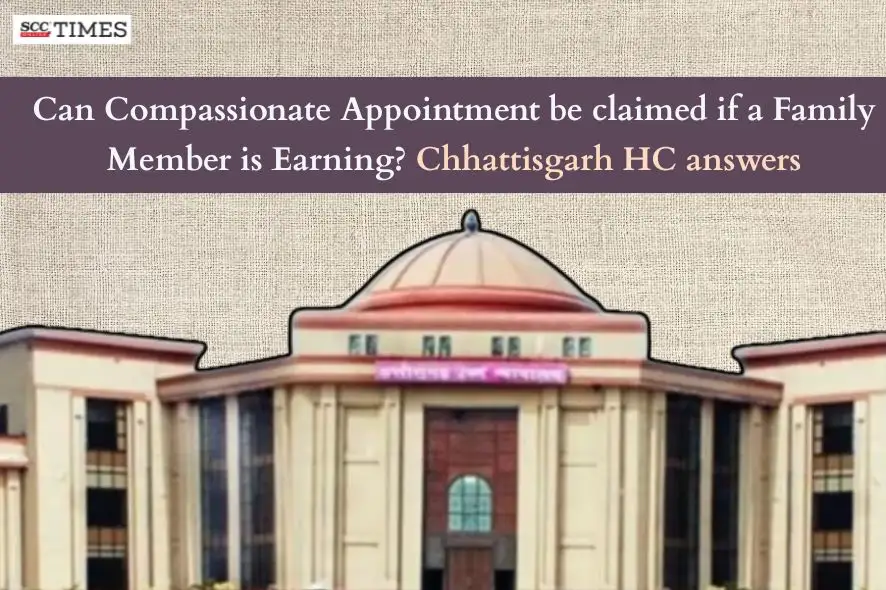
Chhattisgarh High Court: In a writ appeal filed by the son of a deceased SECL employee against the rejection of his claim for compassionate appointment, the Division Bench of Ramesh Sinha*, CJ., Arvind Kumar Verma, J., rejected the appeal, holding that since the deceased employee’s wife was employed, the son was disentitled from consideration. Thus, the Court upheld the order denying compassionate appointment to the son and reaffirmed that a compassionate appointment, if a family member earns, is not automatically available.
Background
The father of appellant 1 and husband of appellant 2 was employed as a Subordinate Engineer in South Eastern Coalfields Limited (“SECL”), died due to a sudden illness in harness. He was survived by appellant 2 (wife), appellant 1 (son), and another son. The name of appellant 1 was proposed for employment on the ground that his mother, i.e., the deceased employee’s wife, was working as a temporary Teacher in Vidyut Gruh Higher Secondary School No.1, Korba, drawing a salary of Rs 42,304.
However, the claim of the appellants was denied vide communication dated 20-8-2020 on the ground that the deceased employee’s wife was already in service; therefore, the employment of an additional dependent would not be considered.
Aggrieved, the appellants filed a writ petition, which was dismissed by the Single Judge vide the impugned order. Hence, the present appeal.
Analysis
At the outset, the Court reiterated that the foundational principle governing compassionate appointment was that such an appointment is not a matter of right but an exception to the general rule of recruitment, intended solely to mitigate the immediate financial hardship of the family of a deceased employee. The policy in force on the date of death of the employee alone governs the claim, and subsequent amendments or circulars cannot be applied retrospectively unless expressly so provided.
Given this, the Court stated that the reliance placed on Circular dated 25-06-2024 (“the 2024 Circular”) issued by SECL was misconceived. Clause 1.6(vii) of the 2024 Circular provides for consideration of compassionate appointment to an additional dependent even in cases where another dependent is already in service. The Court reasoned that the 2024 Circular was issued much after the death of the employee (2018) and does not provide for retrospective operation. Therefore, the Court held that the Single Judge was justified in declining to apply the 2024Circular to the appellants’ claim.
The Court further held that the Single Judge has rightly relied upon the Circular dated 13-03-1981 (“the 1981 Circular”), which governs compassionate appointment in respect of executive employees, as it was evident that the deceased employee was treated as an executive employee for service benefits and compassionate appointment according to the records placed before the Court and the stand taken by SECL. Clause (vii) of the 1981 Circular clearly stipulates that a compassionate appointment cannot be granted where one dependent of the deceased employee is already in employment. The mere fact that the deceased was initially appointed in the non-executive cadre or that he was subsequently reverted did not, by itself, invalidate the application of the executive policy, particularly when SECL had consistently treated the case as one governed by the executive Circular.
Noting that, undisputedly, the deceased employee’s wife was employed as a teacher, the Court stated that the Court stated that the policy does not draw any distinction between temporary or permanent employment, nor does it restrict the embargo only to employment under SECL.
“The existence of an earning member in the family disentitles the claimant from consideration under the compassionate appointment scheme.”
The Court further remarked that the plea of financial hardship was raised in a general manner without any cogent material to demonstrate acute indigence warranting deviation from the applicable policy.
“Sympathy or hardship, howsoever genuine, cannot be a ground to direct compassionate appointment in contravention of the governing circular.”
Thus, the Court held that the Single Judge had correctly appreciated the facts on record, applied the relevant policy, and followed the settled principles of law governing compassionate appointment. No perversity, illegality, or jurisdictional error was pointed out, warranting interference by the Court in the exercise of appellate jurisdiction.
Accordingly, the appeal was dismissed.
[Minketan Chandra v. South Eastern Coalfields Limited, 2026 SCC OnLine Chh 694, decided on 07-01-2026]
*Judgment authored by: Chief Justice Ramesh Sinha
Advocates who appeared in this case:
For the petitioner: Yogesh Kumar Chandra
For the respondent: Vaibhav Shukla