Disclaimer: This has been reported after the availability of the order of the Court and not on media reports so as to give an accurate report to our readers.
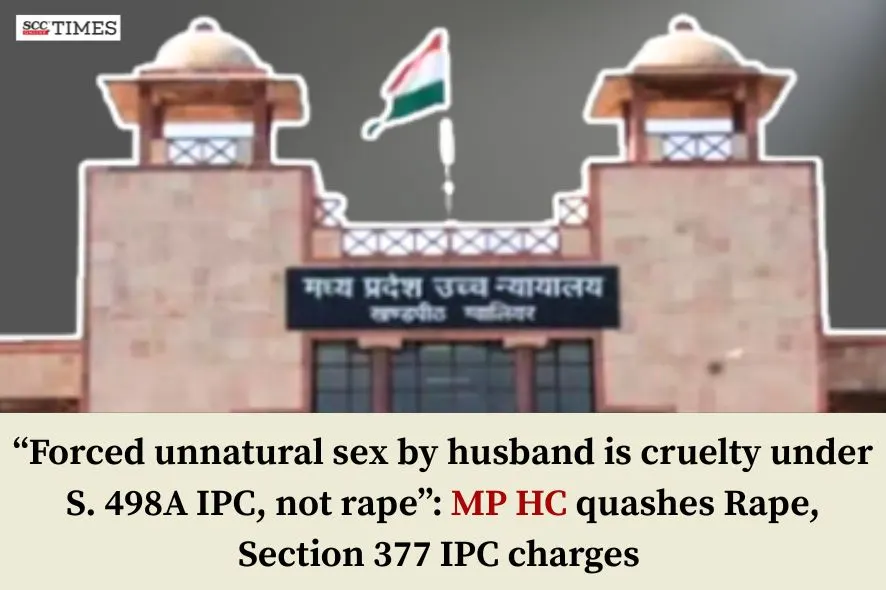
Madhya Pradesh High Court: In a petition filed by a husband for quashing a rape case filed against him by his wife, the Single Judge Bench of Rajesh Kumar Gupta, J., partially allowed the petition, holding that forced unnatural sex by a husband is cruelty, but cannot be prosecuted as rape.
Background
The accused and prosecutrix married in 2022; however, soon after, the couple started quarrelling, and the wife alleged that the accused used to exert violence on her in private. Allegedly, once the accused smashed her head into a wall, and she went to her maternal house and reported the incident at Mahila Thana, Padav, Gwalior. However, the dispute subsided after counselling, and she went back to her matrimonial home. The wife also alleged that the accused would forcefully make physical relations with her and commit unnatural acts on many occasions against her will.
Allegedly, on the day of the incident, the accused hurled abuses and assaulted her, and her mother and sister counselled her to report the same. Thus, she filed the present FIR under Sections 498A, 376(2)(n), 377, 323, 294 of the Penal Code, 1860 (“IPC”).
Hence, the present application for quashing.
Issue
Whether the offence of Section 377 of the IPC between husband and wife can be weighed parallel to the offence of rape as defined under Section 375 of the IPC?
Analysis
Regarding the contention that the present FIR was filed with the intent of extorting money/property, the Court remarked that the claims did not disclose any details of the offence, were general and omnibus in nature, and were not explained by any encouraging evidence. Thus, the Court remarked that the accused husband’s prosecution was an abuse of process of law, which, to secure the ends of justice, was liable to be annulled at the threshold.
On the aspect of rape, the Court held that sexual intercourse by a man with his own wife, where the wife is a major, and there is no force/coercion, falls within Exception 2 of Section 375 IPC. Hence, a charge under Section 376 of the IPC could not be sustained. Thus, in the present case, wherein the wife was not underage, sexual intercourse or sexual act by the husband with his wife could not be termed as rape, even if alleged to be without consent. In this regard, the Court placed reliance on Kuldeep Singh v. State of Punjab, 2025 SCC OnLine SC 211, wherein it was held that since the complainant and the accused were legally married, the intercourse fell under Exception 2 to Section 375 and no prima facie case of rape under Section 376 IPC was made out.
However, the Court opined that, “forced unnatural sex by a husband on his wife amounts to cruelty under Section 498A of the IPC, but cannot be prosecuted as rape under Section 376 of the IPC as in a Section 377 context, marital rape concept is not recognized under current law because of the express marital exception in Section 375.”
Thereafter, the Court analysed Sections 375 and 377 of the IPC to assess what act is “unnatural”. The Court referred to Navtej Singh Johar v. Union of India, (2018) 10 SCC 1, wherein the Supreme Court interpreted to include oral and anal sex in ‘carnal intercourse against the order of nature’ in Section 377. The Supreme Court also held that if an unnatural offence was consensual, then an offence under Section 377 of the IPC was not made out.
The Court remarked that Section 377 of the IPC was not well-equipped and that an unnatural offence had not been defined anywhere.
The Court further stated that the amended definition of Section 375 makes it clear that two things are common in the offence of Section 375 and Section 377, firstly, the relationship between the offence is committed, i.e., husband and wife, and secondly, consent between the offender and victim. As per the amended definition of rape in Section 375, if the offender and victim are married, then consent is immaterial, and no offence is made out. For offence under Section 377, as has been laid down by the Supreme Court in Navtej Singh Johar (supra), the offence is not made out if there is consent. There is repugnancy because if no offence could be made out, with or without consent, between a married couple under Section 375, how could Section 377 be attracted if it is committed, without consent, between husband and wife.
However, the Court reiterated that if the provisions of a later enactment are so inconsistent or repugnant to the provisions of an earlier one that the two cannot stand together, the earlier one is abrogated by the latter.
Thereafter, the Court noted that the offence under Section 377 of the IPC had been alleged, but relevant medical reports were not collected, and the trial for Section 377 of the IPC had begun based only on the oral submissions. The validity of the offence also fell under more doubt when it was alleged that there was an extreme matrimonial dispute between the couple before the Family Court. The Court further noted that even the medical examination report of the wife indicated nothing regarding unnatural sex, and no definite opinion was given by the examining Doctor on fellatio or buggery, as no injury signs were detected.
Regarding the offences under Section 498A, 323, and 294 of the IPC, the Court held that the prosecution had established its case; therefore, the validity of these offences had to be proved during trial before the Court concerned at the appropriate stage. Hence, the Court did not draw any view on the aforesaid offences.
Hence, considering the overall facts and circumstances of the case, the Court partially allowed the petition to the extent that the offences under Sections 376(2)(n) and 377 of the IPC were quashed, but charges under Sections 323, 294, and 498-A of the IPC were maintained.
[Shubham Mangal v. State of Madhya Pradesh, 2026 SCC OnLine MP 177, decided on 07-01-2026]
Advocates who appeared in this case:
For the petitioner: Harshit Sharma
For the respondent: Public Prosecutor Satendra Singh Sikarwar and Advocate Yogesh Singhal
Buy Penal Code, 1860 HERE