


Disclaimer: This has been reported after the availability of the order of the Court and not on media reports so as to give an accurate report to our readers.
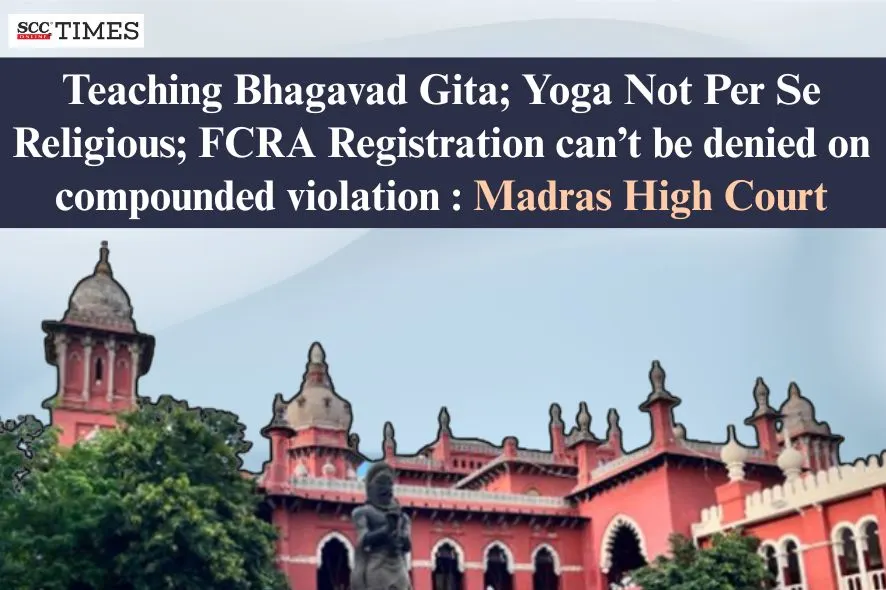
Madras High Court: In a petition challenging respondent 2’s (Director, FCRA Wing, Ministry of Home Affairs) order rejecting FCRA registration on the ground of receipt of foreign contribution without prior permission, even after the offence was compounded under Section 41 of the Foreign Contribution (Regulation) Act, 2010 (FCRA), a single-judge bench of G.R. Swaminathan, J., set aside the impugned order and remitted back the matter to Respondent 2 for fresh consideration.
Factual Matrix
In the instant matter, the petitioner, a public charitable trust established on 08-06-2017 by disciples of Swami Dayananda Saraswati of Arsha Vidya Gurukalam, Coimbatore, is engaged in teaching and training students from around the world with the avowed objective of spreading the knowledge of Vedanta along with Sanskrit language, teaching Hatha Yoga and yoga philosophy, and digitising and preserving ancient manuscripts.
The trust deed was duly registered, and the Trust was also granted registration under Section 12-A of the Income Tax Act, 1961 (Income Tax Act). In September 2021, the petitioner applied for registration under the Foreign Contribution (Regulation) Act, 2010 (FCRA), however, the application remained unprocessed for nearly three years.
In October 2024, the authorities raised certain queries. Thereafter, the petitioner submitted a fresh application in Form FC-3A on 27-01-2025. Clarifications were sought in April 2025, inter alia, regarding receipt of foreign contribution from a trustee based in the United States, alleged mismatch in the description of the nature of the organisation, and discrepancies in the name of the functionary. The petitioner furnished a detailed reply on 28-04-2025 along with supporting documents.
Despite the explanations, the respondent 2 rejected the petitioner’s application vide order dated 08-09-2025 on grounds that —
-
the petitioner had received foreign contribution without prior permission and had transferred foreign contribution to another organisation; and
-
the petitioner appeared to be a religious organisation.
Aggrieved, the petitioner approached this Court challenging the impugned rejection order.
Moot Points
-
Whether the rejection of FCRA registration on the ground of prior contravention was sustainable after the offence had been duly compounded under Section 41 of the FCRA?
-
Whether the conclusion that the petitioner “appears to be a religious organisation” satisfied the statutory requirement under Section 11 of the FCRA?
-
Whether the impugned order suffered from violation of principles of natural justice and disproportionality?
-
Whether the writ petition was maintainable despite the availability of an appellate remedy under Section 31 of the FCRA?
Parties’ Contentions
The petitioner contended that the impugned order was arbitrary, vague, and passed in complete disregard of relevant materials. It was argued that the alleged contravention had already been compounded by the Ministry of Home Affairs upon payment of the prescribed compounding fee, thereby wiping the slate clean. It was further urged that the petitioner was a charitable and educational organisation and that teaching Vedanta, Bhagavad Gita, and Yoga could not be mechanically equated with religious activity.
On the other hand, the respondents submitted that registration under the FCRA is not a matter of right and that strict scrutiny is warranted having regard to national security considerations. It was argued that the petitioner had admittedly contravened the FCRA and that an effective alternative remedy by way of appeal was available.
Court’s Analysis
On the issue related to receipt of foreign contribution without prior permission, the Court noted that the authorities themselves had offered the petitioner an option to compound the offence, which was availed of, and an order compounding the offence was passed on 01-08.-025. Once an offence is compounded, “the contravention can never be an adverse ground which can be cited against the applicant”. The Court held that to disqualify the petitioner on the basis of a technical violation, which stood compounded, would clearly attract “the vice of disproportionality”.
The Court further observed that the allegation of transfer of foreign contribution to another organisation was introduced for the first time in the impugned order. The Court stated that the petitioner was never put on notice in this regard. Moreover, the order did not disclose the name of the organisation, the date of transfer, or any particulars whatsoever. The Court held that such an allegation was hit by vagueness and constituted a clear violation of principles of natural justice.
Emphasising on the significance of the expression “definite” under Section 11 of the FCRA, the Court asserted that the authority is required to arrive at a clear and categorical conclusion regarding the nature of the organisation and a tentative finding that the petitioner “appears to be religious” does not meet the statutory threshold.
The Court rejected the premise that teaching Bhagavad Gita or Vedanta renders an organisation religious in character. Referring to Shyamal Renjan Mukherjee v. Nirmal Ranjan Mukherjee, 2007 SCC OnLine All 1301, the Court observed that Bhagavad Gita is “not a religious book” but a treatise on moral and philosophical truth forming part of Bharatiya civilisation. The Court made similar observations with regard to Vedanta and Yoga and held the same to be universal and secular in character, with spirituality and religion not being interchangeable concepts.
“Bhagavad Gita is not a religious book. It is rather a moral science.”
The Court noted that the petitioner was already recognised as a charitable organisation under the Income Tax Act. The Court noted that Section 52 of the FCRA provides that the Act is in addition to and not in derogation of other laws and the certificate issued under Section 12-A of the Income Tax Act is a relevant material and held that failure to consider the same amounted to non-application of mind.
On the issue of maintainability, the Court reiterated that the existence of an alternative remedy does not bar the exercise of writ jurisdiction where there is violation of natural justice. The Court also noted that the statutory appeal under Section 31 lies to the High Court itself, and therefore, the objection raised by the respondents could not be sustained in the facts of the case.
Court’s Decision
The Court set aside the impugned order dated 08-09-2025 and remitted the matter to the Respondent 2 for fresh consideration. The Court directed the authority to issue a proper notice, based on relevant materials, if it proposed to rely on the allegation of transfer of foreign contribution, and thereafter pass a reasoned order in accordance with law within a period of three months.
[Arsha Vidya Parampara Trust v. Union of India, 2025 SCC OnLine Mad 13781, Decided on 19-12-2025]
Advocates who appeared in this case:
Mr. Sricharan Rangarajan, Senior Counsel for Mr. Mohamed Ashick, Counsel for the Petitioner
Mr. A.R.L. Sundaresan, Additional Solicitor General of India assisted by Mr. K. Govindarajan, Deputy Solicitor General of India, Counsel for the Respondents


A very sensible and logical decision.