Disclaimer: This has been reported after the availability of the order of the Court and not on media reports so as to give an accurate report to our readers.
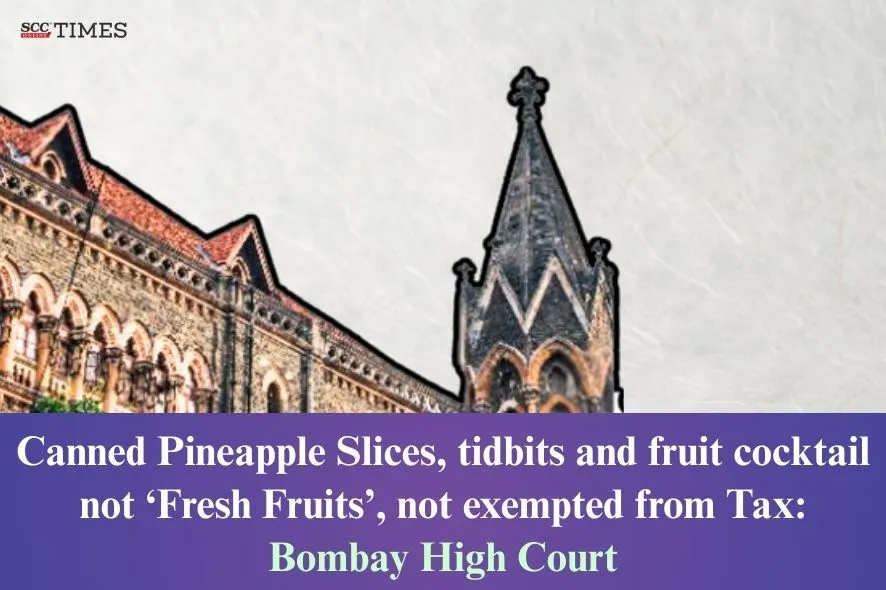
Bombay High Court: In a reference under Section 61 of the Bombay Sales Tax Act, 1959, to determine whether pineapple slices, pineapple tidbits and fruit cocktail preserved in sugar syrup and canned in vacuum sealed containers constituted “fresh fruits” falling under Entry A-23 of the Schedule and therefore exempted from tax, a Division Bench of M.S. Sonak* and Advait M. Sethna, JJ., set aside Maharashtra Sales Tax Tribunal’s (Tribunal) order and held that canned pineapple slices, tidbits and fruit cocktail are not “fresh fruits” under Entry A-23.
In the instant matter, the assessee is engaged in the manufacture and sale of juices, instant soft drinks, powders, essences and various processed food items such as pineapple tidbits, pineapple slices, mixed fruit jam, tomato purée and sweet corn. The assessee had earlier enjoyed exemption under the 1979 Scheme of Incentives, but in the assessment year 1991—1992, exemption benefits were denied for certain products not expressly mentioned in the eligibility certificate.
A dispute arose as to whether pineapple slices, pineapple tidbits and fruit cocktail preserved in sugar syrup and canned in vacuum sealed tin containers could be classified as “fresh fruits” within Entry A-23 and thus entitled to nil rate of tax. Entry A-23 at the relevant time read as “Fresh vegetables … Fresh fruits — Nil.”
The Tribunal, relied on Deputy Commissioner, Sales Tax (Law) Board of Revenue (Taxes) Ernakulam v. Pio Food Packers, [1980] 3 SCR 1271, and held that processed pineapple slices did not lose their essential identity as fruit and therefore qualified as “fresh fruit.”
The Court reiterated that in the absence of statutory definition, items in taxing statutes must be construed “in terms of their commercial or trade understanding, or according to their popular meaning.” The Court emphasised that the Scientific or technical meanings must be avoided unless the Legislature indicates otherwise.
Applying the Common Parlance Test, the Court observed that “would a householder when asked to bring home some ‘fresh fruit’ … bring home pineapple slices or a fruit cocktail preserved in sugar syrup canned and sealed in vacuum containers?” and answered the same in negative.
The Court noted that the Tribunal had relied heavily on Pio Food Packers (Supra), and clarified that the issue in that case concerned whether processing pineapple into slices amounted to “manufacture.” The Court emphasised that the observations in Pio Food Packers (Supra) must be read “in the context of the issue before the Supreme Court”, which did not involve classification under an entry specifically requiring the fruit to be “fresh.” Hence, the Court held that the Tribunal erred by relying on isolated sentences without appreciating their context.
The Court stressed that the Legislature’s choice of the word “fresh” in Entry A-23 “must not be ignored or made meaningless.” The Court asserted that had all types of fruits been intended to be included, the Legislature could have simply used the word “fruits.” It was emphasised that the term “fresh” excludes canned, preserved, dried or otherwise processed fruits.
The Court further noted that Sterling Foods v. State of Karnataka, [1986] 3 SCR 367 like Pio Food Packers (Supra), involved classification for purposes of manufacture and did not deal with an entry using the limiting word “fresh.” Additionally, the Court noted that the term “shrimps, prawns and lobsters” in that case was not qualified by words such as “raw” or “fresh” and the same made a “significant difference.”
The Court held that the Tribunal was not justified in classifying canned pineapple slices, tidbits and fruit cocktail preserved in sugar syrup as “fresh fruit” under Entry A-23. The Court answered the reference in favour of the Revenue and against the Assessee, set aside the Tribunal’s decision.
[Commr. of Sales Tax v. Sudha Instant Soft Drinks and Essences, Nagpur, 2025 SCC OnLine Bom 5141, Decided on 04-12-2025]
*Judgment by Justice M.S. Sonak
Advocates who appeared in this case:
Mr Amar Mishra, AGP, Counsel for the Applicant/State