








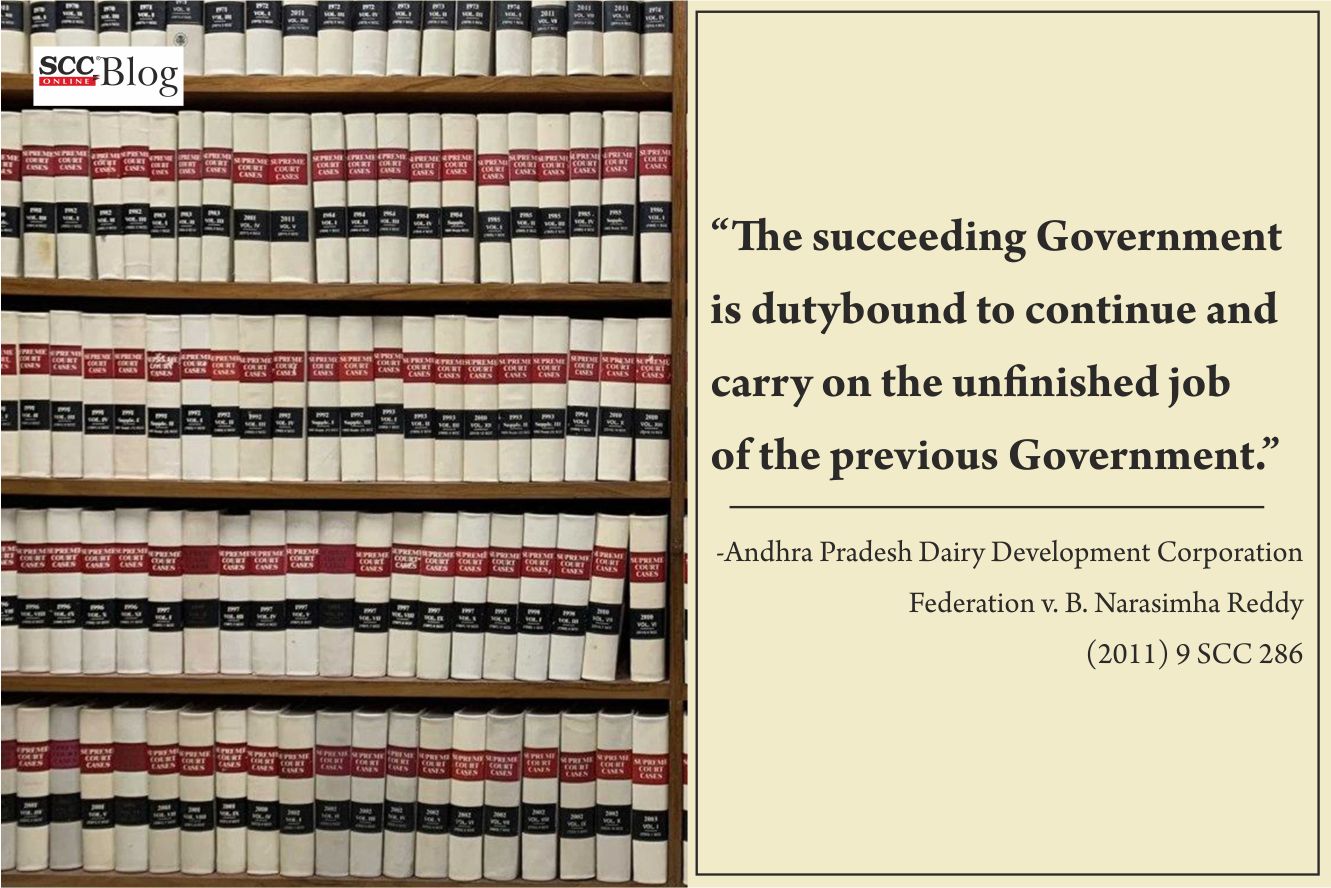
In Andhra Pradesh Dairy Development Corporation Federation v. B. Narasimha Reddy, (2011) 9 SCC 286 explained the principle of promissory estoppel that binds the succeeding Government to carry on the unfinished job of the previous Government. The bench of P. Sathasivam and B.S. Chauhan, JJ held,
“40. In the matter of the Government of a State, the succeeding Government is dutybound to continue and carry on the unfinished job of the previous Government, for the reason that the action is that of the “State”, within the meaning of Article 12 of the Constitution, which continues to subsist and therefore, it is not required that the new Government can plead contrary to the State action taken by the previous Government in respect of a particular subject. The State, being a continuing body can be stopped from changing its stand in a given case, but where after holding enquiry it came to the conclusion that action was not in conformity with law, the doctrine of estoppel would not apply. Thus, unless the act done by the previous Government is found to be contrary to the statutory provisions, unreasonable or against policy, the State should not change its stand merely because the other political party has come into power. “Political agenda of an individual or a political party should not be subversive of rule of law.” The Government has to rise above the nexus of vested interest and nepotism, etc. as the principles of governance have to be tested on the touchstone of justice, equity and fair play.”






41 replies