Introduction
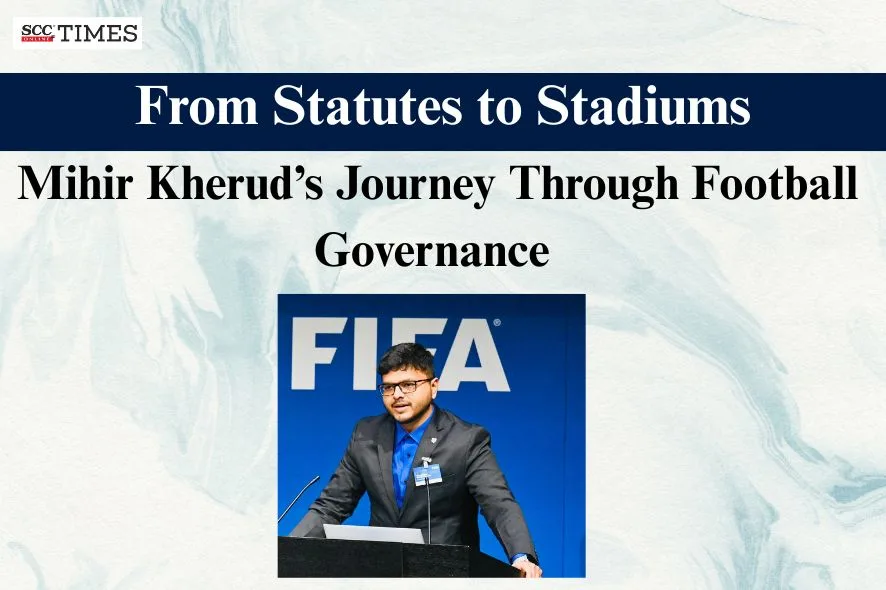
Advocate Mihir Kherud is an accomplished International Sports Lawyer and currently serves as the Head of Department and Senior Legal Manager of the Players’ Status and Registration Department (PSRD) at the All India Football Federation (AIFF), where he also performs secretariat duties for the judicial bodies of the AIFF. A magna cum laude LLM graduate from the University of Zurich in International Business and Sports Law and a participant of the Federation Internationale de Football Association (FIFA) Diploma in Football Law (3rd edition), he combines legal precision with a deep passion for sport. A former Rotaract Club President, he embodies leadership, integrity, and innovation in India’s sports governance landscape.
Questions
1. To begin with, could you share your journey from Indian Law Society (ILS) Law College to becoming the Head of PSRD at the AIFF?
My journey from ILS Law College to heading the PSRD at AIFF has been a bit like a footballer’s rise through the divisions, minus the running, but with far more paperwork. I began at Davies Wallis Foyster (DWF) Mindcrest, working on legal compliance for multinational clients, which taught me precision and patience (useful when reviewing contracts and even more useful when handling football disputes). Wanting to combine law with my passion for sport, I pursued an LLM in International Business and Sports Law at the University of Zurich, graduating magna cum laude my academic equivalent of a top-corner finish. I joined AIFF in 2022 and steadily moved into dual roles as Senior Legal Manager and Head of PSRD, where I now oversee disputes, regulatory harmonisation, committee operations, and the occasional football drama, all with the aim of keeping Indian football compliant, structured and moving forward.
2. The field of sports law is still emerging in India. What motivated you to explore this niche area, and how do you think it is evolving within India’s broader legal landscape?
I was motivated to pursue sports law because it brings together legal analysis, governance, and an industry that has immense social and economic relevance, offering a more dynamic and impactful path than traditional legal practice. The field demands a balance of regulatory understanding, compliance expertise, and dispute resolution skills. Although still developing in India, sports law is growing rapidly as sports bodies adopt more transparent policies, structured governance models, and greater accountability mechanisms. With the recent introduction of the National Sports Governance Act, 2025 the sector is entering a new era of regulation and professionalisation, and it is clear that the future of Indian sports will increasingly rely on trained sports lawyers to guide institutions through these evolving standards.
3. You pursued your LLM in International Business and Sports Law from the University of Zurich and are also part of the FIFA Diploma in Football Law. What approach would you recommend to students aspiring for global degrees, scholarships, or specialised diplomas in international sports law?
For students aspiring to pursue international degrees, scholarships, or specialised diplomas in sports law, I always recommend a combination of early clarity, consistent preparation, and strategic exposure. Building a strong foundation in core legal subjects, gaining practical experience through internships or research, and staying updated on global sports governance trends are essential first steps. Equally important is, demonstrating genuine motivation through writing, volunteering, or involvement in sports-related projects, as admissions committees value authenticity over buzzwords. Networking with professionals, attending webinars, and seeking mentorship can also provide direction and open doors to opportunities. A clear and well-written personal statement also makes a meaningful difference. And finally, never underestimate the importance of passion because in sports law, you will sometimes find yourself defending rules that look like they were drafted during a very long extra-time match.
4. As Head of PSRD, you oversee player registration, eligibility verification, and status determination, functions that directly impact thousands of professional athletes. Could you elaborate on the primary responsibilities of your department and the most complex challenges it navigates daily?
I oversee the full lifecycle of player registration, eligibility verification, and status determination, ensuring that every athlete meets all regulatory, contractual, and procedural requirements before getting registered with a club or a member association to participate in leagues. Our team manages large-scale data processing under tight deadlines, interprets complex and evolving domestic and international regulations, and works closely with legal, compliance, and competition units to resolve issues that could affect roster rules or competitive integrity. Among our most persistent challenges are navigating cross-border documentation standards, maintaining secure and accurate databases, detecting and preventing age fraud through rigorous document validation and verification protocols, and balancing the need for speed with uncompromising accuracy, especially during high-pressure periods such as transfer windows.
5. How does the Swiss and European approach to player regulations, transfer mechanics, and sports dispute resolution differ from what you encountered in India’s emerging football landscape? What key insights from your Zurich education have you successfully transplanted into your work at the AIFF?
In reality, there is not a significant difference between the Swiss, broader European, and Indian approaches to player regulations, transfer mechanics, or dispute resolution, because all member associations are ultimately required to follow FIFA’s rules and regulations with strict compliance. FIFA ensures that transparency, procedural clarity, and uniformity are maintained across all processes, particularly in areas like player registrations, transfer documentation, and dispute resolution mechanisms. Through my education in Zurich and FIFA’s Diploma in Football Law, I gained a deeper understanding of how these global standards are interpreted and implemented across jurisdictions, and I have been able to apply that knowledge at AIFF to ensure that our systems, protocols, and decisions align fully with FIFA requirements in every sector.
6. How do you navigate the interplay between FIFA regulations, Indian employment laws, and federation bye-laws when adjudicating complex player registration disputes?
Navigating the interplay between FIFA regulations, Indian employment laws, and federation bylaws is made efficient by the clarity of FIFA’s framework, which AIFF follows closely and which remains fully compliant with national legal requirements. All domestic disputes are handled by the AIFF Players’ Status Committee under the AIFF Regulations on the Status and Transfer of Players (RSTP), ensuring consistency with both international and domestic standards. This integrated approach allows complex matters such as the recent registration of foreign player Ryan Williams, which required coordination across multiple authorities and compliance checks to be completed without major hurdles, demonstrating the effectiveness of a system grounded in clear regulations, proper processes, and strong institutional collaboration.
7. Sports law uniquely combines elements of commercial contracts, arbitration and ethics. How do you balance these legal intersections while resolving complex disputes?
Balancing the commercial, arbitral, and ethical dimensions of sports law becomes practical and structured because FIFA, Court of Arbitration for Sport (CAS), and other international bodies provide a wealth of case studies and precedents that guide the handling of day-to-day disputes. The regulations themselves are comprehensively drafted to anticipate and address most legal scenarios, reflecting the maturity of football governance globally. Since, the sport has evolved significantly outside India, many issues we encounter domestically already have established precedents or interpretative guidance, making it easier to apply consistent and legally sound solutions. The key is to stay continuously updated with evolving jurisprudence, remain accessible to stakeholders, and ensure that each decision aligns with both the regulatory framework and the broader principles of fairness and integrity in sports.
8. As someone leading in a niche and dynamic field, how do you stay updated with evolving FIFA statutes, CAS precedents, and global best practices in sports arbitration?
I stay updated with evolving FIFA statutes, CAS precedents, and global best practices by building a strong professional network and diligently following all available sources, essentially committing to continuous reading and engagement. FIFA has made access to jurisprudence much easier: The newly launched FIFA Football Jurisprudence Database offers public access to football-related CAS and Swiss Federal Tribunal decisions from 2002 to the present, searchable by topic, year, outcome, and more, which provides a rich resource for monitoring how past disputes have been resolved worldwide. In addition, the publicly accessible archive of CAS awards gives detailed insight into arbitration trends, contractual interpretations, disciplinary rulings, and procedural developments. By combining these resources with regular communication within the global sports-law community, I ensure that our federation remains aligned with international jurisprudence and prepared to apply those precedents in domestic disputes.
9. As Indian football continues to evolve both on and off the field, what is your long-term vision for strengthening the legal and governance structures of the sport, and how do you hope your work contributes to that journey?
As Indian football continues to grow, my long-term vision for strengthening its legal and governance structures is rooted in creating a system that is updated, organised, and truly accessible to everyone involved in the sports. With stakeholders becoming increasingly aware of their rights and responsibilities, it is essential that we build greater legal capacity and ensure that processes are clear, structured, and user-friendly. One challenge I have consistently observed is that many players and clubs are unsure how to assert their rights simply because they do not know, how to file a proper claim. To address this gap, I introduced a basic claim-filing template and ensured that my team actively guides stakeholders to the correct forums while keeping them informed of their rights and obligations under the regulations. By promoting awareness, simplifying procedures, and expanding resources within this sector, I hope to contribute to a stronger governance culture that supports fair play, transparency, and professional growth across Indian football.
10. What advice would you offer to law students or young lawyers aspiring to enter sports law or work with organisations like FIFA or AIFF?
If it makes you feel any better, I had absolutely no idea that I would end up working for the Indian football team while I was doing my LLM, I genuinely thought the closest I would get to football was arguing offside decisions with my friends. So, my advice is simple: Do not panic if you do not have a perfectly mapped-out sports law career. In this field, hard work and staying aware of what is happening around you take you much further than any long-term prediction. Keep learning, keep showing up, and stay curious because sometimes you offer to “quickly help” with one small rule during a match weekend, and before you know it, you have become the official hotline for every football-related legal crisis, which is usually the moment you realise sports law has quietly chosen you.
1. Adovcate; International Sports Lawyer and the Head of Department and Senior Legal Manager of the Players’ Status and Registration Department (PSRD), All India Football Federation (AIFF)
2. Student Ambassador, ILS Law College, Pune.