Disclaimer: This has been reported after the availability of the order of the Court and not on media reports so as to give an accurate report to our readers.
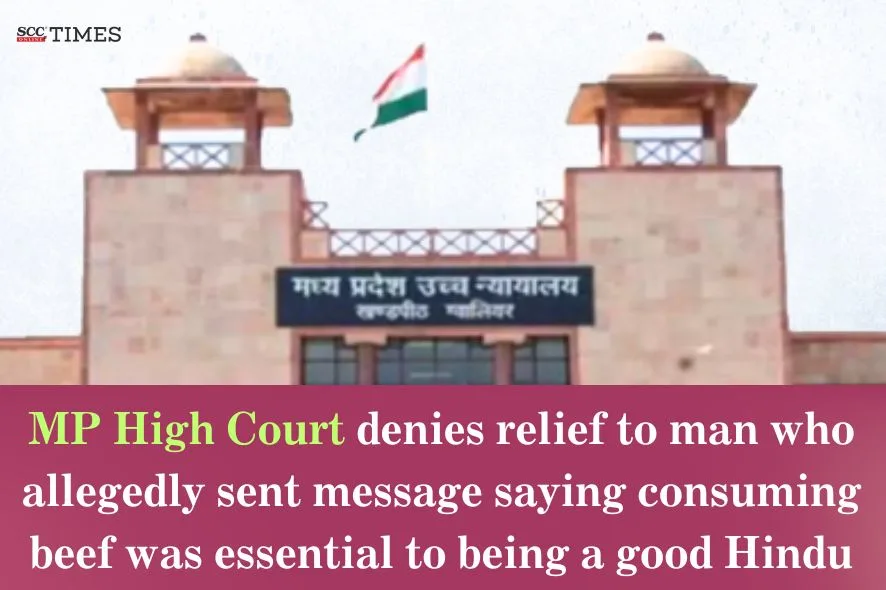
Madhya Pradesh High Court: In a writ petition filed by a man who allegedly sent a message asserting an offensive statement like consuming beef was essential to being a good Hindu, the Single Judge Bench of Milind Ramesh Phadke, J., dismissed the petition, holding that the allegations contained in the impugned FIR, prima facie, disclosed ingredients of the alleged offences.
Background
The petitioner operated a WhatsApp group, “BP Bauddh Patrakar News Group,” where he would send content allegedly for readers interested in journalistic discourse, current affairs, and counter-narrative discussions.
On 26-09-2025, the complainant, a member of the group, was aggrieved by a seven-page message sent by the petitioner containing allegedly derogatory and misleading comments regarding the Hindu religion and the Brahmin community. The forwarded message allegedly included assertions relating to ancient rituals, such as claims that consuming beef was essential to being a good Hindu, bull sacrifices and meat consumption were obligatory on certain occasions, Brahmins regularly consumed bovine meat, and cows and bulls were allegedly slaughtered in various religious ceremonies. As the cow is held in high reverence in Hinduism, the complainant stated that the said post deeply hurt his religious sentiments as well as other Hindu and Brahmin community members.
Thus, he filed a complaint against the petitioner, and the impugned FIR was registered under Sections 196(1)(b), 299, 353(1)(c), 353(2) of the Bharatiya Nyaya Sanhita, 2023 (“BNS”).
The petitioner contended that the said group was a closed digital forum wherein only he was authorised to post messages or content, and the platform primarily functioned as an informational medium for readers and followers; it was a limited, non-public, and voluntarily joined forum. Regarding the incident, he contended that he shared certain excerpts from scholarly literature, a book authored by Dr. Surendra Kumar Sharma (Agyaat), which, to the best of his knowledge, was not banned by either the Central or State Government.
Analysis
At the outset, the Court held that the allegations contained in the impugned FIR, prima facie, disclosed ingredients of the offences invoked. Further, the Court stated that whether the petitioner acted with deliberate and malicious intention, whether the extract was quoted in good faith, whether the content was merely academic or capable of disturbing public tranquillity, and whether the post overstepped the permissible limits of free speech, were matters to be examined based on evidence collected during the investigation. These were not issues that could be adjudicated at this preliminary stage.
The Court further stated that the plea of mala fides asserted by the petitioner was also a question of fact, which would require evidence and could not be conclusively determined in proceedings under Article 226 at the stage of investigation.
“The mere assertion that the FIR is a counterblast to earlier journalistic reports cannot, in itself, justify quashing of the FIR when the allegations otherwise disclose cognizable offences.”
The Court reiterated that at the stage of considering a prayer for quashing of an FIR, the Court is required only to examine whether the allegations, taken at face value, disclose the commission of any cognizable offence. In this regard, the Court placed reliance on State of Haryana v. Bhajan Lal, 1992 Supp (1) SCC 335, wherein it was held that quashing is justified only in the rarest of rare cases where the allegations do not constitute any offence or are absurd and inherently improbable.
The Court also relied on Neeharika Infrastructure (P) Ltd. v. State of Maharashtra, (2021) 19 SCC 401, wherein the Supreme Court reiterated that the High Court, while exercising jurisdiction under Article 226 of the Constitution or Section 482 of the Criminal Procedure Code, 1973, must refrain from conducting a roving enquiry into the truthfulness of allegations or evaluating the sufficiency of evidence at the FIR stage. The Court further observed that when the FIR discloses the commission of cognizable offences, investigation should ordinarily proceed unhindered.
Considering the aforesaid settled law, the FIR, and submissions, the Court held that no case was made out for the exercise of extraordinary jurisdiction under Article 226 of the Constitution.
Accordingly, the petition was dismissed.
[Buddha Prakash Bouddha v. State of Madhya Pradesh, 2025 SCC OnLine MP 8877, decided on 19-11-2025]
Advocates who appeared in this case:
For the petitioner: Aman Raghuwanshi
For the respondent: Panel Lawyer Padamshri Agarwal
Buy Constitution of India HERE

Buy Code of Criminal Procedure, 1973 HERE