Disclaimer: This has been reported after the availability of the order of the Court and not on media reports so as to give an accurate report to our readers.
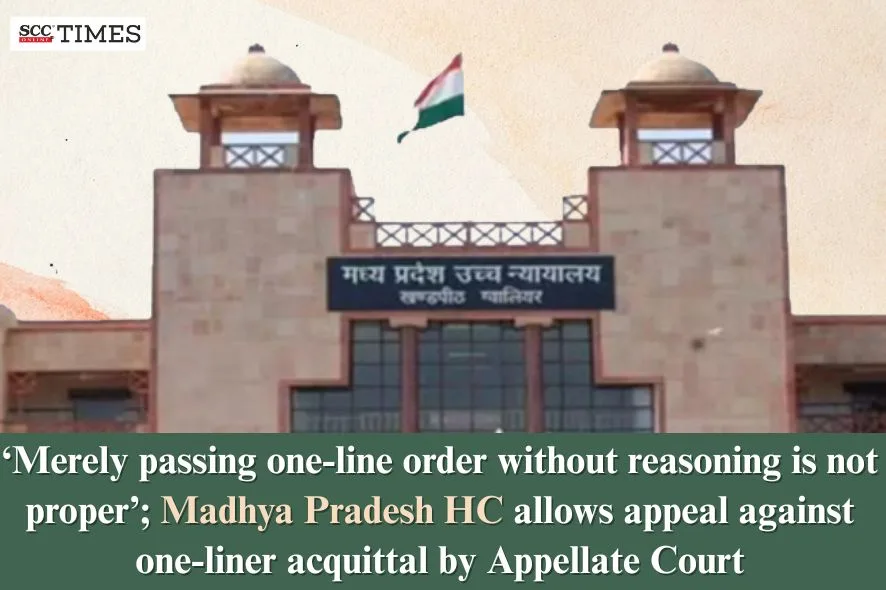
Madhya Pradesh High Court: In a criminal appeal filed by the State against the Appellate Court’s order acquitting the convict under Section 323 of the Penal Code, 1860 (“IPC”), the Single Judge Bench of Rajendra Kumar Vani, J., allowed the appeal, holding that the impugned order was untenable as merely passing a one-line order without reasoning was improper on the part of Appellate Court.
Background
The State contended that the Appellate Court acquitted the convict without assigning a reason by setting aside the conviction and sentence awarded by the Trial Court. The judgment/order was allegedly short, cryptic, and non-speaking as it did not contain any discussion or reasoning.
Analysis
Upon perusal of the impugned judgment and the Trial Court’s judgment, the Court noted that the Trial Court discussed the evidence and other factual aspects, thereby convicting and sentencing the convict under Section 323 of the IPC. However, the impugned judgment passed by the Appellate Court was short, cryptic, and non-speaking. No reasoning was given in the impugned judgment. The Trial Court’s judgment was set aside by merely stating that the appeal was allowable; therefore, it was allowed.
The Court held that the impugned judgment was condemnable, not tenable, and could not be deemed lawful as no reasoning was given for setting aside the Trial Court’s judgment, which entailed the appreciation and marshalling of the evidence on record.
In this regard, the Court placed reliance on Bani Singh v. State of U.P., (1996) 4 SCC 720, wherein the Supreme Court held that law clearly expects that the appellate court to dispose of the appeal on merits, not merely by perusing the reasoning of the trial court in the judgment, but by cross-checking the reasonings with the evidence on record with a view to satisfying itself that the reasoning and findings recorded by the Trial Court are consistent with the material on record.
The Court also relied on State of Rajasthan v. Sohan Lal, (2004) 5 SCC 573, wherein the Supreme Court reiterated that giving of reason for a decision is an essential attribute of judicial and judicious disposal of a matter before Courts, and which is the only indication to know about the manner and quality of exercise undertaken, as also the fact that the Court concerned had really applied its mind.
The Court remarked, “It is not expected from a Judicial Officer of the Appellate Court to pass such a short, cryptic and non-speaking order without going into the merits of the case, discussing the evidence, and testing the reasoning given by the Trial Court.”
“Merely passing one line order that the appeal is accepted and to set aside the findings of the Trial Court without assigning any reason is not proper on the part of the Appellate Court.”
Thus, the Court allowed the appeal, holding that the impugned judgment was liable to be set aside and the matter was required to be remanded to the Appellate Court for deciding it afresh.
[State of Madhya Pradesh v. Babulal Malviya, 2025 SCC OnLine MP 9370, decided on 11-12-2025]
Advocates who appeared in this case:
For the appellant: Public Prosecutor D.R. Vishwakarma
For the respondent: Mahesh Prasad Rajak