Arbitration Law Roundup: A quick recap of the top arbitration cases from November 2024
Top arbitration cases on unilateral appointment, seat of arbitration, limitation period, scope of judicial scrutiny and more.

Bringing you the Best Analytical Legal News


Top arbitration cases on unilateral appointment, seat of arbitration, limitation period, scope of judicial scrutiny and more.
Referral courts, at the stage of deciding an application for appointment of arbitrator, must not conduct an intricate evidentiary enquiry into the question whether the claims raised by the applicant are time barred.”
“The evidence on the part of the appellants would reveal that instead of establishing ‘animus possidendi’ under hostile colour of title, they have tendered evidence indicating only permissive possession and at the same time failed to establish the time from which it was converted to adverse to the title of the respondent which is open and continuous for the prescriptive period.”
In cases where a search is conducted after 31-03-2021, the first proviso to Section 153C (1) would have to be construed and tested as regards the date when the Assessing Officer decides to initiate action against the non-searched entity.

The Court was of the view that both, the applicant in viewing the requirement of filing the appeal within six months as per S. 378(5) CrPC; and the respondents contending that the appeal should have been filed within sixty days as per S. 378(5), were equally incorrect.
This report covers the Supreme Court’s Never Reported Judgment dating back to the year 1953 on limitation period of suit on possession of immovable property.
“The length of the delay is a relevant matter which the court must take into consideration while considering whether the delay should be condoned or not.”
Supreme Court, while allowing the present petition, appointed Justice Sanjay Kishan Kaul, Former Judge of the Supreme Court of India, to act as the sole arbitrator.
Supreme Court acknowledged that in case of special law prescribing a limitation period, Section 5 of the Limitation Act would have no application.
“It is a well-settled law that while deciding the question of appointment of arbitrator, the Court shall not touch the merits of the case as it may cause prejudice to the case of the parties.”
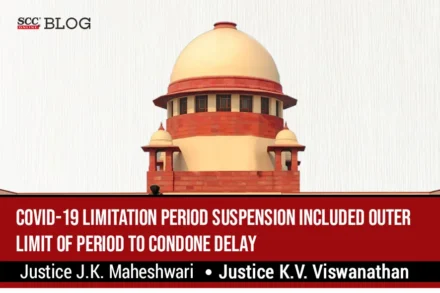
The appellants mainly averred that the further period of 90 days had not expired on the date of imposition of lockdown as on 23-03-2020.
“Section 28 of the Hindu Marriage Act, 1955 and Section 19 of the Family Courts Act, 1984 operate in different spheres and apply to orders passed by different forums i.e., District Court and the Family Court respectively.”
The Delhi High Court observed that there was an unexplained substantial delay in issuing the impugned Show Cause Notice dated 09-11-2017 and thus, is inexcusable in the eyes of law
Supreme Court observed that if it is accepted that the period of limitation prescribed under Section 11B of the Act shall not be applicable with respect to claim for rebate of duty as there is no mention of Section 11B of the Act either in Rule 18 or in the notification dated 6.9.2004, then there will not be any period of limitation for making an application for rebate of duty.

Delhi High Court: In a case filed by Extramarks Education India Private Limited (petitioner) seeking appointment of an arbitrator to
Consumer Disputes Redressal Commission Gujarat State, Ahmedabad: Justice V.P. Patel, President and U.P. Jani, Member, addressed an appeal which was raised in
Telangana High Court: Abhinand Kumar Shavili, J., addressed a matter wherein the name and logo of a company were in dispute. Instant
National Company Law Appellate Tribunal- A Coram of Anant Bijay Singh, J. (Judicial Member) and Shreesha Merla (Technical Member) dismissed an appeal
Delhi High Court: Suresh Kumar Kait, J., reversed the order of the lower court issuing summons against the accused in a case

Calcutta High Court: Ravi Krishan Kapur, J., while addressing an issue pertaining to Employees’ State Insurance Act, 1948, observed that, The ESI Act