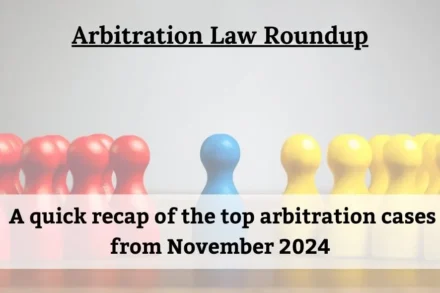

Arbitration Law Roundup: A quick recap of the top arbitration cases from November 2024
Top arbitration cases on unilateral appointment, seat of arbitration, limitation period, scope of judicial scrutiny and more.
“The enquiry is nothing but an eye wash because the same was conducted without following any procedure which had to be mandatorily followed.”
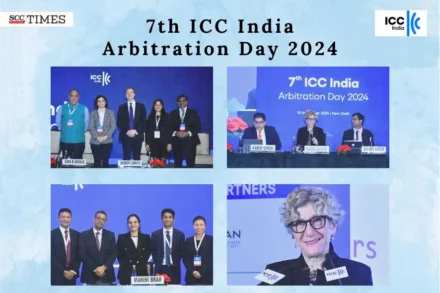
The International Chamber of Commerce (ICC) organised the 7th Edition ICC India Arbitration Day bringing together global legal professionals, arbitrators, corporate leaders, and academics to discuss the evolving landscape of arbitration.
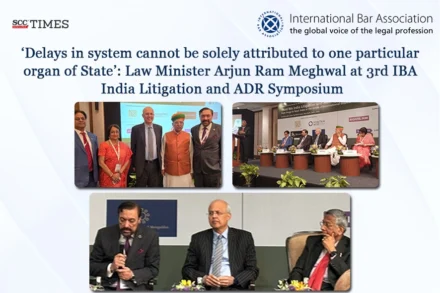
Third IBA India Litigation and ADR Symposium 2024: From fringe to focal: India at the centre of international dispute resolution- a symposium presented by the IBA India Working Group of the IBA Asia Pacific Regional Forum and supported by the IBA Arbitration Committee
Referral courts, at the stage of deciding an application for appointment of arbitrator, must not conduct an intricate evidentiary enquiry into the question whether the claims raised by the applicant are time barred.”
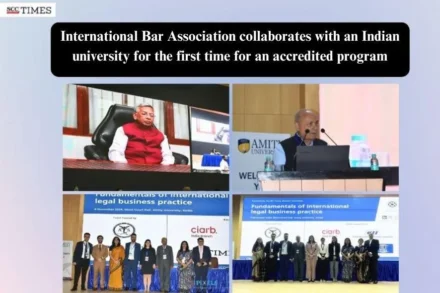
The International Bar Association Young Lawyers’ Committee hosted this course to assist young members of the legal profession with the fundamentals of international legal practice.
The Court clarified that the ‘Closest Connection Test’ for determining the seat of arbitration is no longer a viable criterion for determination. The seat of arbitration cannot be determined by formulaic and unpredictable application of choice of law rules based on abstract connecting factors to the underlying contract.
The Court said that governmental entities must be treated in a similar fashion to private parties insofar as proceedings under the Arbitration Act are concerned, except where otherwise indicated by law.
In the present case, Clause 12 of the partnership deed indicated that the Partnership Act, 1932 and its Rules shall cover only those aspects not specifically mentioned in the deed.
In the Judgment dated 12-09-2024, Supreme Court had held that an application for extension of time for passing an arbitral award under Section 29A (4) read with Section 29A (5) is maintainable even after the expiry of the twelve-month or the extended six-month period. The court, while adjudicating such extension applications will be guided by the principle of sufficient cause.
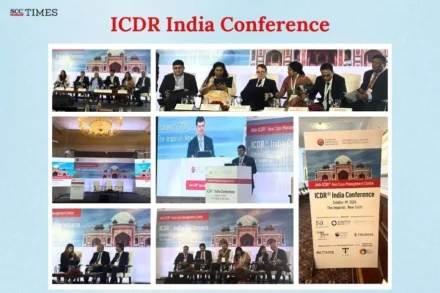
This report provides insights into the first-ever ICDR Conference held in India. It highlights the key discussions, themes, and outcomes of the event, showcasing the innovative ideas and collaborative efforts presented by participants in the field of dispute resolution.
‘Courts, while evaluating a challenge under Section 34, would not be justified in faulting an award merely because an alternative view was possible or that, in their opinion, a more just conclusion could have been reached.’
“Merely for the reason that the view of the Appellate Court is a better view than the one taken by the arbitral tribunal, is no ground to set aside the award”.
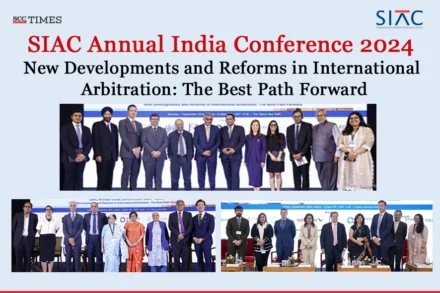
The Singapore International Arbitration Center (SIAC) organised its Annual India Conferences 2024 in Mumbai and Delhi on September 6th and 7th respectively
by Vasanth Rajasekaran* and Harshvardhan Korada**
To resolve the questions arising and considering the uncertainties regarding time-lapse between the date of the award and its enforceability and the ever-fluctuating exchange rates, the Court formulated twin principles.
The event is scheduled on 21-09-2024.
by Prashant Pakhiddey* and Manav Gill**
The Mumbai Centre for International Arbitration (MCIA) Council is responsible for the implementation of the MCIA Rules.
This post provides an overview of the key highlights from the Uzbekistan Arbitration Week