








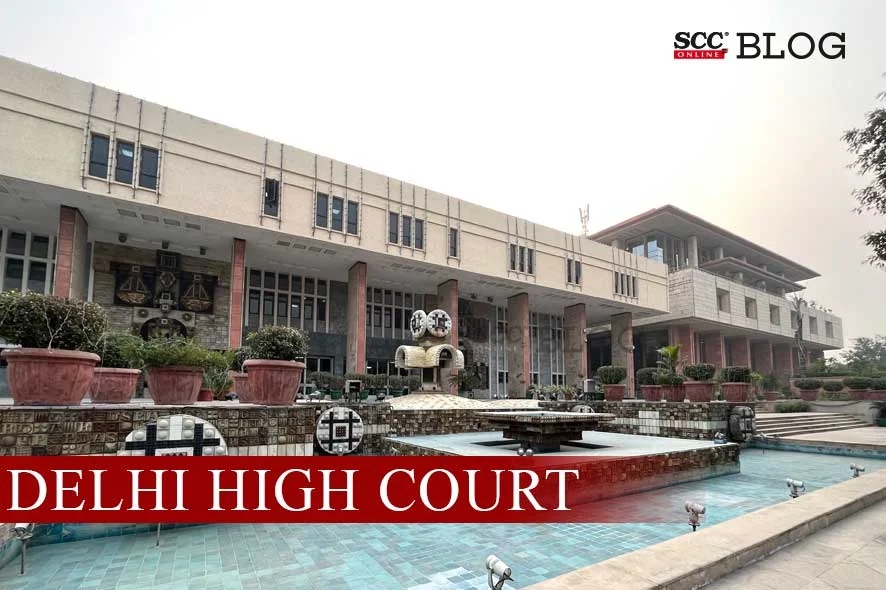
Delhi High Court: In a writ petition seeking to direct Dainik Jagran, Respondent 2 and Hindustan Times, Respondent 3 to conceal the petitioner’s identity while circulating news or any article that was carried out by them, Subramonium Prasad, J.*, opined that merely because a publication was related to a Court proceeding, it could not be concluded that the publication tended to impair the Court’s impartiality or affected the Court’s ability to determine the true facts. One had to carefully see the nature of the publication and find out as to the content of the publication would cause prejudice to the trial of a case or not. The Court opined that it could not be concluded that the guidelines laid down in Sahara India Real Estate Corpn. Ltd. v. SEBI, (2012) 10 SCC 603 was not violated, as it was well settled that the gag orders should be passed only when it was necessary and to prevent substantial risk to fairness of a trial. Thus, the Court directed the petitioner to pay Rs. 10,000 to the Armed Forces Battle Casualty Welfare Fund for wasting the judicial time of this Court.
Background
In an instant case, it was stated that the Assistant Commissioner of Police, Respondent 4, was a close associate of a land mafia and had an eye on the petitioner’s property. It was alleged that there was a constant threat to the petitioner and his family members from enjoying their property. Subsequently, a writ petition was filed by the petitioner’s mother to curb the procedural overreach of Respondent 4.
The petitioner stated that only with the sole motive to jeopardize the petitioner’s mother’s case and to misguide the court from inquiring the procedural overreach carried out by Respondent 4, Respondent 4 briefed Respondent 2 and Respondent 3, regarding a case which was pending adjudication before Consumer Forum, Lucknow.
Thus, the petitioner approached the present Court seeking to direct Respondent 2 and Respondent 3 to conceal identity of the petitioner while circulating news or any article that was carried out by them, wherein the petitioner’s name appeared. The petitioner also prayed for a direction of Union of India to ensure strict compliance of PUCL v. State of Maharashtra, (2014) 10 SCC 635.
Analysis, Law, and Decision
The Court noted that the petitioner approached the present Court for a gag order against Respondents 2 and 3, without bringing on record all relevant facts and material and opined that the instant petition was nothing but a complete abuse of process of law by the petitioner. Further, a reading of the newspaper cuttings also did not indicate that it was any way connected to the writ petition filed by the petitioner’s mother.
The Court opined that merely because a publication was related to a Court proceeding, it could not be concluded that the publication either tended to impair the Court’s impartiality or affected the ability of the Court to determine the true facts. One had to carefully see the nature of the publication and find out as to the content of the publication would cause prejudice to the trial of a case or not. Prejudice by a publication could be of two categories, one which impaired the courts impartiality and the other with prejudiced the Court’s ability to determine the true facts. The Court opined that the petitioner had not revealed the writ petition’s nature, and the prayer sought in the writ petition. Further, the petitioner also did not file anything related to the pending consumer case. Thus, the Court opined that the contents of the newspaper, did not indicate any kind of apprehension, danger or prejudice that could be caused to the petitioner or his mother.
The Court opined that it could not be concluded that the guidelines laid down in Sahara India Real Estate Corpn. Ltd. v. SEBI, (2012) 10 SCC 603 was not violated, as it was well settled that the gag orders should be passed only when it was necessary and to prevent substantial risk to fairness of a trial. Thus, the Court directed the petitioner to pay Rs. 10,000 to the Armed Forces Battle Casualty Welfare Fund for wasting the judicial time of this Court.
[Ajay Kumar v. Union of India, 2024 SCC OnLine Del 579, decided on 25-01-2024]
*Judgment authored by- Justice Subramonium Prasad
Advocates who appeared in this case :
For the Petitioner: Aditi Shivadhatri, Capt. Subedita Rani and R. R. Bharati, Advocates;
For the Respondents: Himanshu Pathak, Sr. Panel Counsel with Mimansak Bhardwaj, GP and Samman Kumar Singh, Advocate.









0 replies